Tag Archives: disability

On Disability and the Public Service Announcement

A huge number of Public Service Announcements (PSAs) have been devoted to the topic of disability, but capturing disability in 30 seconds is like editing War and Peace down to a novella. You might get the message, but it’s rarely the full picture. But that isn’t to say PSAs can’t be poignant, effective, and positive.

Disability-related PSAs cover a wide range of topics, but generally there are three main categories that the message falls into: how people with disabilities are viewed/treated by society, their value in the job market and society, and what their lives are like. Although these are pretty straightforward messages, there is a great deal of variety in the ways in which these basic messages are presented.

First, there are those that I like to call the “twist ending” PSA, where you see a person doing something difficult or exciting and it is not revealed until the last few seconds that the person in question has a disability. These are a very common form of PSA and they are meant to challenge the assumption that disabled people can’t do things that an able-bodied person can do. They show that disability does not stop people from living a successful and exciting life. The revealing of the disability at the end is meant to get an emotional reaction from the viewer. It’s meant to surprise and to get the viewer to rethink the capabilities of people with disabilities.

Second, there are the “interview gone wrong” PSAs that show the unfair scrutiny placed on job candidates with disabilities. Usually this involved one or more insensitive able-bodied people asking inappropriate or condescending questions to a job candidate. Sometimes it’s presented in humorous way, where the bumbling interviewer unintentionally offends the applicant over and over again. These try to show you the kind of discrimination and misunderstanding that can happen in the workplace (sometimes in an exaggerated manner).

Finally, there are PSAs there are the “just like us” PSAs that show people with disabilities talking about their lives or doing something ordinary. The message is simply to show what it’s like to be disabled. Sometimes these PSAs are used to describe the extra challenges disabled people face from day to day, like inaccessibility or being constantly forced to prove their intelligence and worth. They also show that disabled are pretty much like everyone else and want the same rights and privileges. This is one in a series of animations of real interviews:

This one also shows a person with a disability doing something ordinary, but also shows how the simplest actions are often misjudged by able-bodied people:

Since disability is a broad but personal topic, I am curious to see which style you find most compelling. I feel that the ”twist-ending” PSAs have an unintended negative undertone. I understand that the point they are trying to get across is that people with disabilities can be super successful, skydive, ride a horse, or do anything they want. But I feel the problem here is twofold. First, the “surprise” ending paints the person as a novelty and reinforces the thought that people with disabilities don’t normally do awesome things. They are expecting the viewer to be shocked that the person relating her amazing skydiving experience is blind. Second, it doesn’t take into account that there are people that can’t jump out of a plane or work a traditional 9-5 job. These people can enjoy an exciting and fulfilling life too. So I feel like these types of PSAs are excluding a lot of people.

The ”interview gone wrong” PSAs can help the viewer see how ridiculous the stereotypes can be by making fun of the person who stereotypes the job candidate. But some people may feel that this message trivializes the disproportionate amount of scrutiny people with disabilties face in the job market. I would not be surprised if many suc people have been in a similar work situations and it’s probably not so funny then.

Personally, I think the creature discomfort videos have the most straightforward and effective message. Having real people describe their experiences reveals that they have basically the same desires as everyone else. If the goal of the PSA is to put a human face to disability, then what better way is there to do so than to listen to actual people. Some may think that using animated animals instead of actual people is a cop-out since it avoids engaging the viewer with disability directly. But I don’t think the animals are used just to make disability friendly to the eye (although it’s possible that that plays a role). I’m thinking they used the animals because they are relate-able but very attention-getting, probably more attention-getting than video clips or animations of people.

I am curious to see which style you find most compelling and why.

———————

Lauren McGuire is a SocImages intern and an assistant to a disability activist.  She recently launched her own blog, The Fatal Foxtrot, that is focused on the awkward passage into adulthood.

If you would like to write a post for Sociological Images, please see our Guidelines for Guest Bloggers.

Genevieve Loh Tells Us Who is Hideous

On June 2nd, Davina spotted this piece in a Singapore newspaper.  It lists the “ten characters we love, who got hit (repeatedly) by the ugly stick.” With Freddy Krueger, the ten uglies tell us something about who we have decided are hideous and who we are allowed to be overtly disgusted by.  Alongside the The Rolling Stones (is that about age?) and monsters, ghosts, and aliens (Beetlejuice, Orcs, and Jabba the Hut) are fat people (Fat Bastard, who they also critique for being a “ginger,” and Tom Cruise’s character in Tropic Thunder who is also described as fat), people with “deformities” (Cruise’s character and Sloth from The Goonies), and women without make-up (Mariah Carey).

Distortion Visual Normalizes the Ideal Body

Penny R. sent along a new campaign byChanging Habbits, an organization aiming to draw attention to our carbon footprint.  To illustrate your environmental impact:

Each part of the body is allocated to a different type of environmental burden: the feet correspond to the transport footprint, the hands to home energy, mouth to water, stomach to consumption, bottom to waste and the eyes and head to electrical consumer products.

When you enter your data, the website shows you your environmental impact by distorting an ideal figure:

Abby Jean at FORWARD argues that the visualization technique, by showing you an image you are supposed to think is grotesque, encourages people to be disgusted by bodies that don’t conform to the ideal. She writes:

The whole purpose of the website, the underlying assumption that makes this a meaningful exercise to convince people to reduce their environmental impact, is that when people see these “distorted” human forms that represent themselves, they will be so horrified that it will motivate them to reduce their impact so they can again be “normal.”

There’s got to be a way that we can encourage and motivate people to be more environmentally aware without drawing from, relying on, and reinforcing these ideas about “normal” bodies.

I went through the exercise to see if I had any choice in the shape or sex of my body. I didn’t.  This is me, apparently:

So, according to Changing Habbits, except for the fact that we’re harming the planet with our ugliness, we’re all be strappin’ dudes with low body fat and nice biceps!

Age, Education, and Functional Decline

This is the second post using material borrowed from the essay, “Facts and Fictions About an Aging America.”  Our online host, Contexts magazine, is offering some free content, including this essay, now through March 15th.  See yesterday’s post here.

—————————-

While people in industrialized countries live longer and healthier lives than ever, more educated people enjoy even less morbidity than less educated people.  The figure below illustrates the decline in mental and physical function over time for people with a college degree, a high school degree, and no degree at all:

The figure shows that more educated people experience “excellent health” than less educated at every age, except perhaps 85 and above.  Why might this be?

Well, higher educated people may come from wealthier families who were able to provide their children with health care, good nutrition, and exercise.  Having degrees may also correlate with jobs that are less harmful to the body and offer both health insurance and more free time to exercise.  Lower educational attainment is likely correlated with economic insecurity; a lifetime of struggling to make ends meet could create the kind of bad stress that interferes with both mental and physical health.

Other theories?  Thoughts on these?

Lady Gaga’s Disability Project

Lady Gaga, for all the things that can be said about her, is doing something interesting with disability. Ruth D’R. sent in these images from a recent photoshoot:

(I included this last one beacuse I thought it might be referencing mental illness.)

We’ve featured Gaga’s video for Papparazi before (to highlight it’s sexualized violence), but I thought it was worth re-using in this context because it, too, has disability imagery:

She kept the disability theme at the VMA awards:

So, what do you think? Do you think Gaga is trying to make some kind of statement? Or is she just trying to be edgy and doesn’t really care about the issue?  (As seems to be common in fashion.)

Is she simply sexualizing disability? And is that good or bad?

Is the overall effect to make people with disabilities seem empowered?  Or, as in the very first image, helpless?

Might she be trying to problematize the “normal,” as she does in many ways but, in this case, normal bodies? Does it work, given her conformity to norms of attractiveness (both body and face)?

Or… since Gaga is known for being just-plain-weird, does that mean that her adoption of these props is an attempt to be weird (as in: wheelchairs and walking with a limp are weird and so I’ll do them to be weird)?  Even if that is true, does pushing them into view normalize them?  Heighten their weirdness?  Both?   Or does it depend on the viewer?

For more analysis, read also this blog post over at Bitch magazine written by Annaham (someone who actually knows something about disability studies).

————————————–

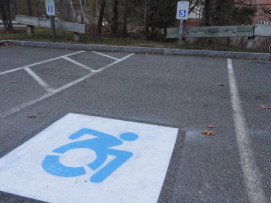
For more on disability and representation, see our posts on the model, Victoria, what does a sexy disabled man look like?, Britain’s disabled model competition, dolls with Down’s Syndrome, a nude calendar featuring Paralympic athletes, the  misery of wheelchairs, the disabled girls video game, little people in commercials, and the international symbol.

ADHD Website Tells Women They’re Annoying in Relationships

Annelise M. sent us a link to a relationships advice slide show at ADDITUDE, a website for people with Attention Deficit Disorder and other learning disabilities.  The slide show title is “7 Tips for Better Communication in Your ADHD Relationships.”  However, even though men are diagnosed with ADD and ADHD two to four times more often than women, the subtitle makes it clear that the advice is for women only and the text specifies “ADD women” and the “partner” or “spouse” is always a “him” (so also heterosexist).  The advice was gender-neutral, but the authors decided to go with gender stereotypes instead.

The slide show begins with this image reminding us that women are always talking at men:

add0

Continues with this image reminding us that women are always talking period:

add3

Then turns to this image to make sure we understand how annoying it is when women talk:

add2

And finishes up with this image illustrating just how crazy women are:

add1

You could easily have read this in Cosmo or Glamour, replacing “ADD women” with “women,” and it would have been just another typical advice list for women (who, with or without ADD, are totes annoying, amirite?).

“Men at Their Most Masculine” Art Project (NSFW!)

Hermes sent in a link to a feature in The Morning News titled “Men at Their Most Masculine,” in which men were asked about what made them feel masculine and photographed in situations that reflect their masculine identities. Under each image is the quote that was included with it:

07

“I feel masculine when I am home, I can take care of myself. I often feel emasculated when I leave my apartment though, with everyone asking me if I need help. I don’t need any help.”

10

“To be masculine is to dominate in one’s field of study.”

Some of the following are definitely Not Safe for Work, so after the jump…

(more…)

Little People and Representation

I don’t know much, perhaps anything, about how Little People feel about their representation in the media.  However, when AJ S. sent in the commercial below, I couldn’t help thinking about the early inclusion of blacks in U.S. television and movies. 


When black actors were given their first roles in American entertainment, they usually played characters that were highly offensive and stereotypical.  However, while the representation was problematic, the fact that black actors were hired at all was a major step forward at the time and the fact that individual black actors were getting paid was no small thing.

I wonder, then, how to think about the commercial above.  It counts on an audience thinking that Little People are, at best, adorable and, at worst, laughable.  Then again, it’s an opportunity to raise awareness and for actors to get jobs. 

Is this presence better than no presence?  Does it matter that nothing seems to have changed since The Wizard of Oz?  That is, is it unfair to characterize this as “early” representation? Then again, have representations of blacks undergone a qualitative change? One could argue “no.” Is the comparison with representations of blacks even fair?  Useful?  Obfuscatory?  What do ya’ll think?

P.S. – I put the “disability” tag on this post with some consternation.  Being small can be framed as disabling, but I imagine this is a political issue.  I also know that some conditions that cause short stature are disabling in other ways.  I don’t know… just doin’ my best here.