
Flashback Friday.
I heard stories this week about dung beetles and cuttlefish. Both made me think about the typical stories we hear in the media about evolved human mating strategies. First, the stories:
—————————-
Story #1 :The Dung Beetle
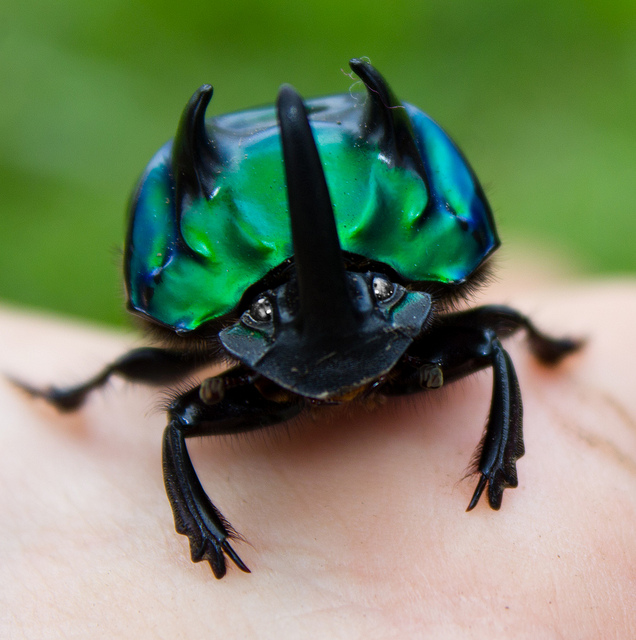
A story on Quirks and Quarks discussed the mating strategies of the dung beetle. The picture above is of a male beetle; only the males have those giant horns. He uses it to defend the entrance to a tiny burrow in which he keeps a female. He’ll violently fight off other dung beetles who try to get access to the burrow.
So far this sounds like the typical story of competitive mating that we hear all the time about all kinds of animals, right?
There’s a twist: while only male dung beetles have horns, not all males have horns. Some are completely hornless. But if horns help you win the fight, how is hornlessness being passed down genetically?
Well, it turns out that when a big ol’ horned male is fighting with some other big ol’ horned male, little hornless males sneak into burrows and mate with the females. They get discovered and booted out, of course, and the horned male will re-mate with the female with the hopes of displacing his sperm.
But.
Those little hornless males have giant testicles, way gianter than the horned males. While the horned males are putting all of their energy into growing horns, the hornless males are making sperm. So, even though they have limited access to females, they get as much mileage out of their access as they can.
The result: two distinct types of male dung beetles with two distinct mating strategies.
———————————
Story #2: The Giant Australian Cuttlefish
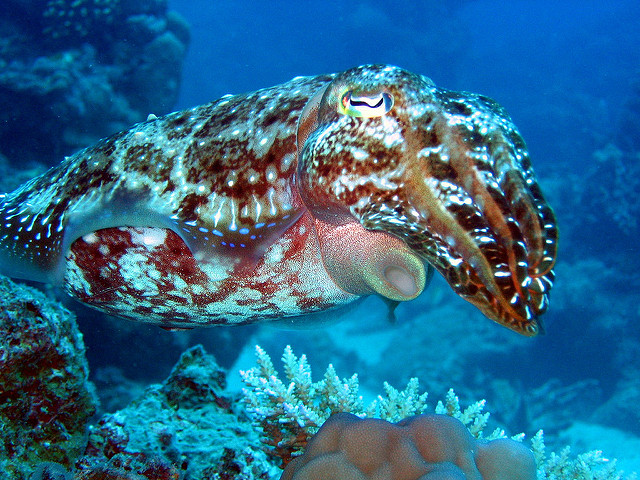
The Naked Scientists podcast featured a story about Giant Australian Cuttlefish. During mating season the male cuttlefish, much larger than the females, collect “harems” and spend their time mating and defending access. Other males try to “muscle in,” but the bigger cuttlefish “throws his weight around” to scare him off. The biggest cuttlefish wins.
So far this sounds like the typical story of competitive mating that we hear all the time about all kinds of animals, right?
Well, according The Naked Scientists story, researchers have discovered an alternative mating strategy. Small males, who are far too small to compete with large males, will pretend to be female, sneak into the defended territory, mate, and leave.
How do they do this? They change their color pattern and rearrange their tentacles in a more typical female arrangement (they didn’t specify what this was) and, well, pass. The large male thinks he’s another female. In the video below, the cuttlefish uses his ability to change the pattern on his body. He simultaneously displays a male pattern to the female and a female pattern to the large male on the other side.
———————————
So, can the crossdressing cuttlefish and dodge-y dung beetle tell us anything about evolved human mating strategies?
Probably not.
But I do think it tells us something about how we should think about evolution and the reproduction of genes. If you listen to the media cover evolutionary psychological explanations of human mating, you only hear one story about the strategies that males use to try to get sex. That story sounds a lot like the one told about the horned beetle and the large male cuttlefish.
But these species have demonstrated that there need not be only one mating strategy. In these cases, there are at least two. So, why in Darwin’s name would we assume that human beings, in all of their beautiful and incredible complexity, would only have one? Perhaps we see a diversity in types of human males (different body shapes and sizes, different intellectual gifts, etc) because there are many different ways to attract females. Maybe females see something valuable in many different kinds of males! Maybe not all females are the same!
Let’s set aside the stereotypes about men and women that media reporting on evolutionary psychology tends to reproduce and, instead, consider the possibility that human mating is at least as complex as that of dung beetles and cuttlefish.
Originally posted in 2010.
Lisa Wade, PhD is an Associate Professor at Tulane University. She is the author of American Hookup, a book about college sexual culture; a textbook about gender; and a forthcoming introductory text: Terrible Magnificent Sociology. You can follow her on Twitter and Instagram.
Comments 51
TheophileEscargot — June 28, 2010
The book "Love of Shopping is Not a Gene" by geneticist Anne Innis Dagg is a great resource on how dubious "sociobiology" is used to justify existing gender roles.
http://boingboing.net/2009/11/04/love-of-shopping-is.html
For instance, she points out that violence in chimpanzee males is often used to explain why males are intrinsically aggressive. But chimpanzee females are highly promiscuous, yet that's generally ignored since it doesn't fit socially conservative ideas that females are naturally chaste.
JihadPunk77 — June 28, 2010
haha wow. the horned/hornless dung beetles remind me very much of dudes who drive a Hummer or one of these dumb gas-guzzling giant SUVs or trucks with huge tires, and then those guys who don't drive those... LOL
Erika — June 28, 2010
That's why I don't understand people who are so close-minded about gender roles being rooted in biology; many other species exhibit such varied mating strategies. Quite a few complex species form matriarchal family bonds, and in certain species -- spotted hyenas being a prominent example -- the females are typically far larger and more dominant than males.
People who are usually so adamant about the complexity (and thus superiority) of humans never seem to think that human mating strategies could be as complex!
George — June 28, 2010
It seems to me unlikely that humans have evolved a diversity of mating strategies as seen in dung beetles and cuttlefish. All human's have a common ancestor about 200,000 years ago. On the other hand cuttlefish and dung beetles are much older species and reproduce on a much shorter timescale.
To the extent that human mating strategies differ it is based on learned behaviour and social conditioning, not on biology. I don't understand the obsession in the social sciences with trying to refute biological theories of human behaviour. Biological theories tell us about the broad outlines of human behaviour. For example, they explain why men and women across widely different societies tend to find the same things attractive about the opposite sex. They obviously cannot tell us why one particular person finds another particular person attractive. It is also still possible for isolated cultures in unique circumstances to develop in ways that differ significantly from the average human behaviour. Part of the problem is probably that articles on the subject in the popular press are overly speculative or deliberately made to seem inflammatory.
The fact is that humans are a species that has evolved through evolution and therefore to some extent human nature is evolved. Our society would make more progress in addressing social problems if we accepted this premise and worked from there, rather than engaging in futile attempts to refute it simply because it challenges some people's ideological biases.
jeffliveshere — June 28, 2010
I highly recommend Joan Roughgarden's "Evolution's Rainbow," which is basically a bunch of descriptions of how gender(s) and reproduction strategies are incredibly diverse: http://books.google.com/books?id=dASsUFtN57sC&printsec=frontcover&dq=evolution%27s+rainbow&hl=en&ei=Qd0oTPe-GYeFnQfGormpAQ&sa=X&oi=book_result&ct=result&resnum=1&ved=0CCgQ6AEwAA#v=onepage&q&f=false
Zidel333 — June 28, 2010
@Jeffliveshere, I was actually going to post the same book. Joan Roughgarden was originally born John, but after getting her PhD in biology from Harvard, and teaching at Stanford, she came as trans. Her most famous book is Evolution's Rainbow, and it's easy enough, most anyone who isn't a sexual or evolution bigot can read and appreciate it. Roughgarden writes about how Darwin was wrong on some key points in terms of sexual diversity and mating practices, how various species have more then 1 gender (which as a Trans she's obviously interested it) and what that means in a larger biological and social stand point. Highly recommended book.
ramblingperfectionist — June 28, 2010
Erm, who says humans have only one type of mating strategy? The idea of men whining their way into having sex is not entirely uncommon, for one thing. I think you're assuming a narrowmindedness that doesn't exist, at least for a lot of people
Em — June 28, 2010
Thanks for this post, it was really interesting and lovely to read. I'll keep the link handy for the next hobby evolutionary psychologist I'll encounter. ;)
Palaverer — June 28, 2010
Thank you for the fascinating post. I'd also like to thank Theophile and jeff for the links.
cb — June 28, 2010
The Economist had an article about the exact same thing a few weeks ago, but citing studies of guppies and crickets! Very interesting. Here it is: http://www.economist.com/node/16271349?story_id=16271349
Stef — June 28, 2010
Why the focus on the "ways to attract females" angle? What about what females do to attract males?
AR — June 28, 2010
One of the main things I got out of The Selfish Gene was the following understanding of evolved mating behavior: because the ideal behavior depends on the behaviors others are using, and in ways that tend to produce negative feedback, there is no ideal behavior that works in all populations, and the proportion of behaviors in use is constantly changing. Further, there will always be minority behaviors that are highly effective,precisely because they are minorities.
For instance, being a sneaky male beetle would not be as useful if all males were sneaky. Then, the male would be competing against a lot of other males, in which case there would be an advantage to being big and possessive, because it would cut down your competition to only those few sneaky guys who could get past you. Not ideal, but a vast improvement. Conversely, if every male were possessive, a lone sneaky one could spread his genes all over the place, and would be competing only with a single other male. These two considerations, and undoubtedly many other factors, result in the observed situation in which multiple strategies co-exist. If we observed the proportion of male strategies over time, I'd bet good money on it fluctuating over the generations.
I highly recommend that book for anyone interested in life. Evolution's actual predictions about human mating behavior are completely compatible with what is observed in the world, which is that there are numerous strategies in play whose proportion is constantly changing. Cultural considerations add to its complexity, but they do not contradict it.
Most evolutionary material you hear from the media is to actual biology what The Physics of Star Trek is to actual physics. The lines of reasoning seem superficially similar to a layman, but even a casual analysis of the subject shows it to be in contradiction to long-established principles.
Captain Pasty — June 28, 2010
It is also the same with the orang utan. The males can grow huge and defend a territory with females in it. But other males will remain smaller and not get the massive face flanges. This is so that they still appear juvenile (and therefore are not a threat to the big males) and they can secretly mate with the females. So there are also two mating stretegies in orang utans.
Best of teh Internets: Gender Roles and Sexy Time « hepfat — June 28, 2010
[...] Images talks about two members of the animal kingdom – the dung beetle and the cuttlefish – that have (at [...]
Carlo — June 28, 2010
Two other books on the subject of the diversity of animal mating systems:
"Biological Exuberance" Dr. Bruce Bagemihl
"Sexual Selections: what we can and can't learn about sex from animals" - Marlene Zuk
Carlo — June 28, 2010
Also, as for the link between biology and behavior: It is all biology. and it all evolved. As for whether a trait is "genetically based", that too is a thorny question. All traits (including behavioral traits) arise as an interaction of gene systems and the specific environments they find themselves in. The distinction between nurture and nature is an artificial construct for understanding two interacting forces in development (the written code vs. how that code is activated). Nevertheless, these two forces are intertwined so completely that the statement "Male aggression is caused by genes, not environment" is as ridiculous as saying "Darkness is caused by night." You cannot have a trait (phenotype) without both the genotype and the environment it is expressed in.
There is plenty of research available to show that the ability to learn - the ability to create culture and shared knowledge is itself and evolvable, adaptive trait. Not just in humans - but in birds and many other mammals. Because mating systems are so complex (even in very simple animals), involving all kinds of learning, culture, so called "hard wired" traits (things that do not vary much across environments), it is ridiculous for anyone to claim what is right, true or moral about human mating systems. We should expect them to be diverse and complex. Not just because we've evolved for a long time (just like everything else currently alive), but because we have many layers of plasticity, both cognitive and physical. We are eminently flexible. Each of these things adds variation into the mix, creating complexity.
Socio/psycho biology may sometimes stumble into some unsavory conclusion and be misused (as all science occasionally is) by people using it as a weapon, instead of a tool. However, the basic idea of using our biological and evolutionary knowledge to understand human ideas, cultures, behaviors etc is not a bad one. We are after all animals just like any other and are subject to selection and evolution. It is important to remember however that true evolutionary studies are rarely prescriptive (what should be), they are always descriptive (what is observed). And anyone claiming to know the whole truth is almost always guaranteed to be wrong. Wildly wrong.
Reynaldo M. — June 29, 2010
I was just reading "The greatest show on earth" this reminds me of the title. Rather timely Id say. I was just getting ready to give a dissertation about why irreducible complexity, or the second law of thermodynamics, or the flagella engine is not against evolution. I am absolutely amazed at what I find in the comments, not one zealous evolution denier.
And that reminds me of the "God delusion" and how the research showed that intellectuals were much more atheistic then non intellectuals. Congratulations on creating such a community in this blog.
Woz — June 29, 2010
"Maybe females see something valuable in many different kinds of males!"
And vice versa...I'm sure this was just written quickly and I don't want a troll accusing me of reading far too much into everything, but while we're talking about the problematic use of nature metaphors in human sexual patterns, it's important to point out that men choose and even reject sex as well...
Jennifer S. — June 30, 2010
Echoing the concerns of a few comments above... This post successfully and fascinatingly refuted the evolutionary biology cliche that it's "natural" for males to use a strategy of aggression and violence in mating, and that this is the only successful mating strategy. However, it uncritically accepts the similar cliche that females are strictly passive and receptive in mating situations. For the animals, it's just whoever can get to her, by strength or by cunning, wins. Even when referring to humans, it's a gatekeeper model - "females may see something valuable in many different kinds of mates." Because women never actively pursue mates or are rejected by them, I guess.
Now, I'm no biologist and I know nothing about the mating habits of these animals, but I'd bet that the narrative of passive female mate as prize for successful males is as shaped by our cultural biases as the narrative that those males can only be successful through brute strength.
Tyler — July 7, 2010
I'm a hornless male... waiting to sneak in the hole... err... burrow.
GenderEnder — July 13, 2010
From the post: "Perhaps we see a diversity in types of human males (different body shapes and sizes, different intellectual gifts, etc) because there are many different ways to attract females. Maybe females see something valuable in many different kinds of males!"
Did no one else take notice of the seeming absurdity of sentence? I don't really know how to explain what I mean coherently right now, but I don't think I need to.
Kyle Thomas — July 13, 2010
I think this is an unfair representation of what GOOD evolutionary psychologists have actually said about human mating strategies. True, the media tends to say that there is only one strategy, and some naive theorists seem to think this, but the primary literature is MUCH more complex than this. This is yet another mis-representation of evolutionary psychology.
I recommend Donald Symon's fantastic book, The Evolution of Human Sexuality, as a great starting point for how Evolutionary Psychologists actually think about this complicated subject.