
Flashback Friday.
A study published in 2001, to which I was alerted by Family Inequality, asked undergraduate college students their favorite color and presented the results by sex. Men’s favorites are on the left, women’s on the right:
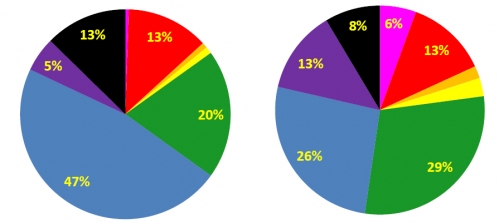
The article is a great example of the difference between research findings and the interpretation of those findings. For example, this is how I would interpret it:
Today in the US, but not elsewhere and not always, blue is gendered male and pink gendered female. We might expect, then, that men would internalize a preference for blue and women a preference for pink. We live, however, in an androcentric society that values masculinity over femininity. This rewards the embracing of masculinity by both men and women (making it essentially compulsory for men) and stigmatizes the embracing of femininity (especially for men).
We might expect, then, that men would comfortably embrace a love of blue (blue = masculinity = good), while many women will have a troubled relationship to pink (pink = femininity = devalued, but encouraged for women) and gravitate to blue and all of the good, masculine meaning it offers.
That’s how I’d interpret it.
Here’s how the authors of the study interpreted it:
…we are inclined to suspect the involvement of neurohormonal factors. Studies of rats have found average sex differences in the number of neurons comprising various parts of the visual cortex. Also, gender differences have been found in rat preferences for the amount of sweetness in drinking water. One experiment demonstrated that the sex differences in rat preferences for sweetness was eliminated by depriving males of male-typical testosterone levels in utero. Perhaps, prenatal exposure to testosterone and other sex hormones operates in a similar way to “bias” preferences for certain colors in humans.
Go figure.
Important lesson here: data never stands alone. It must always be interpreted.
Originally posted in 2010.
Lisa Wade, PhD is an Associate Professor at Tulane University. She is the author of American Hookup, a book about college sexual culture; a textbook about gender; and a forthcoming introductory text: Terrible Magnificent Sociology. You can follow her on Twitter and Instagram.
Comments 94
REAvery — May 19, 2010
Dear authors of study: Sex and gender are not interchangeable words. Did you divide people up by their personal identity? Use gender. Did you divide them up based on what genitals they were born with? Use sex. And don't try to tell me that rats have gender.
Also, if you're going to draw random conclusions about in-utero hormone exposure linking up with human color preferences, please actually study in-utero/prenatal hormone exposure in your subjects. Thanks.
meerkat — May 19, 2010
I would interpret it this way: Blue is the prettiest color and more women know this than men. My interpretation is not very serious. It is biased because I like blue.
Leslee Beldotti — May 19, 2010
Huh. My favorite color is orange.
Does that make me a hermaphrodite, or an alien?
Willow — May 19, 2010
Another case of universalizing modern Western/American norms.
Among other ridiculousness. Their logic is "rats like the way things taste based on sex, and humans like the ways things look based on...gender (or maybe sex?), therefore the same thing causes both." ??? Seriously? Am I reading that wrong?
Deaf Indian Muslim Anarchist — May 19, 2010
green is my favourite colour. being from India, I had recently visited my family there a few weeks ago. While there, I noticed a lot of Indian men wearing pink.
AnthroGrad — May 19, 2010
There could be a slight underlying biological issue, in that males are more likely to be red-green colorblind. Of course, it doesn't seem to have affected the preference for red.
Ang — May 19, 2010
No one's favorite is black?
Soc Prof — May 19, 2010
Lisa--you said it!!!!
V.V. — May 19, 2010
I guess they weren't allowed to list black as a color or something? I can't imagine that 0 people said "black."
Katy — May 19, 2010
Wow, the "interpretation" by the study authors is totally illogical.
Anonymous — May 19, 2010
Biologically based color preference, huh? I guess because these particular color preferences are obviously cross-cultural and true throughout all of history, that's a logical interpretation...oh, wait, did they forget that part of the study?
EMB — May 19, 2010
What about the green? That seems like a fairly significant difference (as opposed to red, for example).
Syd — May 19, 2010
I do know that women can actually see more colors than men, which might account for the diversity. However, that refers to specific shades, not the 'red-blue-green' typical colors.
angelica — May 19, 2010
Ooh, even better explanation: women in the past needed to forage for berries, therefore they're naturally more likely to favour pink shades!
I <3 Ev Psych. No, really, there was a study a while back that actually asserted that. Men, then, presumably prefer blue because, erm... all those bright blue woolly mammoths they were hunting or something.
maggie — May 19, 2010
I pretty well refused to wear pink until I was out of high school. I felt I was supposed to like it, being a girl and all. So therefore, I hated it.
maggie — May 19, 2010
Heh, my avatar is pink. :)
mari tov — May 19, 2010
http://blog.xkcd.com/2010/03/01/color-name-survey/
I think the interesting dynamic is not just men liking blue, but rather women being much more involved in color overall.
Anonymous — May 19, 2010
The higher percentage of women liking pink or purple is expected enough: most of the men who prefer it wouldn't admit it, for the reasons you gave.
But what about the greater preference, among women, for green? That, along with pink and purple, almost totally accounts for the lower percentage choosing blue, as compared to men. Here's a theory, off the top of my head:
maybe humans in general initially prefer blue, for some survival related reason (water, clear skies?), but women, being encouraged by society to engage in more activities that involve choosing and comparing colors (fashion, interior decorating, etc.) are more likely to change their initial preference (from trends, cultural associations or plain old desire for variety), hence the greater diversity in favorite colors among the women overall.
Hey, it's pulled out of thin air, but so is their "neurohormonal" explanation.
Jadehawk — May 19, 2010
can I just ask WTF taste has to do with color? why are the authors asserting that a rat's gender-based preference for tastes has anything to do with people's preference for color?
Because all I can think of now is "purple is a fruit" :-p
Laura — May 19, 2010
Everyone who is involved in evo psych research should be required to do a second degree in sociology first. There, I said it. The wild leaps to hormonal causes and selection during some unspecified "caveman era" are embarrassing, especially to anyone who's studying evolution for real.
antigone — May 19, 2010
I find it interesting that so few women picked pink, yet the "girl version" of everything is ALWAYS pink or maybe lavender. This is especially true of young children. It's hard to find any female-gendered products for babies and little girls that are green or blue.
I don't think blue or green are particularly masculine, unless we're talking about babies, but it depends on the shade. Anyway, I think it's natural to like green and blue as these are the colors which form the backdrop in nature.
Mindy — May 19, 2010
If you want an actually interesting look at differences in people's perceptions of color, check out the survey results from XKCD's poll: http://blag.xkcd.com
Umlud — May 19, 2010
The sample population was undergraduates. I wonder how these researchers controlled for university colors. For example, if you were to walk around the University of Michigan campus during the regular term, you would find a lot of yellow and blue (the colors of the university). One would see similar color associations at other campuses.
If the study was done at Minot State University, that could go some way to explaining the green (Minot State's colors are red and green).
queenstuss — May 19, 2010
I wonder also about the psychology of colour - do more people like blue because it's more calming? I don't know if that's the case, but is there something that makes certain colours more attractive than others?
Brenda — May 19, 2010
IMO, these "female humans prefer pink" conclusions fall down, once you look back only 100 years and see several publications in English advising that boy babies should be in pink and girl babies in blue.
The gendering of colours is cultural, it changes, and we're all soaking in it.
I have 2 boys ages 5 and 2. I would like to dress them up in a combined theme. Any ideas? | couple dress up games — May 20, 2010
[...] What Explains Differences in Color Preference by Sex … [...]
thisdesertlife — May 20, 2010
The cheese, however, does.
May — May 21, 2010
Aren't many men color blind?
n — May 23, 2010
i've read that blue and green are the colors most humans prefer as they are the color of the sky,many bodies of water and most plantlife
i always say that men LOVE pink,lace,satin and ribbons thats why women wear it. it doesnt reflect our tastes so much as it does those of the gender we're expected to attract
Brianna G — May 23, 2010
My interpretation: Blue and green are interpreted as calming, relaxing, and unoffensive colors in our culture. They are thus very popular with both genders in Western, American culture-- something reflected in everything from cars and the color we paint our walls to school and team colors.
However, men are more inclined to cling to gender norms and want to have the masculine color, blue-- they may also care less, and pick blue because they don't have a favorite color and it's a popular color, while women are encouraged to care about colors and shades from a young age and thus are less likely to go with the default.
An informal survey of my friends reveals that most of them interpret blue as the most common favorite color, so maybe guys were thinking "I guess I like blue, everyone likes blue."
GKK — June 1, 2013
Heh.
Most mammals are red-green colour-blind. They don't see red. Except for great apes. And some new world monkeys, but only the female ones. Male humans are often red-green colour-blind, and there's evidence that a great many of them are sort of colour deficient in that way, seeing fewer shades of reds, and fewer shades in general.
http://www.asu.edu/news/research/womencolors_090104.htm
If you told me you were doing this study I would have hypothesized, based on this information about mammalian colour-vision, that you would find that women have a wider variety of favourite colours and that men more rarely have a favourite colour that includes reddish tones. Which is exactly what you got. I would speculate that pinks and purples look less interesting to men.
(My childhood dog showed a marked colour preference for blue. If you put a red or pink scarf on him, he'd take it off and bury it. If you put a blue one on, he'd look enormously pleased and leave it on. Blue and lemon-yellow look bright and colourful to dogs. Reds and pinks probably look like muddy greens and mustard colours, depending on the shade. I didn't know that at the time. Now I have the amusing realization that my dog was actually rejecting reds and pinks because they didn't look vivid, while I reject them because they are too vivid.)
Thomas U. Torp — June 6, 2014
Reading the evo-psych explanation, I wonder how they'd interpret answers if they could sample the colour preferences of a group of ancient Greeks - living in a civilization which didn't even have a word for "blue".
ghjfdjcgb dtu.c — February 18, 2015
hnk vcg
paul schaefer — November 20, 2015
The data as presented in the post supports neither explanation. My interpretation would be that slightly more men than women like blue and slightly more women than men like pink.
elcalebo — November 21, 2015
Their explanation that this is likely to be neurohormonally caused also implies that it's not socially caused. But they aren't able to eliminate this factor because they don't treat it as a variable, because they don't really vary it ("a large sample of North American college students" in or around 2001 only includes societies that match your description e.g. blue gendered masculine, femininity devalued etc.). To deny the influence of a factor that you didn't actually test for is bad science, whatever discipline you're in.
Sakis Aralikis — November 24, 2015
Actually, based on the evidence from this study, the only interpretation that can be provided is that there may be some factors that produce slight differences in colour preference between male and female North American college students. There is nothing in the study that suggests a link with neither culture and social environment nor biology or genetics.
Mordicai — November 27, 2015
When all you have is a hammer...
This is a great example of why liberal arts requirements at colleges are important. You've got to fill your tool box with all kinds of paradigms.
Darth Vader — October 15, 2018
This varies by culture. Some colors are preferred by different cultures. Where did this survey/data come from
big dick — January 9, 2019
6blood walk
uhhhhh — January 9, 2019
o na na na
Anonymous — January 14, 2020
ZzZzZ
Anonymous — January 14, 2020
DBS
HI — January 14, 2020
AAXMMAXWEWGOKU