prisons

whenever i go a few days between posts, folks start wondering whether all is well. well, aside from a mounting backlog of email, all is well. swell, really. i’ve just returned from a few busy days in beautiful oregon, where i enjoyed a productive trip as department chair, researcher, and public criminologist.

As chair, i had a lovely meal with a generous donor to the minnversity’s sociology department. i know that not every academic enjoys this sort of thing, but I love this aspect of being chair. i’ve met a lot of very smart, successful, and civic-minded people this way. and, contrary to my expectations when i became chair, i never ever have to ask them for money.

as researcher, i spent some time on an nsf grant with melissa thompson, a former advisee who is now professin’ at portland state. melissa is the p.i. on this grant, so i’m mostly following her lead – not quite a full role reversal from her days as my research assistant, but we’ve both come a long way. she’s the first of my advisees to come up for tenure, so i’m feeling a bit senior these days.

as public criminologist, i spent yesterday afternoon at oregon state penitentiary, where my pubcrim colleague michelle inderbitzin has led several inside-out classes. several of the men on a-block had read my work on disenfranchisement with jeff manza, but we had a long and wide-ranging group discussion about mandatory minimums, family support, public opinion, the economics of crime, and the politics of criminal justice. i learned a lot — and hope i struck the right balance between talking and listening.

i didn’t have time to see all of portland, but i saw enough to know why melissa is so happy there. the pic above is from the japanese garden — a last-minute stop on the way to the airport this morning. beautiful.

just released from the bureau of justice statistics:

Parents in Prison and Their Minor Children
Presents data from the 2004 Survey of Inmates in State and Federal Correctional Facilities about inmates who were parents and their minor children. This report compares estimates of the number of incarcerated parents and their children under the age of 18, by gender, age, race, and Hispanic origin in state and federal prisons in 1991, 1997, 1999, 2004, and 2007. It presents the total number of children who were minors at some time during their parent’s incarceration. The report describes selected background characteristics of parents in prisons, including marital status, citizenship, education, offense type, criminal history, employment, prior experiences of homelessness, drug and alcohol involvement, mental health, and physical and sexual abuse. It provides family background of inmate parents including household makeup, public assistance received by household, drug and alcohol use, and incarceration of family members. It includes information on the children’s daily care, financial support, current caregivers, and frequency and type of contact with incarcerated parents.

  • The nation’s prisons held approximately 744,200 fathers and 65,600 mothers at midyear 2007.
  • Parents held in the nation’s prisons—52% of state inmates and 63% of federal inmates—reported having an estimated 1,706,600 minor children, accounting for 2.3% of the U.S. resident population under age 18.
  • Growth in the number of parents held in state and federal prisons was outpaced by the growth in the nation’s prison population between 1991 and midyear 2007.

mother jones offers a quick breakdown of estimated annual costs per inmate in california prisons. source data come from the bureau of justice statistics, the california department of corrections and rehabilitation, and the national association of state budget officers.

i collapsed some of the smaller categories, but a more detailed table is available online. a big chunk of the annual $49k is clearly tied up in security (mostly personnel, i’m sure, rather than hardware) and another large piece of the pie in medical and psychiatric costs. hmmm. it might be instructive to compare this annualized per person cost breakdown with that of other institutions, such as military, health care, or educational institutions.

just about every prison has a hole, a box, or a seg unit. these are thought to deter inmates from disruptive behavior, incapacitate those dangerous to themselves or others, and, sometimes, to protect inmates who might be especially vulnerable. if a prison is a microcosm of society, the seg unit is therefore the prison’s prison.

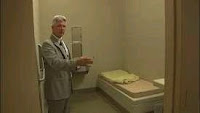
minnesota’s ancient correctional facility in stillwater just built a new $19,600,000 segregation unit to house the institution’s most disruptive residents. such costs strike those on the left as an outrageous expenditure in dehumanization, while striking those on the right as an outrageous expenditure in mollycoddling. having visited this facility and other century-old units on several occasions, however, i agree with prison administration on the need for such a facility. if you think the new seg unit is dehumanizing, you should’ve seen the old one — violent, frighteningly loud, with fires, floods, and flying feces a constant threat to staff and inmates.
during visits, i thought it unimaginable that people could spend any length of time in such conditions and still be expected to function as productive citizens upon their release. one hopes that the colder but safer space in the new unit may ultimately play some role in reentry and reintegration. a kare-11 report (with a bit of video from the old seg unit) quotes stillwater’s warden on this point:

“It wasn’t designed for being more comfortable, but designed as being more humane,” Warden John King explained. “That’s an important thing, to treat offenders humanely because they’re going to be back on the streets and in our communities,” he added.

bruce western offers a fine piece in the new boston review — a characteristically thoughtful analysis of mass incarceration, nicely presented for non-experts. bruce argues that the failure of the great experiment in mass incarceration is rooted in three fallacies of the tough-on-crime perspective:

1. the fallacy of us and them.
2. the fallacy of personal defect.
3. the myth of the free market.

the argument, and the article, is well worth a read, as are the review’s other contributions: no further harm by mary katzenstein and mary lyndon shanley, and guarded hope by robert perkinson.

the bureau of justice statistics has released a large-scale study of self-reported sexual victimization in local jails. i made the quick figure above to show the estimated prevalence of such victimization for different inmate groups: about 5% of females and 3% of males reported sexual victimization and rates were disproportionately high for inmates of color, youth, and more educated inmates. prior victimization and (self-identified) sexual orientation are most strongly correlated with victimization, however, with about one in 10 bisexual inmates and almost one in five homosexual inmates reporting sexual victimization.

one hopes that such data can help provide a road map for reducing sexual assaults in correctional facilities — and protecting those most subject to victimization. courageously, the bjs report also identifies the specific jails with especially high or low rates of sexual victimization:

The Torrance County Detention Facility (New Mexico) had the highest rate — 10.1% when sexual victimization excluded willing activity with staff and 8.9% when victimization excluded abusive sexual contacts (allegations of touching only). The Southeastern Ohio Regional Jail and the Bernalillo County Metropolitan Detention Center (New Mexico) were also among the top five facilities on each of these more serious measures of sexual victimization.

the chronicle of higher education offers a fine article on some of the difficulties facing prison researchers. the minnesota department of corrections and the university’s internal review board have been very supportive of my research, so i’m counting my blessings.

is it possible to make a difference in a student’s education in just one day? i guess it depends on the day.

having taught three inside-out classes in the oregon state penitentiary, i can say with absolute certainty that spending a quarter learning inside a maximum-security prison can change a life. i’ve seen it happen with my students, both inside (inmates) and outside (osu students). they learn about each other and from each other in ways that forever change their perspectives about crime, conformity, punishment, and prisons.

the challenge for me lately is to figure out if i can extend that kind of learning opportunity to more students in my larger on-campus classes. the first experiment took place this week when i took a dozen osu students into the penitentiary to meet with the lifer’s club. for me, the main goal was to humanize the other — to let the two groups interact and ask each other questions in a relatively informal setting (there were ground rules, of course, including strict limits as to the personal information exchanged. i was in no way bringing a dating pool into the prison). i wasn’t sure how much would be accomplished in one 2-hour session, but the students and the lifers were eager for the opportunity to meet. after getting through all the red tape, i was happy to facilitate the meeting between the two groups.

so what was the result? i asked the osu students for feedback and here are excerpts from some of their comments:

Thank you so much for giving me and the other students the opportunity to have an experience such as this one. It has definitely been one of the highlights of my college career. I appreciate it. I thought the lifers were great. I think it’s only natural for everyone to be a little nervous at first so I don’t know how to get around that, but they were all very open and respectful, and most were very eager to have discussion after a little warming up. I got so many different perspectives and insights from them, it was very beneficial.

The time we spent with the lifers was really life changing on how I now view prisons and inmates. I had never been to a prison before and definitely have never spoken to a big room of convicts. Every single inmate that I was able to talk with was very respectful of me and the other students in my group. I was surprised that so many had a positive outlook on life, even after being locked up for years and having many years to go until they had a chance of parole and some not even having that chance.

I went into this thinking these are all going to be bad guys with no personality, very mean, no remorse. I was really nervous when they all walked out. But after talking to a lot of them you realize they are humans too.

I would just really encourage those who participated to share with others what you saw, what you experienced, and encourage people to open their eyes and hearts to the idea that these men are PEOPLE, people who have paid a huge debt for their crimes and should be forgiven and given a chance to succeed in life.

so, i guess you can make a significant difference and push the limits of education in one day. it’s good to know. tomorrow morning i have a meeting at a correctional facility for girls and young women to discuss ways that my delinquency and sociology of education students might work with them in service-learning projects spring quarter (as in later this month). it will be an enormous amount of work to set it up, but it just may be worth it.

on another note, this blog will be moving to a new address shortly and it looks like we may be gaining new friends and readers in the process. stay tuned…