Dr. Jennifer S hewmaker is a nationally certified school psychologist, psychology professor, and mother to three daughters. Her book Sexualized Media Messages and Our Children: Teaching Kids to Be Smart Critics and Consumers takes on children’s consumption of sexualized media messages, providing parents, teachers, and professionals with strategies for abating their influence. Combining academic prowess with personal experience, she deftly demonstrates the impact of both positive and negative media messages. I sat down for an email chat with Jennifer—a colleague I “met” through the Brave Girls Alliance—to ask her more. To learn more about Jennifer’s work, check out her recent TEDx talk “Does Sexy Media Matter?” and visit jennifershewmaker.com. Follow her on FB and Twitter @drjenshewmaker.
Deborah Siegel: It kills me all over again to read of studies that, as you document, “link the consumption of sexualized media with body dissatisfaction and negative body behaviors such as dieting for girls even down to the age of six.” Six! And we know things only get worse as little girls grow up. At the same time, in the six and a half years since I myself became a parent, I’ve gone from “Never Princess” to “a little bit seems ok” to “I let my daughter keep the disembodied Cinderella head our cousin gave her and am now jamming in the car with her to Taylor Swift.” Any advice for parents who feel beat down by the culture, and our own confusions and compromises, to help us keep the faith?

Jennifer Shewmaker: This is such a good question. As parents we do have to find the best fit for our own families. For example, when my daughters were young, they enjoyed Disney Princess movies and costumes. I let them engage with princesses, but we also talked about the messages. So, with Snow White, I would ask, “What do you think about Snow White falling in love with the Prince like she did? Could she really know him, or can he really know here? How do you think people fall in love?” Giving young children the chance to think through ideas like that as they watch media helps them build their skills in becoming critical consumers, and learn to look at stories with a critical, realistic eye.
DS: Ok, so maybe not all is lost over here. It was a proud moment when my daughter called out Anna, from Frozen, for “falling in love at first sight” with the dude who turned out to be a bad guy. As parents, it’s not like we can issue a princess media blackout–nor would we necessarily want to perhaps, since these shows, it seems, offer teachable moments about the culture we live in. Critiquing the “external blocking” paradigm, whereby parents try to control the media content their children consume, you call instead for a more “ecological approach”. Can you explain what you mean by that?
JS: Sure. An ecological approach just means that we’re going to think about the environment in which the child is growing up. That includes the family their in, the peers they’re close to, the school they attend, and so forth. We have to ask what kinds of supports, skills, and messages a child is getting within that context. Media is a part of a child’s ecology, or environment, but it’s not the only part, and definitely not the strongest component. When a child has a family around them that helps them build their confidence and competence in critiquing media, when they have a peer group in which they build caring community, when they’re learning from all of the important people and groups in their lives to understand where their value lies, that is going to give them the tools to thrive, even when they face challenges like sexualized media. It goes back to those 5 C’s of thriving, confidence, competence, character, caring, and connection.
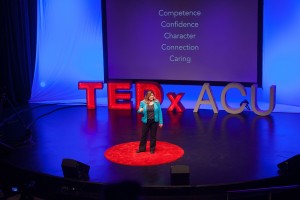
DS: I love this photo of you on a TEDx stage, with the “5 C’s” on the screen behind you. But as writers, educators, and activists who also parent or take care of children, it’s not enough to be the sage from the stage–right? Often our best lessons and learnings, I find, are the ones that take us by surprise. So I love asking gender experts this question: What’s surprised you most about the way sexualized media consumption has played out in your own home?
JS: When I started researching sexualized media, it was because I felt so overwhelmed by the messages. I really did wonder if there was a healthy way to address it. Once I discovered the 5 C’s of thriving, and started connecting those with the things I was hearing from kids in the interviews and surveys that I had collected, I began to understand that we don’t have to be afraid of negative or unhealthy media messages, we just need to know how to help our kids process them and build their skills to respond effectively. Now that my daughters are 12, 15, and 17, I see them using those skills everyday, and that is so encouraging. I know that what I share with parents will work, because it has worked in my very own family.
DS: Your book is anchored around “four interpersonal mediating variables” that can change the way adults living and working with children respond to sexualized media. What’s new or different about the way you’re understanding these wider contexts in which media literacy (or lack thereof) evolves?
JS: So many times when people have looked at media and how it effects kids, it’s been done from only one perspective. My idea is that we have to take a broader view, and understand that a child lives and develops within a context that’s dependent upon those variables, such as their gender, their family environment, connection to the culture of celebrity, and the other communities that they’re a part of. When we understand that each child can build the five C’s of thriving within each of these contexts, that gives us a good place to start in helping them become critical consumers of all kinds of media.
DS: Let’s throw another “C” into the conversation: consent. How early do you feel should we start talking with children—boys and girls—about consent? What are some age-appropriate ways to inform and forewarn, without scaring them?
JS: In the book I share an exercise that you can do with young children, even preschoolers, to help them begin to understand the concept of consent. This activity is called, It’s just a hug, and it’s one that I’ve used with young children for years. I start by asking them a few questions:
–Do you always want to be hugged?
–How does it feel if someone hugs you when you don’t want to hug?
–When you want to hug a friend and they don’t want to hug, how do they feel if you hug them?
–What might you do instead of forcing a hug?
This activity gives you a chance to start building language around body ownership, that each person has the right to say what they do and don’t want done to their body, and the chance for everyone to think about asking for and obtaining consent, what to do when someone denies it, and how to refuse consent themselves. Once you’ve set up the idea of consent with this activity, you can talk about it in different ways as the child gets older.
DS: You write that sexualized media “presents a dilemma” for both boys and girls, and you note that many adults talk about that dilemma more openly with daughters than sons. Why is that, do you think? And how can we help adults feel more comfortable broaching these critiques with boys?
JS: I think that many adults think that “boys will be boys,” instead of understanding that our boys need and want guidance on how to develop healthy relationships and a healthy understanding of how to go about building those just as much as our girls do. For example, it’s really important for both boys and girls to understand the concept of consent from both the perspective of giving and obtaining consent. Both boys and girls can be sexually abused, assaulted, and manipulated, and we want all of our kids to understand both how to treat others with respect and how to ask for respect themselves.
I believe that open conversations about our bodies, good and bad touch, how to say no or yes to touch, and so forth are important for all kids. In the book I give some specific conversation starters to help us do that with all children. And, it’s vital that we have these conversations about consent and contraception with our boys as they get older. We don’t want our son to be the bystander who saw someone getting assaulted and didn’t step in, we want him to be the one who helped, who called an adult, who noticed something was going on and asked for help.
I invite you to join my Facebook community, pin with me on Pinterest at Tots in Genderland, follow @girlmeetsvoice, and subscribe to my quarterly newsletter to keep posted on coaching, workshops, writings, and talks.