sport

New & Noteworthy

TSP board member Eleanor Nickel has a new Discovery, “Love Behind Bars.” Based on a recent article by Kristin TurneyKatelyn Rose MalaeMacKenzie A. Christensen, and Sarah Halpern-Meekin, the ripple effect of jail incarceration is strongly felt by women and children of incarcerated persons.

Our latest Media Report on Clippings features some Spookiology from Margee Kerr, Lars Birger Davan, Marc Eaton, and Dennis Waskul in Axios and Atlas Obscura, Patricia Romero-Lankao on transitioning to green energy and equity in NPR, and Alexei Levinson on the war in Ukraine and Putin’s career in The Bell.

From the Archives

How do we relate to people around the world experiencing war and trauma? Read our ‘There’s Research on That’ by Brooke Chambers to learn more about how distant war and the degree media coverage can impact our selective empathy of conflicts.

Student loan forgiveness developments continue to make headlines. Read our ‘There’s Research on That’ by Amber Powell on how student loan debt disproportionately impacts students of color and women.

Backstage with TSP

We are growing! New board members are joining the TSP team and bringing new perspectives and energy! Podcast planning is also our primary project. We are currently looking for recent sociological books to add to our current SOC 101 episodes.

More from our Partners & Community Pages

Contexts has new pieces to check out:

Council on Contemporary Families latest include:

Photo Credit: Nathan Rupert, Flickr CC

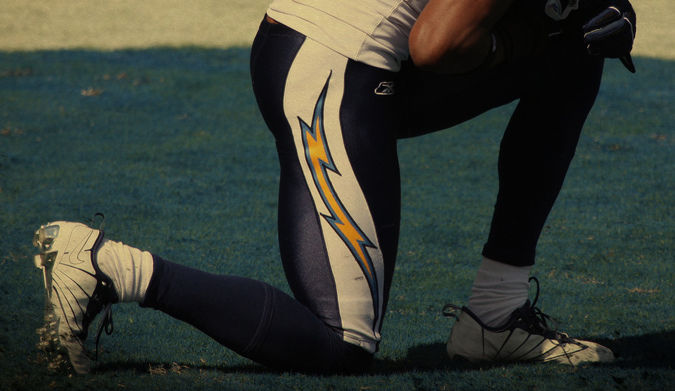
In case you were otherwise occupied, on Christmas Day the Associated Press named the “NFL National Anthem Protests” the top sports story of 2017. In a year of many huge sport stories both on and off the field, the AP said the story was the “runaway winner” for its staff. This doesn’t surprise me at all. I’ve studied sports-based social activism for a long time, but I’ve never had more media calls and requests for interviews in my career than these past few months.

The single biggest reason for the story, I’m pretty sure, involves our President’s seemingly unprompted and unusually profane attacks in September on football players who had engaged in demonstrations and the NFL. For better or for worse, Trump’s attention provoked a tidal wave of unprecedented gestures of protest and support across the league (and across both racial lines as well as those of management and ownerships) that gave the story its scale, scope, and intrigue. But there’s much more to say about it than that, much more.  I’ve been tracking this all fall as part of my own research project on the “new era” of African American athletic activism we are currently witnessing, and I am going to pull some of that together in a commentary with my sport and politics collaborator Kyle Green.  We are hoping to run that piece in the lead-up to the Super Bowl here in the Twin Cities at the end of January, so stay tuned!

There are two points I’d like to address here, by way of year-end retrospective: “kneeling” and “remembrance.” On kneeling, why do athletes feel the need to protest?

“Why do they do it?” is far and away the most common question I get from journalists and regular folks alike. Underlying this inquiry is the sense (a) that these demonstrations are disrespectful and (b) that professional athletes are super-rich, superstars who should be so satisfied with their lives and salaries and fame that they’d have no reason to complain or be angry, much less act out in public. At best, they see African American athlete activists as spoiled complainers, more interested in politics, making news, and making money than anything else. For many Americans, athletic protests are as incomprehensible as they are inappropriate.

Based on the athletes I’ve talked to and my earlier research on black athletic activism in the 1960s, I see the issue quite differently. and commitments. In a society that continues to be plagued by disproportionate police brutality, persistent racial gaps, and overt bigotry and bias, they feel compelled to do or say something. Sometimes it is in support of communities of color—their communities—who continue to face persistent racism and discrimination. Sometimes it is quite personal, stemming from their own ongoing individual experiences with racism and discrimination. And almost always it is quite principled and reasoned, with a clear understanding of the costs and consequences (which are far more real and extensive than most of us realize). Athlete activists don’t take their activities lightly or think of them as disrespectful or anti-American. Quite the contrary, they understand activism as consistent with the higher moral standards, ideals, and aspirations of both American democracy and sport culture.

But there is something else here too: It is also the fact that many —to make it seem like everything is okay. This was a major motivator for the African American athletes who participated in protests in the year leading up to the 1968 Olympic Games. As high jumper Gene Johnson explained in support of the “Olympic Project for Human Rights:”

“The United States exalts its Olympic star athletes as representatives of a democratic and free society, when millions of Negro and other minority citizens are excluded from decent housing and meaningful employment” (Race, Culture, and the Revolt, 2003, p. 84).

Or, as the OPHR organizing pamphlet put it: “We must no longer allow this country to use black individuals of whatever level to rationalize its treatment of the black masses.” 

So, that’s kneeling, now for remembrance. A few weeks back I was interviewed by a Time reporter for a special 50th anniversary retrospective issue on the tumultuous year of 1968. Among other things, the reporter asked me what my research on Tommie Smith and John Carlos’s iconic victory stand demonstration taught me about the meanings and implications of the protests of Colin Kaepernick and his NFL brethren. “How will we remember what is going on today, 50 years from now,” she wanted to know?

Social scientists like me, I told her, are loath to make predictions. However this topic is one where I was willing to make an exception. I’m pretty confident that one day in the not-to-distant near future, Kaepernick and company will be remembered far more positively across the American populace than is currently the case. In fact, it wouldn’t surprise me at all if, once the specifics of this moment and the larger racial politics that are unfolding are behind us, these athlete activists come to be revered as courageous, admirable, or even heroic—certainly ahead of their time. If you’re interested, my little quote to this effect can now be found in print on page 92 of the latest issue of Time (dated Dec. 25/Jan. 1) as well as online here.

Such historical re-remembering is a familiar pattern in American culture. It happened to our collective conceptions of Martin Luther King, Jr. and Muhammad Ali. Perhaps most pertinent to this discussion are the memories that surround the perpetrators of one of the most iconic sports demonstrations of all time, Tommie Smith and John Carlos’s 1968 clenched first, victory stand demonstration at the 1968 Mexico City Olympics. Today, most Americans celebrate Smith and Carlos as heroes of the Civil Rights Movement; back in 1968, they were seen as villains, traitors, and worse.

History and memory—what happened and how we think about what happened—are two different things. All too often, the way we remember and romanticize images, individuals, and events comes at the cost of forgetting all of the actual social issues and context that gave rise to them in the first place. As this year draws to a close and we begin to look to the future, let us not lose sight of the racial disparities and social injustices at the root of the biggest sports story of 2017.

When even Michael Jordan—that erstwhile poster child of the transcendent, apolitical, super-star athlete—jumps into the fray, you know something is up. I am referring, of course, to the public announcement Jordan made Monday. Saying he could “no longer stay silent,” legendary #23 pledged to donate $1 million each to a charity for community-police relations and to the NAACP’s Legal Defense Fund. Jordan said, “We need to find solutions that ensure people of color receive fair and equal treatment AND that police officers—who put their lives on the line every day to protect us all—are respected and supported.”

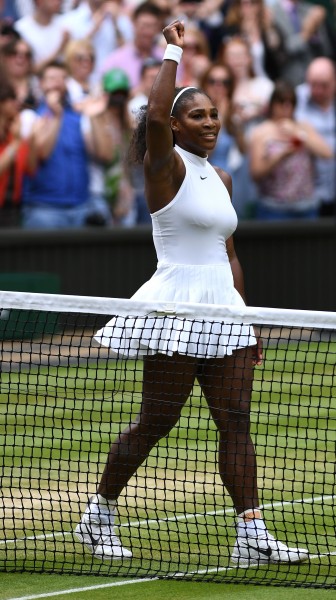
Serena Williams after her 2016 Wimbledon win, via bustle.com.

But Jordan is not the main story here, at least not when viewed in sociological perspective. The main story, the bigger story, is about all of the athletes and sports organizations who have been speaking out about social issues in one way or the other over the course of the past few months: NBA star and American Olympian Carmelo Anthony urging athletes to quit worrying about their endorsement deals and speak out on police killings; tennis player Serena Williams offering support and then a clenched fist salute on the hallowed grounds of Wimbledon; the testimonials of Anthony and fellow NBA stars Chris Paul, LeBron James, and Dwyane Wade at the ESPYs; WNBA players and teams, led by the Minnesota Lynx, dressing in support of Black Lives Matter and against police shootings; the NBA moving next year’s annual All-Star game out of North Carolina because of that state’s LGBTQ politics. My hometown paper, The Star Tribune, ran a whole page story in last Sunday’s sports section about a host of athletes taking social justice stands or actions in Minnesota alone.

Let there be no doubt: we live in a new era of athlete awareness and advocacy, unlike anything we’ve seen since the late 1960s.

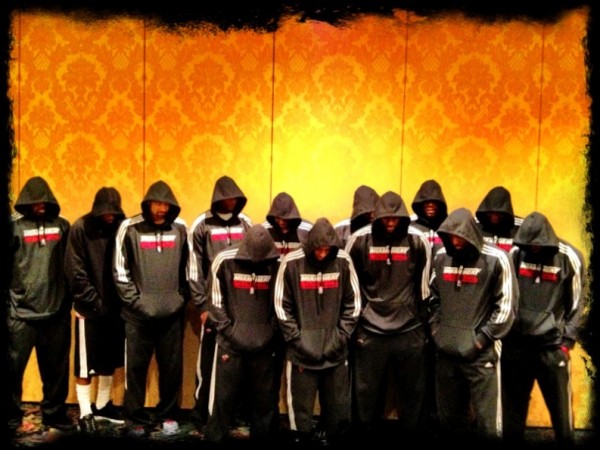
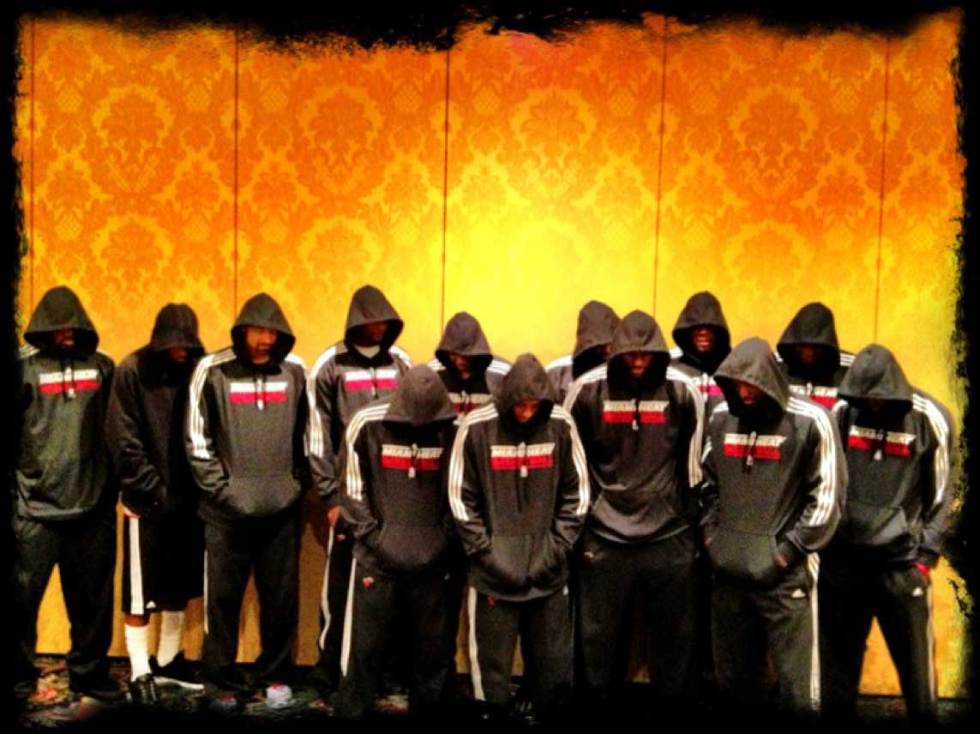
LeBron James and the Miami Heat in 2012, hoods raised and heads bowed in memory of Trayvon Martin.

I believe the roots of this new movement can be traced to LeBron James and his Miami Heat teammates tweeting out a picture of themselves in hoodies, with heads bowed in support of Trayvon Martin, a few years back (see also). Others recall when the entire Phoenix Suns team wore jerseys in solidarity with Latinos who felt threatened by proposed anti-immigration legislation in Arizona. Since then, we’ve seen NBA players like Chris Paul threatening to boycott the NBA All-Star Game unless something done to disavow the blatant racism of then-owner Donald Sterling; St. Louis Rams football players entering the field in the “hands up” gesture of Ferguson protestors; and, perhaps most amazingly, the University of Missouri football team using the threat of a boycott to force the removal of their university’s president.

Hartmann coverAs a scholar who’s done a good bit of work on sport and race and social unrest and social protest over the years—including a book on the 1968 African American athletic protest movement, the activism associated most famously with Tommie Smith and John Carlos’s iconic victory stand demonstration in Mexico City—I’ve been asked a lot of questions and invited to make a lot of presentations on athlete activism over the past year. So, as all of this has been unfolding, I’ve begun work on a paper situating the most recent activism and advocacy in the context of the protests of the Civil Rights era. Below, a few of the points I’m building the paper around:

  1. Athlete Awareness. While public advocacy may be new, social awareness among athletes is not. Athletes, especially elite professional and Olympic athletes, have long been far more educated, intelligent, and aware than prevailing if outdated “dumb-jock” stereotypes allow. The problem, in my view, has not been lack of social awareness and understanding, but barriers to public expression. Anthony has referenced highly lucrative endorsement deals (sometimes offering more renumeration to players than their actual sporting endeavors do), but formal and informal league rules, organizational pressures, and norms about the public roles of athletes all also apply. If there is a new consciousness, in my view, it involves a revitalized understanding of the powerful platform that sports provides athletes who are so inclined to voice their opinions.
  2. Larger Context and Connections. Those athletes who have chosen to use their status as public figures to speak out on social issues are not just speaking off the cuff, nor are they isolated malcontents. These public expressions are deliberate and reflective, responding to social issues such as police brutality and profiling or hateful gender or sexuality policies outside of the world of sport, in concert with other public leaders, and more often than not in close communication with other activists and organizers. Perhaps the best and clearest example of this was at the University of Missouri last fall: football players launched their boycott after working with campus leaders on ways to show their support for student on a hunger strike in protest of racial conditions and treatment on campus.

  3. Black Athletes as Leaders. It almost goes without saying that African American athletes have been the most prominent and powerful figures in this emerging movement (I think all but one of the athletes profiled by the Star Tribune were persons of color)—except that in our perverse “colorblind” culture, we often dodge the opportunity to name race explicitly and talk about it openly. This conversation is important for far more reasons than I can discuss here; it speaks to the unique racial composition of the American sports world, the prominent role of African American athletes in our culture, the centrality of race and racism in American society, and the larger role of sport in the construction, reproduction, and contestation of existing racial hierarchies. At the most basic levels, though, we can consider how sport is both impacted by and a driving force in the larger racial unrest in contemporary America—including the recognition of persistent patterns of racial injustice, emergent movements of resistance and opposition (such as Black Lives Matter), and the countervailing, reactionary movements of containment, denial, and resentment. The role of white athletes will be interesting as today’s movements unfold. At the University of Missouri, white players and coaches supported black activists, and, in the WNBA, star Minnesota Lynx point guard Lindsay Whalen and head coach Cheryl Reeves, both white, lent their support to protesting players. Whether white athletics and athletic leaders continue to step up and assume responsibility remains to be seen. For what it is worth, I’m impressed though not at all surprised the female athletes–including a huge swath of the WBNA–have been such powerful public voices in recent weeks.

Will this advocacy and activism change anything?

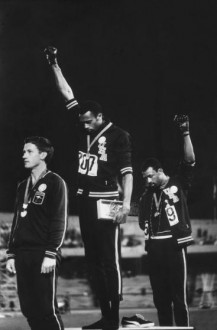
Via Time Magazine, the 1968 Olympics victory stand salute.

The initial answer is not always encouraging. If my study of the 1968 Olympic protests taught me anything, it is that sport protests usually do not change anyone’s mind or political position. Though we tend to heroize Smith and Carlos these days (as we did with the recently deceased Muhammad Ali), the truth is that these athlete advocates were seen as villains and traitors by mainstream Americans in the 1960s. If anything, their actions inspired a good deal of backlash and resentment, probably hardening some lines of conflict and division. Some of that reaction is already unfolding now.

But this doesn’t mean that nothing at all came of athlete activism in the past or today. One of the things that athletic protests and demonstrations can accomplish is forcing Americans who are or were not otherwise interested in such issues to look up from their otherwise comfortable, apolitical lives and pay attention to the social issues around them. So athletic advocacy can, in fact, play an important role in bringing issues of social injustice—police bias and brutality, policies toward LGBTQ Americans—to broader public visibility and debate. I believe it’s already happening.

And all of the money and attention we lavish on athletes and athletics in this country does put athletes in a unique and, on occasion, powerful material position. Witness the events at the University of Missouri: here, we saw athlete activists and their allies using the power afforded to them by virtue of how the institution and the public rely upon them for their athletic performances to force concrete, organizational change. This was amazing, revealing, and essentially unprecedented.

One final point on social and cultural change. When harkening back to 1968, I constantly find myself remembering and trying to remind others that Smith and Carlos not only didn’t change many people’s minds about race problems and civil rights, they didn’t change American norms about the relationships between sport and social change. If fact, they and their allies (as well as their opponents) were caught within prevailing conceptions of sport as a somewhat special, sacred, or apolitical cultural space. To wit: while some saw athlete activists in the 1960s as heroes or villains, public opinion polls showed that most everybody agreed that sport wasn’t a place for politics or, by extension, protest. The two sides simply disagreed on what counted as protest and politics. Those who sided with Smith and Carlos saw them as standing up for what was good, right, and morally just—in the idealistic way that high-minded sport supporters have long celebrated sport; the majority who were against them saw them and their actions as disruptions outside the social status quo.

What is at stake here is not just whether we agree with the particular causes of athlete activists. What is also at stake is how we understand sport and athletes in society, especially when it comes to issues of racial justice and social change. Will the cultural stereotypes about athletes change? Can we begin to see sport as something more than an arena for entertainment and release, or some kind of apolitical sacred space? If social change is hard, sometimes cultural change is even harder—so on those questions, I remain cautious and curious.

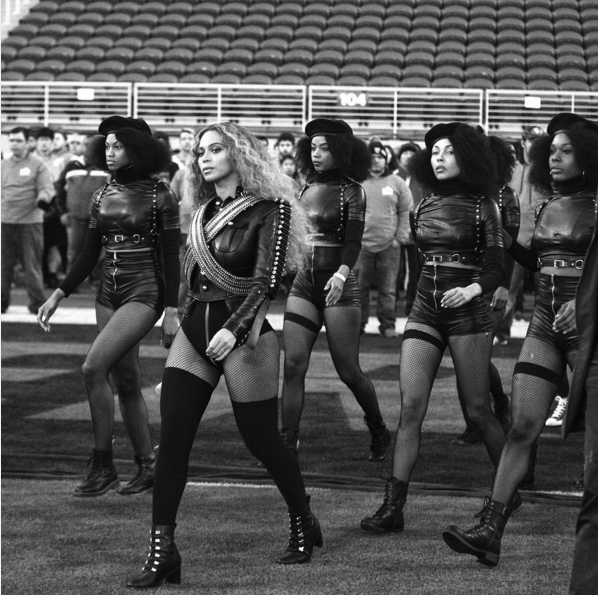
Beyonce and her dancers practice their entrance before the performance. Via Beyonce, Instagram.

Okay, I’ll make this quick since it’s a bit dated. After I wrote that little post about Saturday Night Live’s “Beyonce is Black” spoof a couple of weeks back, I had a number of students and friends wanting to know what I actually thought about her Superbowl performance (well, her part in the Coldplay performance featuring Beyonce and Bruno Mars). I’m no music critic (or big Beyonce fan, for that matter) so I hadn’t really taken the bait. However, I did spend some time reading what other people were saying—both about the performance and about the backlash it seems Beyonce experienced.

One piece that really caught my attention was by the Salon blogger Lasha. She was struck by the very different reception that Beyonce experienced than the one that met rapper Kendrick Lamar after his racially pointed and politically charged performance at the Grammys just days later. According to Lasha, it was one more instance of the unfair, sexist policing of African American women’s political expression.

Lasha’s point about the marginalization of black women’s radicalism is well-taken. I also think there is some additional social context worth considering. For one, there are expectations and previous record. I think part of the thing with Beyonce is that her Superbowl performance was perhaps her first “socially conscious art.” This surprised folks—it defied their expectations of the “Single Ladies” singer, upsetting those who didn’t see it coming or didn’t understand where she was coming from (witness my previous post on the SNL spoof).

Even more important, in my view, is the actual social context of the performances: the music industry versus the sportsworld. We Americans have come to expect and accept social consciousness and political radicalism in the music context. We not only do not expect such expression in sports, we actually oppose it. Not all cultural arenas are unique, and there are many things about the world of sport that make it uniquely powerful and complicated. As I written on many occasions—for example, in the piece Kyle Green and I did on this site about politics and sport being strange bedfellows—there are deep cultural norms about sport that make any kind of social statement in the realm of sport extremely complicated and typically controversial, especially where race is involved.

I won’t try to rehearse all of the ways this works, much less how racial movements and politics are implicated (there’s a lot on this in my book on the 1968 African American Olympic protests, if you are interested). But when it comes to statements of protest, unrest, and activism, Americans tend to see sport as somehow unique or special—either because we see sport as somehow sacred or sacrosanct (that is, above politics) or because don’t want our entertainment complicated or sullied by the realities of the non-sport world. So while sexism is clearly at play, there’s at least one other important thing going on—the idealization of sport on its highest, most holy day in America: Super Bowl Sunday.

IndianaNCAA


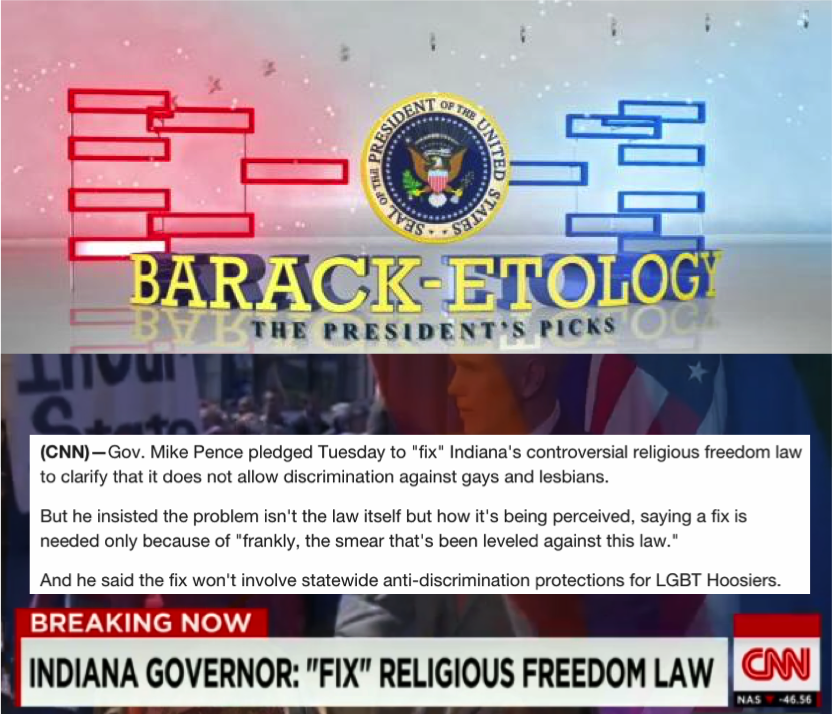
What to feature on the home page this week? How about some research on religion and society, since Passover and Easter are coming up? Or perhaps we should do something on LGBTQ discrimination, given the law that just got passed in Indiana (and a similar one Arkansas’s governor unexpectedly rejected). But maybe those stories are better framed sociologically in terms of protests and social movements, given all of the controversy that has surrounded it. Or does this actually require a religious analysis? After all, the legislation was called “The Restoring Religious Freedom Act.” Maybe, instead of playing our usual “Debbie Downer” role, we should just have some fun and find a piece on the Final Four, March Madness, and the whole spectacle of sport in modern society. (Though, truthfully, talking about college basketball as “spectacle” already feels like falling into familiar habits.)

If only we had a piece that brought all this together in one fell swoop. If only we had a piece that could connect the various dots of religion, rights and freedoms, LGBTQ discrimination, public policy and political protest, and mass-mediated, spectacle sports. And, can we get that before the high holidays are over?

Actually, in a way we have such a piece, or at least the building blocks for one. I’m referring to the drama that is being played out right in front of us this very week in Indiana as Governor Mike Pence, under heavy pressure from those calling for the NCAA to pull its headquarters (if not the Final Four itself) out of the state, scrambles to “fix” the legislation his legislature just approved. What a story! Here we see religion and sexuality come right up against each other, how the Constitutional “rights” of some are balanced (or not) against the Constitutional “freedoms” of others. Here we can observe how institutional power plays out against political protest and passionate social movements, as well as try to ferret out where the mass media and corporate interests with such stakes in March’s Madness will come down. Here we can watch as that seemingly fun, apolitical realm of sport suddenly gets pulled into a very high profile, very controversial, very political debate. And it is all happening during one of the most sacred weeks of the year. (I was talking about the religious folks when I first wrote that but I guess I shouldn’t leave the sports fans out–especially since I count myself, for better or worse, as a member of both of these passionate communities.) It’s almost too good to be true–from a sociological, home page-type point of view.

Of course, we don’t really have that story—or should I say that analysis—yet. If you are working on that and have something to share, please send it along. Sociological analysis doesn’t just write itself. In the meantime, let me share two smaller pieces that might help provide some frame and context.

One is a “TROT!” (There’s Research on That!) piece pulling together some great sociological research on the squishiness (that’s our technical term) of laws regarding religious freedom and the rights of refusal–that is, legal attempts to codify which forms of discrimination on the basis of race, religion, or sexual orientation are allowed; whose rights and freedoms are inscribed and institutionalized; and the problems with trying to enforce these laws and statutes in actual social life. So, while nearly half of all U.S. states have religious freedom and right of refusal laws on the books, most also include codicils specifying that businesses cannot discriminate on the basis of race, religion, or sexual orientation. How Indiana and Arkansas’s laws will—or will not—open the door for business owners and others to close theirs, refusing service to LGBTQ-identified citizens, should be interesting and the research compiled in this piece should help you understand the complexities and perhaps even anticipate how the drama will unfold.

Second, I’d like to direct you to the white paper Kyle Green and yours truly wrote for the TSP politics volume a little while back: “Sport and Politics: Strange, Secret Bedfellows.” The way in which politics and sport are colliding in Indiana right now is nothing new or novel. Too often when we are watching sports we don’t even see the politics being played out right in front of us. And too many of us are too quick to cynically dismiss struggles in the politic realm as mere games that don’t matter anymore. This stuff matters, no matter what side you are on or which team you are rooting for.

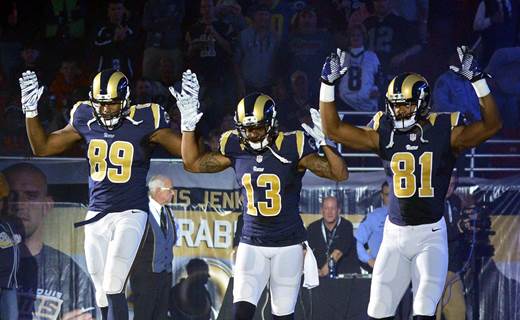
Three of the five Rams players taking the field.

It happened Sunday afternoon. I tried to avoid writing about it, not wanting to be distracted from the bigger picture or detract from what I thought—and still think—the most important stories and issues are. But it hasn’t gone away. With this morning’s headlines and so many references to the image I spent several years of my life researching and writing about, I think I have to say something.

I’m talking, of course, about how five members of the St. Louis Rams football team entered the stadium before their game this weekend with their arms and hands raised, enacting the “Hands Up, Don’t Shoot” pose that has become such a powerful symbol and statement for protesters in Ferguson, Missouri and all over the country.

Let me say, right off the bat, how much I respect and admire the Rams players—Tavon Austin, Kenny Britt, Stedman Bailey, Jared Cook, and Chris Givens—for what they did. Like their coach Jim Fischer, I defend their right to free speech. Perhaps even more than he can or would say, I celebrate their vision and courage, with respect both to their awareness and understanding of the broader social issues involved as well as to how they figured out a way to use their status as athletes to contribute to that conversation. Their use of the hands-up pose was a stroke of symbolic genius that allowed these men, who make their living with their bodies, to speak volumes without actually saying a word. I see them in the proud tradition of Tommie Smith and John Carlos, who in 1968 used the platform afforded them as Olympic champions to call attention to ongoing problems of race and racism in the United States. (Their clenched-fist, victory stand demonstration in Mexico City, the iconic image that has appeared in many media outlets over the past couple of days, is the inspiration and focus of my book Race, Culture, and the Revolt of the Black Athlete.)

Hartmann bookBut lots of people don’t see it this way. Predictably, there has been a backlash against the Rams players, led or at least crystallized by the St. Louis Police Officer’s Association who called the gesture “tasteless, offensive, and inflammatory,” calling for an apology from the players and disciplinary action from the NFL. Some of these criticisms are driven by disagreements with the players’ views and perceived politics. I’m actually okay with that (though I’m probably more on the players’ side than the critics). In fact, a real, meaningful conversation about the incident and subsequent events and larger social and racial issues in and around Ferguson that provoked this demonstration in the first place would be a very good result. Yet that doesn’t seem to be what is happening. Instead, judging by their official statement, the police group seems to continue to see black people and bodies as a threat in need of constant management, policing, and control, all of which maps onto the dynamics between the NFL and its predominantly black workforce.

At a broader level, too much of the reaction to the Rams is driven by the sense that this display was objectionable because it was somehow out of place, because it occurred in the athletic arena. This really rubs me the wrong way, and not only because I firmly believe that athletes, like anyone else, have a right to their opinion and the opportunity to express that opinion freely and publicly. I get frustrated with this response because so often the sporting world is used and/or functions to promote, celebrate, rationalize, and legitimate all kinds of social causes, religious beliefs, and political issues—nationalism, military service, breast cancer awareness, the power of prayer and faith, etc. I don’t see why some social issues are allowed pride of place in the sports arena, while others are not, how some athletic figures are allowed to speak up and even spout off, while others are consistently chastised and silenced. There are clearly double standards often at work here, especially with respect to what is seen as protest or complaint against the mainstream majority.

One of the things that is driving me crazy about my various Facebook networks and Twitter feeds is that so many of the folks who have been critical of the Rams players are the same folks who have been calling for activists, African American and otherwise, to protest peacefully, to express their frustrations about Ferguson without resorting to violence and disorder. Isn’t this exactly what these athletes were doing? As John Carlos himself told the Associated Press: “I don’t think anyone got injured or shot by [the Rams players] expressing emotions.”

The Miami Heat released this protest image as part of the "hoodie" protests following the death of Trayvon Martin.
The Miami Heat basketball team in a protest image posted on LeBron James’s Twitter account following the death of Trayvon Martin.

This morning’s news on this football affair has been driven by the question of whether there was an apology by the Rams or not, with the police folks claiming that “regret” had been “expressed,” while the athletes have refused to back away from their actions and statements. “Did they apologize or not,” were the breathless lines spoken by television reporters as they worked their way through the conflicting hashtags and tweaks. Although I’ve spent much of my professional life thinking about sports, race, politics, and social change, this is exactly the kind of side-show I was afraid of—where talk about athletes and symbolic gestures and official demands becomes the focus of the conversation. The result is that public attention, our attention, is deflected away from the real issues—the deeper social problems of police use of force, of racial disparities in the criminal justice system, of pervasive and persistent racial inequities in contemporary America, and the ongoing scourge of racism itself—that should be the focus of the still-unfolding stories and lessons and (hopefully) reforms coming out of Ferguson. But of course these deeper social realities are precisely what protestors and demonstrators and activists are trying to remind us of and keep our attention focused upon. Even if we don’t agree with their perspectives, conclusions, or suggested solutions, we would do well to honor their effort.

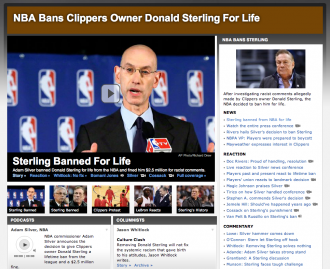
The ESPN.com homepage on 4/30/2014

Or: On Snark and Solutions

Eds note: This is a guest post from Max Fitzpatrick of Central New Mexico Community College and the University of New Mexico.

Recently there has been a lot of righteous finger-wagging at racist comments uttered by older white personalities. When celebrity chef Paula Deene, Los Angeles Clippers owner Donald Sterling, and rebellious rancher Cliven Bundy spoke bad words about black people, mainstream and social media pounced.

Deene and Sterling are economic elites who have made fortunes employing black labor and selling black culture. It is sadly ironic that they disparage the very group whose alienated labor they exploit and whose culture they have commodified. But the popular criticism of their racist statements has not approached such a systemic analysis—remaining instead at the surface level of the individual. The uproar chastises these people as racist celebrities, when the real danger is that they are authority figures presiding over economically powerful institutions with broad cultural influence. Racism matters most when it is combined with power. But the internet snarkfest has avoided that point almost entirely. more...

RU013114This week, on The Editors’ Desk*, Doug Hartmann enumerated and tried to define** six elements of the sociological worldview. Elsewhere on The Society Pages, our many contributors worked to demonstrate that worldview—enjoy!

*That’s right: we all share one desk. It’s adorable. Possibly even adorkable.

**See what I did there? The man never met a conjunction he didn’t like. more...

RU011714

Sign up for the new Friday Roundup Newsletter!

From Sport to Voting Rights

This week The Society Pages checked out gender stereotyping and toys, how we communicate our tone online (but really don’t want to talk on the phone), a whole collection of photoshop in the media, fatherhood and race, and we learned a thing or two from our Nordic friends. Enjoy! more...

RU120613This week we played around with #socgreetings, got excited to see movers and shakers talking about the We Are All Criminals project, and mourned rabble-rousing change-maker Nelson Mandela while hoping those he inspired would continue bending the arc of history… and society. Here’s what else we got up to. more...