social movements

New & Noteworthy

More from our Partners & Community Pages

Council on Contemporary Families

First Publics

Give Theory a Chance [podcast]

Backstage with TSP

  • TSP is easing back into regularly scheduled programming while our board continues to manage stressors related to federal presence in the Twin Cities. Thank you for bearing with us as we navigate new developments.
  • Anastasia Dulle is our newly minted Graduate Editor. She joins Doug and Chris leading TSP operations.
  • The alliteration is back! The “TSP Friday Roundup” is rebranding as “TSP Tuesdays” to accommodate board members’ schedules this semester.
  • Anastasia will work with board member Sara Kadoura to bring you the latest from TSP and our partners every week.
New & Noteworthy

From the Archives

  • The largest annual conference on climate change – the COP30 – kicked off in Brazil this week with 190 countries participating. 2024 was the warmest year on record. Our 2019 piece provides pointers on how to teach students to think sociologically about climate change. {2 min read}
  • This week, many observed Veterans’ Day in honor of the service of US military veterans. This 2019 article looks at cumulative impacts on veterans health including the psychological impacts of exposure to combat as well as the difficult and often unsupported transition from service back to civilian life. {3 min read}

More from our Partners & Community Pages

Council on Contemporary Families

New & Noteworthy

Instagram Activism and Black-Asian Solidarity by S Ericson covers research by Rachel Kuo and Sarah J. Jackson and how Black and Asian activists in 2020-2021 used Instagram to draw on historical cross-racial solidarity, challenging media stereotypes and fostering shared memory to advocate for change.

This week’s Clippings by Mallory Harrington covers recent sociology and sociologists in the news, including the failure of prisons to protect incarcerated people during natural disasters, the evolution of pregnancy depictions in media, how digital aesthetics helped Donald Trump connect with diverse online communities, and Brazil’s Black Consciousness Day spotlighting the country’s slow progress toward racial representation.

Our latest podcast episode, produced by Forrest Lovette, featuring Mallory Harrington and Emma Goldstein discuss Tressie McMillan Cottom recent opinion piece in The New York Times on the connection between tradwives, podcast bros, and wellness influencers and Donald Trump’s recent election win.

From the Archives

Trump’s cabinet picks, including Dr. Mehmet Oz and Fox News presenter Pete Hegseth, highlight the overlap between reality TV and politics, where both rely on performances that blur lines between entertainment and serious decision-making. Check out this 2010 parallel between financial markets and the “classic” Jersey Shore by Lisa Wade.

Two transgender women were attacked at a Minneapolis light rail station last week and the onlookers apparently cheered on their group of attackers rather than helping. The Southern Poverty Law Center reported that hate crimes spiked after the election of Donald Trump in 2016, as covered in this Sociological Images piece from 2016 – and we may see another 2024 surge.

Backstage with TSP

To celebrate our many hours of hard work in 2024, we are planning on a pickleball party this December. With varying degrees of pickleballing experience, it will certainly be memorable. Stay tuned for pictures on X, Bluesky, and Facebook.

More from our Partners & Community Pages

Contexts

Council on Contemporary Families

Sociological Images

  • Who’s Not Cool With AC? by Evan Stewart highlights how public perceptions of air conditioning as a luxury, tied to racialized stereotypes about aid “deservingness,” pose challenges for policymaking on cooling access, especially with climate change.

New & Noteworthy

Tressie McMillan Cottom (Associate Professor at the University of North Carolina’s School of Information and Library Science) wrote an opinion piece for The New York Times in the aftermath of the presidential election. “[T]his election was about enthusiasm and diagnoses. The long-term trajectory of our country has not changed. Millions of middle-class people feel working-class. These Americans have no way to describe what is happening to them,” Cottom described. “Nature abhors a vacuum. But political opportunists thrive in vacuums. This election was about who told a better story about the fundamentals without promising anything to fix those fundamentals. That is the sweet spot for an opportunist like Trump and his party. Sell everything, promise nothing. Keep them coming back for more.” Cottom was also recently on The Daily Show.

From the Archives

The 2024 election has left women’s health in an even more uncertain place, as seen with the failure of pro-abortion ballot measures in three states and Trump’s remark that vaccine skeptic RFK Jr. would “work on women’s health” in his administration. The root of poor health outcomes for U.S. women isn’t just medical—it’s systemic. Inequities shape everything from research that sidelines women’s needs to restrictive laws that worsen health outcomes for all. Check out this post from the Council on Contemporary Families to learn more about the deep-rooted issues impacting women’s health in the U.S. and what is required for real change.

On Wednesday afternoon two people started a demonstration at Texas State University, holding signs and wearing shirts that said “women are property” and “homo sex is sin”. The demonstration sparked a counter-protest of hundreds of students, and images and videos of the demonstration quickly went viral. This 2017 Contexts piece talks about the importance of the media in increasing the reach and impact of protests.

More from our Partners & Community Pages

Contexts:

  • paying attention. period. by Sophie X. Liu on research by Rita Jalali on menstrual health and hygiene (MHH) and how it has been largely neglected in global health agendas due to challenges in measurability and enduring social stigmas, highlighting how inequality within social movements has sidelined issues affecting economically disadvantaged communities.

Council on Contemporary Families

New & Noteworthy

Colleges, administration, and professors across the United States are responding to student organizing around the conflict in Gaza. In light of this organizing, we compiled 6 pieces from us and our partners to read on student organizing.

First Hand Faculty Experiences on Campus Issues

  • Mass Movements; Moral Moments by Donna Gabaccia reflects on her first-hand experience as a faculty member during an incident of police abuse in Minneapolis, recalling a distressing scene where a young Black teenager was unjustly detained by police in a library.

Young Adults and Social Structure of Protests

  • When Youth Become Activists by Amber Joy Powell writes up some research on the nationwide youth-led movement advocating for stricter gun control in 2018, demonstrating the significant impact young activists can have using modern tools like social media to enhance their cause.
  • in brief: close to the issue by Parker Muzzerall on how proximity to protests, such as the Occupy Central Movement in Hong Kong, increases support for the movement and shifts political ideologies leftward among nearby residents, despite the disruptions caused.

Challenges of Involving Police

Public Opinion and Tolerance (or lack of) on Campus Protests and Academic Freedom in Sociology

Turning to Clippings, this week includes Erin Cech and Elana Goldenkoff‘s article for The Conversation assessing how prepared engineers are to face ethical dilemmas regarding AI,  Richard Ocejo in the Times Union on his new book Sixty Miles Upriver: Gentrification and Race in a Small American City, Robert Bullard‘s recent win of the TIME Earth Award in recognition of his work in environmental justice, and Stephanie Alice Baker‘s article for The Conversation on how wellness influencers are contributing to misleading information about birth control on social media sites. 

And lastly, new from The Conversation, we reposted their new piece by Cheryl Cooky, Is this the dawn of a new era in women’s sports? This piece covers Iowa’s Caitlin Clark and the record-breaking viewership of this year’s women’s Final Four.

Behind the Scenes with TSP

Summer is nearly here! At TSP, this time of year means taking inventory of our current projects and setting new goals for the summer. This summer, we will be posting a TSP Summer Reading List with some recommended summer readings:

More from our Partners & Community Pages

The latest from Contexts:

New posts from the Council on Comtemporary Families include:

When even Michael Jordan—that erstwhile poster child of the transcendent, apolitical, super-star athlete—jumps into the fray, you know something is up. I am referring, of course, to the public announcement Jordan made Monday. Saying he could “no longer stay silent,” legendary #23 pledged to donate $1 million each to a charity for community-police relations and to the NAACP’s Legal Defense Fund. Jordan said, “We need to find solutions that ensure people of color receive fair and equal treatment AND that police officers—who put their lives on the line every day to protect us all—are respected and supported.”

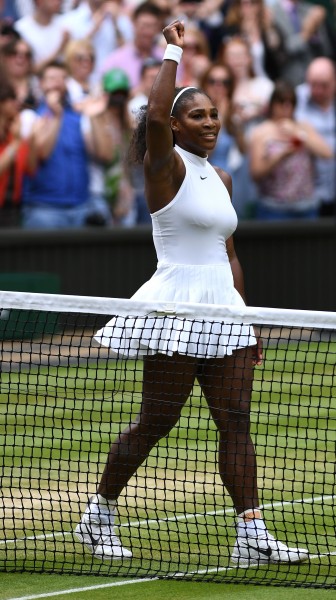
Serena Williams after her 2016 Wimbledon win, via bustle.com.

But Jordan is not the main story here, at least not when viewed in sociological perspective. The main story, the bigger story, is about all of the athletes and sports organizations who have been speaking out about social issues in one way or the other over the course of the past few months: NBA star and American Olympian Carmelo Anthony urging athletes to quit worrying about their endorsement deals and speak out on police killings; tennis player Serena Williams offering support and then a clenched fist salute on the hallowed grounds of Wimbledon; the testimonials of Anthony and fellow NBA stars Chris Paul, LeBron James, and Dwyane Wade at the ESPYs; WNBA players and teams, led by the Minnesota Lynx, dressing in support of Black Lives Matter and against police shootings; the NBA moving next year’s annual All-Star game out of North Carolina because of that state’s LGBTQ politics. My hometown paper, The Star Tribune, ran a whole page story in last Sunday’s sports section about a host of athletes taking social justice stands or actions in Minnesota alone.

Let there be no doubt: we live in a new era of athlete awareness and advocacy, unlike anything we’ve seen since the late 1960s.

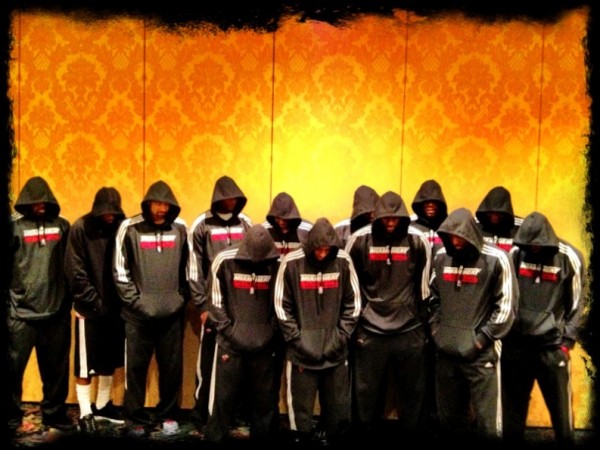
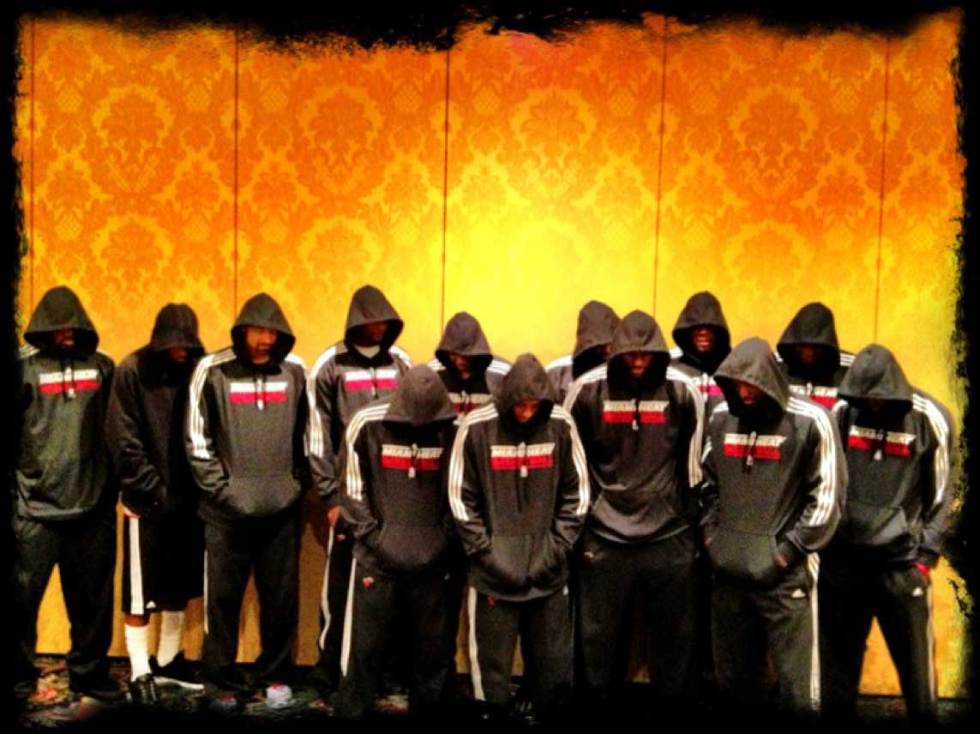
LeBron James and the Miami Heat in 2012, hoods raised and heads bowed in memory of Trayvon Martin.

I believe the roots of this new movement can be traced to LeBron James and his Miami Heat teammates tweeting out a picture of themselves in hoodies, with heads bowed in support of Trayvon Martin, a few years back (see also). Others recall when the entire Phoenix Suns team wore jerseys in solidarity with Latinos who felt threatened by proposed anti-immigration legislation in Arizona. Since then, we’ve seen NBA players like Chris Paul threatening to boycott the NBA All-Star Game unless something done to disavow the blatant racism of then-owner Donald Sterling; St. Louis Rams football players entering the field in the “hands up” gesture of Ferguson protestors; and, perhaps most amazingly, the University of Missouri football team using the threat of a boycott to force the removal of their university’s president.

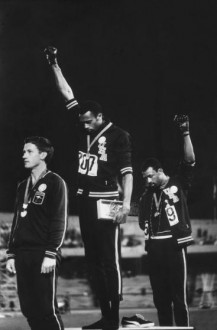
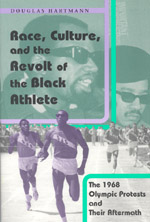
Hartmann coverAs a scholar who’s done a good bit of work on sport and race and social unrest and social protest over the years—including a book on the 1968 African American athletic protest movement, the activism associated most famously with Tommie Smith and John Carlos’s iconic victory stand demonstration in Mexico City—I’ve been asked a lot of questions and invited to make a lot of presentations on athlete activism over the past year. So, as all of this has been unfolding, I’ve begun work on a paper situating the most recent activism and advocacy in the context of the protests of the Civil Rights era. Below, a few of the points I’m building the paper around:

  1. Athlete Awareness. While public advocacy may be new, social awareness among athletes is not. Athletes, especially elite professional and Olympic athletes, have long been far more educated, intelligent, and aware than prevailing if outdated “dumb-jock” stereotypes allow. The problem, in my view, has not been lack of social awareness and understanding, but barriers to public expression. Anthony has referenced highly lucrative endorsement deals (sometimes offering more renumeration to players than their actual sporting endeavors do), but formal and informal league rules, organizational pressures, and norms about the public roles of athletes all also apply. If there is a new consciousness, in my view, it involves a revitalized understanding of the powerful platform that sports provides athletes who are so inclined to voice their opinions.
  2. Larger Context and Connections. Those athletes who have chosen to use their status as public figures to speak out on social issues are not just speaking off the cuff, nor are they isolated malcontents. These public expressions are deliberate and reflective, responding to social issues such as police brutality and profiling or hateful gender or sexuality policies outside of the world of sport, in concert with other public leaders, and more often than not in close communication with other activists and organizers. Perhaps the best and clearest example of this was at the University of Missouri last fall: football players launched their boycott after working with campus leaders on ways to show their support for student on a hunger strike in protest of racial conditions and treatment on campus.

  3. Black Athletes as Leaders. It almost goes without saying that African American athletes have been the most prominent and powerful figures in this emerging movement (I think all but one of the athletes profiled by the Star Tribune were persons of color)—except that in our perverse “colorblind” culture, we often dodge the opportunity to name race explicitly and talk about it openly. This conversation is important for far more reasons than I can discuss here; it speaks to the unique racial composition of the American sports world, the prominent role of African American athletes in our culture, the centrality of race and racism in American society, and the larger role of sport in the construction, reproduction, and contestation of existing racial hierarchies. At the most basic levels, though, we can consider how sport is both impacted by and a driving force in the larger racial unrest in contemporary America—including the recognition of persistent patterns of racial injustice, emergent movements of resistance and opposition (such as Black Lives Matter), and the countervailing, reactionary movements of containment, denial, and resentment. The role of white athletes will be interesting as today’s movements unfold. At the University of Missouri, white players and coaches supported black activists, and, in the WNBA, star Minnesota Lynx point guard Lindsay Whalen and head coach Cheryl Reeves, both white, lent their support to protesting players. Whether white athletics and athletic leaders continue to step up and assume responsibility remains to be seen. For what it is worth, I’m impressed though not at all surprised the female athletes–including a huge swath of the WBNA–have been such powerful public voices in recent weeks.

Will this advocacy and activism change anything?

Via Time Magazine, the 1968 Olympics victory stand salute.

The initial answer is not always encouraging. If my study of the 1968 Olympic protests taught me anything, it is that sport protests usually do not change anyone’s mind or political position. Though we tend to heroize Smith and Carlos these days (as we did with the recently deceased Muhammad Ali), the truth is that these athlete advocates were seen as villains and traitors by mainstream Americans in the 1960s. If anything, their actions inspired a good deal of backlash and resentment, probably hardening some lines of conflict and division. Some of that reaction is already unfolding now.

But this doesn’t mean that nothing at all came of athlete activism in the past or today. One of the things that athletic protests and demonstrations can accomplish is forcing Americans who are or were not otherwise interested in such issues to look up from their otherwise comfortable, apolitical lives and pay attention to the social issues around them. So athletic advocacy can, in fact, play an important role in bringing issues of social injustice—police bias and brutality, policies toward LGBTQ Americans—to broader public visibility and debate. I believe it’s already happening.

And all of the money and attention we lavish on athletes and athletics in this country does put athletes in a unique and, on occasion, powerful material position. Witness the events at the University of Missouri: here, we saw athlete activists and their allies using the power afforded to them by virtue of how the institution and the public rely upon them for their athletic performances to force concrete, organizational change. This was amazing, revealing, and essentially unprecedented.

One final point on social and cultural change. When harkening back to 1968, I constantly find myself remembering and trying to remind others that Smith and Carlos not only didn’t change many people’s minds about race problems and civil rights, they didn’t change American norms about the relationships between sport and social change. If fact, they and their allies (as well as their opponents) were caught within prevailing conceptions of sport as a somewhat special, sacred, or apolitical cultural space. To wit: while some saw athlete activists in the 1960s as heroes or villains, public opinion polls showed that most everybody agreed that sport wasn’t a place for politics or, by extension, protest. The two sides simply disagreed on what counted as protest and politics. Those who sided with Smith and Carlos saw them as standing up for what was good, right, and morally just—in the idealistic way that high-minded sport supporters have long celebrated sport; the majority who were against them saw them and their actions as disruptions outside the social status quo.

What is at stake here is not just whether we agree with the particular causes of athlete activists. What is also at stake is how we understand sport and athletes in society, especially when it comes to issues of racial justice and social change. Will the cultural stereotypes about athletes change? Can we begin to see sport as something more than an arena for entertainment and release, or some kind of apolitical sacred space? If social change is hard, sometimes cultural change is even harder—so on those questions, I remain cautious and curious.

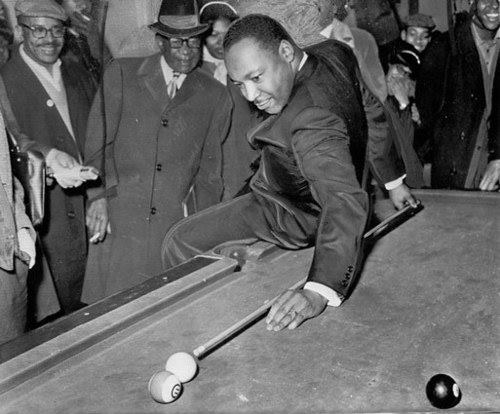
Via Joe Soss on Facebook.

On Facebook, today, scrolling through my friends’ posts, I spotted U of M professor Joe Soss’s post featuring an eye-catching photo of the Rev. Dr. Martin Luther King, Jr. hot-dogging it at a pool hall, accompanied by the following quote:

“We must recognize that we can’t solve our problem now until there is a radical redistribution of economic and political power… this means a revolution of values and other things. We must see now that the evils of racism, economic exploitation and militarism are all tied together… you can’t really get rid of one without getting rid of the others… the whole structure of American life must be changed” (MLK, report to SCLC staff, May 1967).

And I loved Soss’s gloss on the photo: “I bet,” Soss wrote, “he sunk that pool shot too.

The day and the photo got me thinking. I had just done a television interview about how Minnesota was recently ranked as the least racially integrated state in the nation by a financial services website. After making the usual comments about being cautious about state-by-state comparisons, particularly about gaps and changes over time, I talked to the reporter about how Minnesotans’ general sense of themselves as relatively successful in terms of racial harmony and our sometimes self-satisfied liberalism can get in the way of our fully recognizing and then really addressing, in policy and social action, racial inequality problems in our state, especially those pertaining to African Americans.

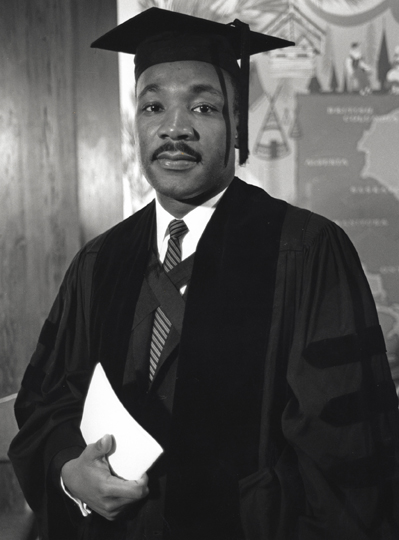
Not all of my comments made it into the piece (see actual story here), and afterwards I found myself thinking back to that most famous of sociology majors, Dr. King (see below for a great photo Soc Images spotted on the HBCU website, dated 1948) and his Letter from a Birmingham Jail. In it, he writes that he believes white moderates are among the greatest obstacles to his vision of change. One passage reads:

…I must confess that over the past few years I have been gravely disappointed with the white moderate. I have almost reached the regrettable conclusion that the Negro’s great stumbling block in his stride toward freedom is not the White Citizen’s Counciler or the Ku Klux Klanner, but the white moderate, who is more devoted to “order” than to justice; who prefers a negative peace which is the absence of tension to a positive peace which is the presence of justice; who constantly says: “I agree with you in the goal you seek, but I cannot agree with your methods of direct action”; who paternalistically believes he can set the timetable for another man’s freedom; who lives by a mythical concept of time and who constantly advises the Negro to wait for a “more convenient season.” Shallow understanding from people of good will is more frustrating than absolute misunderstanding from people of ill will. Lukewarm acceptance is much more bewildering than outright rejection.

I had hoped that the white moderate would understand that law and order exist for the purpose of establishing justice and that when they fail in this purpose they become the dangerously structured dams that block the flow of social progress. I had hoped that the white moderate would understand that the present tension in the South is a necessary phase of the transition from an obnoxious negative peace, in which the Negro passively accepted his unjust plight, to a substantive and positive peace, in which all men will respect the dignity and worth of human personality.

Many years later, many protests and rallies and elections later, America remains torn between high-minded colorblind ideals and persistent racial inequalities, while white Americans have the easy option and privilege of just living with the status quo. Maybe if I had quoted Dr. King directly, I could have made that point even stronger.

Via HBCU. Click for original.

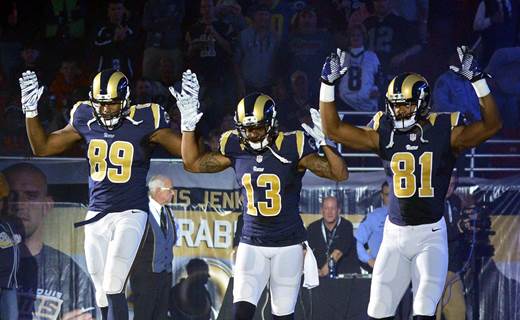
Three of the five Rams players taking the field.

It happened Sunday afternoon. I tried to avoid writing about it, not wanting to be distracted from the bigger picture or detract from what I thought—and still think—the most important stories and issues are. But it hasn’t gone away. With this morning’s headlines and so many references to the image I spent several years of my life researching and writing about, I think I have to say something.

I’m talking, of course, about how five members of the St. Louis Rams football team entered the stadium before their game this weekend with their arms and hands raised, enacting the “Hands Up, Don’t Shoot” pose that has become such a powerful symbol and statement for protesters in Ferguson, Missouri and all over the country.

Let me say, right off the bat, how much I respect and admire the Rams players—Tavon Austin, Kenny Britt, Stedman Bailey, Jared Cook, and Chris Givens—for what they did. Like their coach Jim Fischer, I defend their right to free speech. Perhaps even more than he can or would say, I celebrate their vision and courage, with respect both to their awareness and understanding of the broader social issues involved as well as to how they figured out a way to use their status as athletes to contribute to that conversation. Their use of the hands-up pose was a stroke of symbolic genius that allowed these men, who make their living with their bodies, to speak volumes without actually saying a word. I see them in the proud tradition of Tommie Smith and John Carlos, who in 1968 used the platform afforded them as Olympic champions to call attention to ongoing problems of race and racism in the United States. (Their clenched-fist, victory stand demonstration in Mexico City, the iconic image that has appeared in many media outlets over the past couple of days, is the inspiration and focus of my book Race, Culture, and the Revolt of the Black Athlete.)

Hartmann bookBut lots of people don’t see it this way. Predictably, there has been a backlash against the Rams players, led or at least crystallized by the St. Louis Police Officer’s Association who called the gesture “tasteless, offensive, and inflammatory,” calling for an apology from the players and disciplinary action from the NFL. Some of these criticisms are driven by disagreements with the players’ views and perceived politics. I’m actually okay with that (though I’m probably more on the players’ side than the critics). In fact, a real, meaningful conversation about the incident and subsequent events and larger social and racial issues in and around Ferguson that provoked this demonstration in the first place would be a very good result. Yet that doesn’t seem to be what is happening. Instead, judging by their official statement, the police group seems to continue to see black people and bodies as a threat in need of constant management, policing, and control, all of which maps onto the dynamics between the NFL and its predominantly black workforce.

At a broader level, too much of the reaction to the Rams is driven by the sense that this display was objectionable because it was somehow out of place, because it occurred in the athletic arena. This really rubs me the wrong way, and not only because I firmly believe that athletes, like anyone else, have a right to their opinion and the opportunity to express that opinion freely and publicly. I get frustrated with this response because so often the sporting world is used and/or functions to promote, celebrate, rationalize, and legitimate all kinds of social causes, religious beliefs, and political issues—nationalism, military service, breast cancer awareness, the power of prayer and faith, etc. I don’t see why some social issues are allowed pride of place in the sports arena, while others are not, how some athletic figures are allowed to speak up and even spout off, while others are consistently chastised and silenced. There are clearly double standards often at work here, especially with respect to what is seen as protest or complaint against the mainstream majority.

One of the things that is driving me crazy about my various Facebook networks and Twitter feeds is that so many of the folks who have been critical of the Rams players are the same folks who have been calling for activists, African American and otherwise, to protest peacefully, to express their frustrations about Ferguson without resorting to violence and disorder. Isn’t this exactly what these athletes were doing? As John Carlos himself told the Associated Press: “I don’t think anyone got injured or shot by [the Rams players] expressing emotions.”

The Miami Heat released this protest image as part of the "hoodie" protests following the death of Trayvon Martin.
The Miami Heat basketball team in a protest image posted on LeBron James’s Twitter account following the death of Trayvon Martin.

This morning’s news on this football affair has been driven by the question of whether there was an apology by the Rams or not, with the police folks claiming that “regret” had been “expressed,” while the athletes have refused to back away from their actions and statements. “Did they apologize or not,” were the breathless lines spoken by television reporters as they worked their way through the conflicting hashtags and tweaks. Although I’ve spent much of my professional life thinking about sports, race, politics, and social change, this is exactly the kind of side-show I was afraid of—where talk about athletes and symbolic gestures and official demands becomes the focus of the conversation. The result is that public attention, our attention, is deflected away from the real issues—the deeper social problems of police use of force, of racial disparities in the criminal justice system, of pervasive and persistent racial inequities in contemporary America, and the ongoing scourge of racism itself—that should be the focus of the still-unfolding stories and lessons and (hopefully) reforms coming out of Ferguson. But of course these deeper social realities are precisely what protestors and demonstrators and activists are trying to remind us of and keep our attention focused upon. Even if we don’t agree with their perspectives, conclusions, or suggested solutions, we would do well to honor their effort.

What a night. What a disturbing, terrifying, disconcerting night. A questionable grand jury process. Explanations and pushback. Protests. Police, lots of police. Media everywhere. Some looting and violence. Gas and smoke. Images of burning buildings and cars—fiery images that seem to be on a continuous loop this morning, this difficult morning after. How to make sense of it all? What to say? What to do?

I looked to and start with the President, President Obama, our President. The President’s words last night, in the immediate aftermath of the release of the grand jury decision, were measured, subdued, and multifaceted—begging for peace, pleading for calm and, more importantly, trying to get folks from all different sides with such divergent reactions to better understand each other. I saw our leader trying to explain why, on the one hand, we must respect the rule of law, our law enforcement agents, and the workings of the criminal justice system–as well as why, on the other hand, we need to understand, really understand, why there is so much anger and frustration and resentment from so many. It was very typical Obama—trying, cautiously and stoically, to be that voice of compassion and understanding, that bridge across racial and ideological and political lines, subtlety appealing to our common humanity, our bigger ideals, our better angels.

As a sociologist and a citizen, I found myself deeply sympathetic and aligned. In fact, it is probably the kinds of things I would have said if I had I been in the President’s shoes or on his speech writing team. Although I would have probably developed and further specified the deep and historical sources of anger and frustration—not only with respect to racial disparities and injustices within the criminal justice system at all levels, but also the legacies of segregated housing and lending polices, the realities of poverty, poor education, and unemployment, the persistence of so many stereotypes and racially charged images and rhetoric—I still would have asked for some kind of balance and some larger peace and understanding. In fact, much as Todd Beer in his SocSource/TSP post from earlier in the fall on “Teaching Ferguson,” I still believe that these deeply racialized and even racist historical forces, institutional policies, and contemporary realities—and the very different ways in which they are perceived and understood (or ignored or disavowed)—are crucial to both understanding and explaining both Ferguson the town and Ferguson the cultural firestorm. And this broader historical context and social conditions are all too often missing from media coverage, political discourse, and public understanding with their focus on the specific case in its immediacy and its concreteness. This in mind, I probably also would have also talked about the profound, deeply sociological challenge of confronting obvious, patterned, and systemic inequities of race in both the criminal justice system and the society at large without losing sight of the fact that the specifics of any given incident, event, or case are unique, may not stand in microcosm for the whole, and are probably not the appropriate focus for systemic, institutional change.

But the problem is that all of this, at least as I was watching last night and trying to think it back through this morning, is a little too measured, a little too dispassionate. Part of this is that the whole abstract language of a multi-point, multifaceted analysis and perspective is a little bit too communitarian. That is, it is too heavy on the language of common understanding of our mutual situation when what we are really talking about is the extremely divergent reactions and response of very different and indeed radically polarized communities. There are specific sides and radically different perspectives here, and the stakes require responding to them on their own grounds. Ultimately, however, I think this response–both the President’s and my own—is unsatisfying at the moment, because it is too much about analysis and understanding, and not enough about action, response—what to do and who will lead. Too often the call for calm, clear thinking analysis and understanding—no matter how accurate, no matter how potentially useful—never gets to the next step. Good sociology, in short, does not always make meaningful leadership, much less transformative response and meaningful change.

Ezra Klein’s Vox column this morning (“Why Obama won’t give the Ferguson speech his supporters want”) helped give me a better sense of why Obama gave the speech he did. He is capable of more. Indeed, he did more–much more–on the campaign trail leading up to his historic ascendence to the presidency. But now, as President, he is in a different position. Obama’s challenge is not so much that he needs to try to speak to and represent the nation as a whole. Obama’s challenge right now, according to Klein, is that in our polarized political climate—and no figure is more polarizing than the President, according to the political scientists—anything Obama says on any given issue or cause, any specific position he takes or policy he argues for, tends to be damaging to the cause or any allies he may have. Obama and his advisors have—rightly, it would seem—realized that he is hemmed in and it is better for him to take a middle ground rather than inflame passions yet again. (Immigration, of course, is the exception to this, the arena where Obama and his team have decided to take the hit and fight the good fight, but that is a single and quite exceptional case at this point, as much about political position and institutional power as about rhetoric, understanding, and dialogue).

Ultimately, however, I find myself thinking not about Obama’s political challenges but about the limits and indeed pathologies of a dispassionate if accurate sociological response in a moment of such historical crisis and upheaval. Focusing on the roots and conditions as well as on the need for shared, overarching understanding just doesn’t seem like quite enough. Necessary, but not enough.

RU011014This week saw outrage over personal loans offered to Nevada teachers just to buy classroom supplies (for their public school rooms!), a flurry of suggested “great books in sociology” reading lists, 40 years of the War on Poverty, another fight in the toy aisle, and, of course, Canada’s gift to the U.S., the Polar Vortex (we’re particularly sorry for the South… at least we Minnesota types have some snowpants we can dig out of the basement). Enjoy! more...