social media

New & Noteworthy

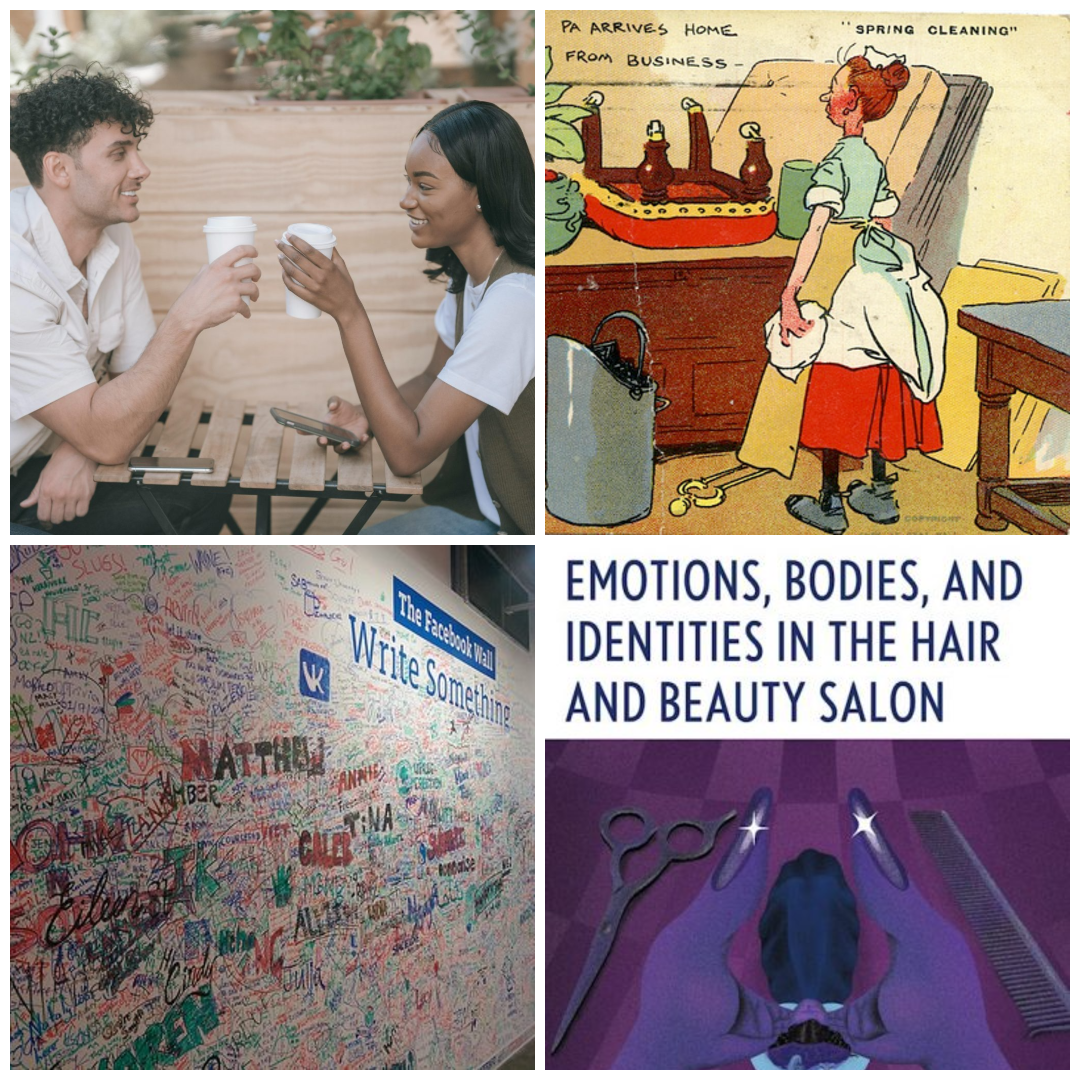
  • How Black Women Navigate Interracial Relationships by Jan-Rose Davis covers a new interview study by Vanessa Gonlin, Chelsey D. Adams, and Elaysha K. Brown. Black women in interracial relationships were often confronted with social tensions rooted in a history of slavery, including accusations of internalized racism from other Black people. {3 min read}

From the Archives

  • Spring has sprung! As we move into the warmer season, revisit this 2016 TROT for research on the sociology of spring cleaning. {3 min read}
  • This past weekend, the Islamic holiday Eid converged with Nowruz, the start of the Persian New Year. Next week, the Jewish holiday Passover will converge with Christian celebrations of Holy Week and Easter. This Discovery from 2016 discusses how social media facilitates exposure to religious diversity, which can in turn impact people’s own religious practices. {3 min read}

More from our Partners & Community Pages

Council on Contemporary Families

New & Noteworthy

From the Archives

  • A measles outbreak at the University of Florida has reached 60 cases. Measles are preventable by vaccines, and were declared eradicated in 2000. This 2015 TROT by Caty Taborda examines how vaccinations have become viewed as a personal choice, to the potential cost of public health. {2 min read}
  • Valentine’s Day was this past weekend! Here’s a 2024 roundup from TSP on sociological research related to love, relationships, and Valentine’s Day itself.

More from our Partners & Community Pages

Council on Contemporary Families

New & Noteworthy

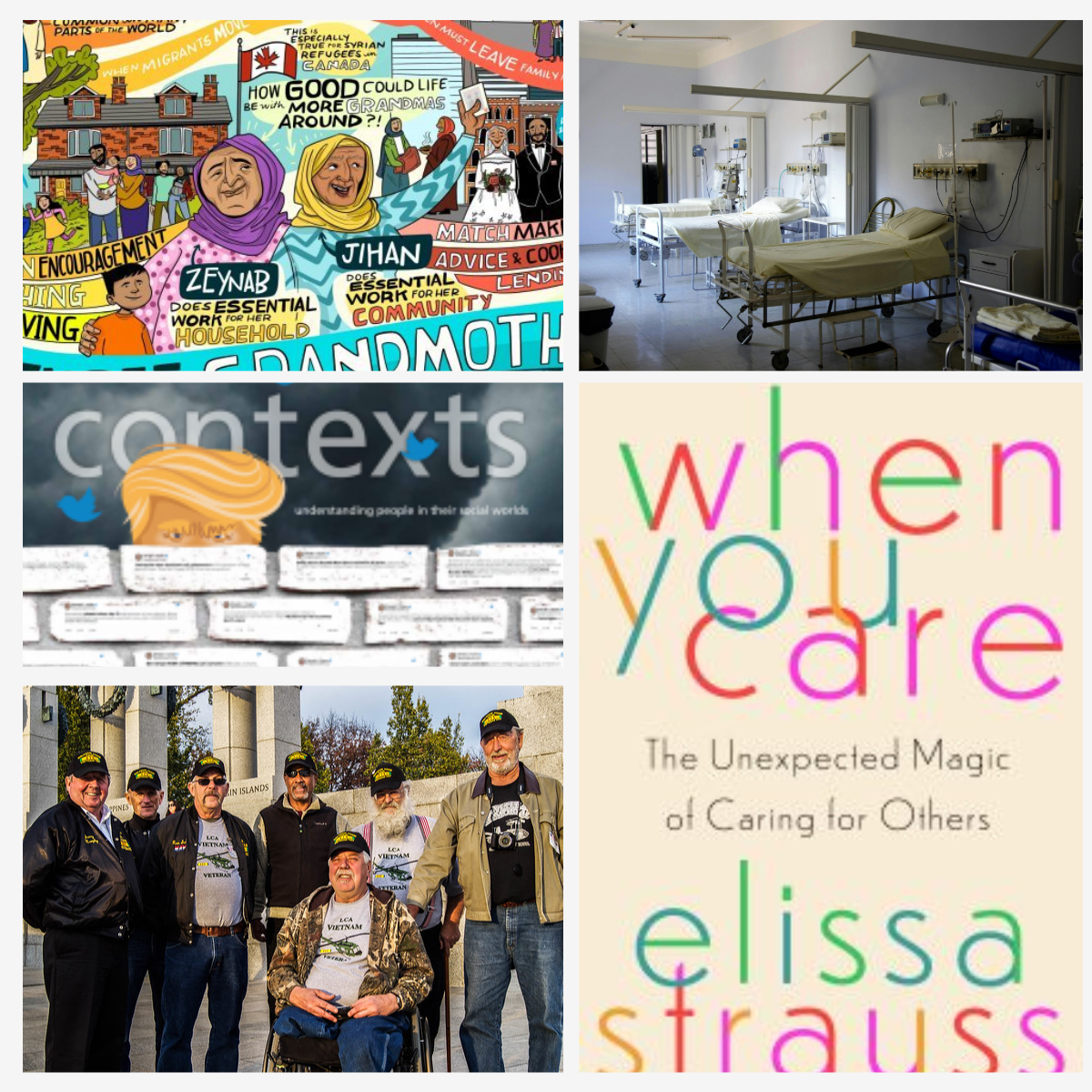
Our new Discovery by Mallory Harrington, Disease Stigma Through the Media covers research by Rachel Best and Alina Arseniev-Koehler. In this piece, the different levels of stigmatization of diseases are investigated via the media coverage and stereotyping that accompanies them. They find that the level of overall disease stigma has decreased over time, but it remains high for behavioral and infectious diseases.

In case you missed it, we posted some new TikToks on the value and importance of sociology via Nicole Schmitgen. Give them a watch, like, and share!

From the Archives

Trump’s trial continues to capture headlines. Take a look back on contexts’ Winter 2018 issue (trump365) on a time where Trump’s policies impacts on society were taking place real-time.

Wars in the Middle East and Eastern Europe continue to leave millions harmed and the impacts will continue far beyond when the bullets stop flying. Read our 2019 Discovery on veteran’s mental health by Allison Nobles to learn more.

More from our Partners & Community Pages

The latest from contexts includes:

  • the case for grandmothers by Neda Maghbouleh on the critical roles and resilience of elder matriarchs in multigenerational Syrian migrant households in Canada, despite immigration policies that often overlook their value.
  • from the corner to the digital street by Parker Muzzerall on research by Yuan Hsiao who finds that real-world interactions and proximity among Chicago’s Latino gangs significantly influence their online conflicts, demonstrating the complex interplay between offline realities and online behaviors.

Council on Comtemporary Families has a new piece:

New & Noteworthy

This week’s Clippings includes Samuel L. Perry‘s work in The Washington Post on new House Speaker Mike Johnson and assault weapons, Carolina Are in El País on sexualization in social media, Carolyn Liebler in The Washington Post on the Census and measuring Americans with Indigenous heritage, and Amin Ghaziani in SciTechDaily on the ambivalence of coming out experiences of LGBTQ adults.

From the Archives

Pain and suffering are commonplace in the news, especially now. Read j. Siguru Wahutu’s TROT on “consuming the pain” through images of the “other” in the media.

Daylight savings time was this past Sunday (in case you haven’t noticed by now). Learn more about the history of Daylight Savings time by reading Lisa Wade’s piece in Sociological Images.

Backstage with TSP

Because of TSP’s growing student board, we have increased the number of “pitches” per week (where students review recent academic articles, write a brief summary, and present the articles to the rest of the board) and “workshops” (where students share their Discoveries drafts on screen and the rest of the board provides feedback real-time). This increased frequency of pitches and workshops will enable us to publish more content in the upcoming months!

More from our Partners & Community Pages

Contexts has a new piece on “dyadic interviewing”, interviewing both young adults and their parent, in research with Elena van Stee, Gaby FloresAriel Chan, and Angelica Qin.

Council on Contemporary Families has a new piece on 7 patterns of women’s journey through motherhood, education, and work through adulthood by Bo-Hyeong Jane Lee and Anna Manzoni.

First Publics has a new Reflections by Michael Kennedy on his teaching journey towards a critical and public-oriented approach.

New & Noteworthy

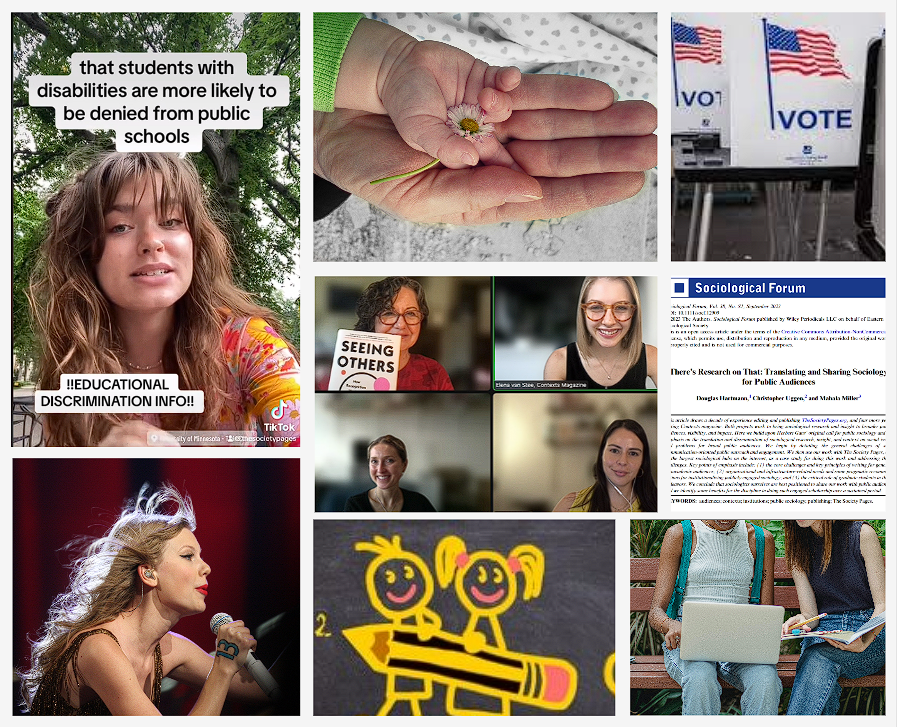
TSP is happy to announce our official TikTok page and our first video by board member Nicole Schmitgen on our TSP discovery Separate, Unequal, and Denied: The Double Discrimination of Black Disabled Students by Ellie Nickel – which are both based on “Not in My Schoolyard: Disability Discrimination in Educational Access,” in the American Sociological Review. Check it out!

Leo LaBarre’s most recent piece, “Child Poverty Prevention Policies and CPS Involvement” covers how poverty policies can impact the level of CPS involvement. This piece covers work by Jessica Pac and colleagues in Social Service Review on different policies’ potential to reduce the national CPS caseload by 669,018.

Citings & Sightings

Evan Steward (former TSP alum) at UMass Boston published a piece in The Conversation about voting patterns and religious affiliations. There were a number of surprising findings (at least to me).

Brian Donovan has been in the news for the sociology course The Sociology of Taylor Swift at The University of Kansas. Read some coverage of this course here and others like it.

Backstage with TSP

At our latest TSP meeting, we assigned “beats” for our board members, or topical areas of sociology that each member keeps a close eye on. This is one way we keep tabs on all the going-ons in the world of sociology. We also premiered our social media team’s latest work, discussed some candidates for potential discoveries, and discussed a recent publication by Dr. Uggen, Dr. Hartman, and our former Graduate Managing Editor Mahala Miller on how we translate research for public audiences.

More from our Partners & Community Pages

Contexts has a new video to watch:

Council on Contemporary Families latest on:

Julian Povey//Flickr CC.

This fall I’ve been working on the address I’m supposed to give as President of the Midwest Sociological Society in Chicago this coming March (23-26). Playing off of our program theme of a year ago, it is tentatively titled: “Sociology and its Publics: The Next Generation.” Among the themes I’ve been reading about and trying to think through are the social conditions and institutional infrastructures of public engagement—and very high on that list are all the new social media forms that began to appear just as the thing we call “public sociology” was beginning to be named and championed by Michael Buroway.

If you are interested in such topics, Kieran Healy has a great piece on social media and public sociology that you should take a look at. It is based on a talk he gave recently at UC–Berkeley.

Almost as if by ESP, Joel Best of the University of Delaware sent me this little reflection he wrote about the evolution of media coverage of his research on fear and Halloween over the years. It seems both timely and appropriate to share (with his permission).

“Experiencing the Death of Print.”

In 1985, I published my research on fears of Halloween sadism, first in a sociology journal and then in Psychology Today magazine. My principal finding—that I could not find any reports of children being killed or seriously injured by contaminated treats received while trick-or-treating—struck the press as newsworthy, and I wound up giving a couple dozen interviews that year.

That was the beginning of a seasonal job. For 31 years, I have fielded late-October calls from reporters at all sorts of media—a few hundred in all, I suppose. The great majority came from newspapers. Typically, a reporter would be assigned to write a story about Halloween safety and, not really knowing how to proceed, she’d often check LEXIS-NEXIS to see what other reporters wrote on the topic the previous year, find me quoted, and then give me a call.

This year had a normal amount of traffic—eight requests for interviews, which covered the usual topics. But there was one difference: I spoke to only one newspaper reporter. All the other interviews were for podcasts, websites, or other Internet-based media.

We hear a lot about the death of print: newspapers and magazines have declining circulations. Young people, in particular, prefer to get their news through electronic means. As a result, newspapers are publishing fewer pages of news and employing fewer reporters to write stories. The inevitable result is fewer feature stories about Halloween safety, and therefore fewer print journalists contacting me. Print journalism may not be dead, but it doesn’t seem that healthy. Once again, Mills has been proven right: the sociological imagination can link my personal experiences to larger public issues.

With a high school senior in the house and the Facebook everywhere, there’s no way I could resist this great little piece from the Social Media Collective. Bonus points for layering in two of my current favorite sociological concepts: diversity and homophily. Give it a read and let me know what you think—especially you high school seniors and college freshmen out there.

(Thanks to Karl Bakeman @wwnsoc for the heads-up on this one !)