public opinion

New & Noteworthy

From the Archives

  • The president’s xenophobic remarks this week renewed political attacks on Somali-Americans. The population is also a target of increased ICE actions in the Twin Cities. This piece – #BlackMuslimsResist: Minnesota Somalis Fight Back – from our partners at the Center for Holocaust and Genocide Studies places this moment in historical context, reminding us how the president’s 2017 “Muslim ban” caused pain and inspired resistance in the Twin Cities. {3 min read}
  • Another TSP article from 2023 highlights how immigration arrests affect the children who witness them, shaping their future relationship with law enforcement. {3 min read}

More from our Partners & Community Pages

Contexts

Give Theory A Chance 

Council on Contemporary Families

  • This week, CCF reprinted a report by Renee Ryberg and Arielle Kuperberg on the thin landscape of financial assistance for student parents enrolled in colleges and universities. The study was published earlier this year in The Journal of Higher Education. {7 min read}
  • Last week, a CCF brief by Zhe (Meredith) Zhang detailed the author’s findings on differences in unpaid caregiving work by gender and sexual identity. The study, by Zhang, Madeline Smith-Johnson, and Bridget K. Gorman, was published last year in Demography. {7 min read}

New & Noteworthy

From the Archives

  • As Hurricane Erin nears the U.S., officials issue emergency warnings. Severe weather doesn’t just damage communities, it leaves lasting impacts on children. Read this 2018 piece to learn more, The Emotional Toll of Natural Disasters by Jasmine Syed.
  • ICE in the U.S. is also, again, capturing headlines. A town in Maine was accused by the Federal Government of “reckless reliance” on the Federal Government’s E-Verify program which was used for hiring a police officer that was recently arrested. However, these pushes for deportations isn’t new and was actually highest during President Obama’s tenure. Read Mass Deportation Isn’t New to learn more.

More from our Partners & Community Pages

And don’t forget to check out the latest from:

Contexts

Council on Contemporary Families

First Publics

Sociological Images

New & Noteworthy

This week’s Clippings includes: Jonathan Rauch wrote in The Atlantic on how Trump’s administration embraces “patrimonialism,” a loyalty-based governing style that breeds corruption. Karyn Vilbig explained in The Conversation how improved views of Black Americans from 2012 to 2020 drove increased support for social welfare programs. The ASA and AFT sued over a federal directive banning race considerations in education, with ASA President Adia Harvey Wingfield warning it harms research and public understanding. Meanwhile, Gallup reports 9.3% of U.S. adults now identify as LGBTQ+, with Jessie Ford telling The New York Times that younger generations see sexuality as a spectrum.

Our new Discovery, Gendered Division of Labor Among the Elite by Daniel Cueto-Villalobos, covers new research by Dr. Jill Yavorsky finding that traditional gender roles remain dominant among the super-rich, shaping broader cultural norms.

From the Archives

Fans have taken to the internet to mourn the deaths of actors Michelle Trachtenberg and Gene Hackman this week. This 2016 piece by Amber Joy Powell explores how the public mourns the death of celebrities, including with online tributes.

A child in Texas died of measles a couple days ago, the first U.S. death from the disease in 10 years. This follows an outbreak of measles in rural communities in West Texas, where rates of opting out of vaccines are high. This piece from 2015, written during a measles outbreak in southern California by Caty Taborda, covers research on the politicization and distrust surrounding vaccines and vaccine refusals.

The imprisoned leader of a Kurdish militant group has urged its members to lay down their arms, potentially putting an end to the organization’s decades-long war with the Turkish government in which 40,000 people have died. Back in 2017, the Kurdish Region of Iraq held an independence referendum. At that time, Dr. John Kendall wrote for the Center for Holocaust and Genocide Studies about the history of Kurdish nationalism.

More from our Partners & Community Pages

Contexts

  • The Winter 2025 issue is available for viewing, covering some soc takes on Trump’s second term, corporations and conservation, VA privatization, and much more!

Council on Contemporary Families

  • A must read opinion reprint from Newsweek by Kirsten Stade, arguing Trump’s expanded Global Gag Rule is the extreme end of a widespread pronatalist ideology that pressures women into childbearing for political and economic gain.

New & Noteworthy

Forrest Lovette‘s new Discovery, Volunteering or Vacationing? covers research by Netta Kahana on the shifting public opinions about combining travel with volunteering activities–practices, known widely as volunteer tourism or sometimes “voluntourism”. The research found that the participants shared positive self-evaluations of their characters and used them to dispel any perceived judgments from society that might be raised about their participation. 

This week’s Clippings includes Zeynep Tufekci in NHPR on organizing pre-post social media, Beth Linker in The New York Times on their new book Slouch: Posture Panic in Modern America, Nicole Kravitz-Wirtz in The New York Times on gun violence and COVID-19, and Jess Carbino on The League dating app in Yahoo! Life.

Backstage with TSP

The TSP board held our end-of-the-year gathering, and celebrated our star graduating undergrads – Leo LaBarre, Caroline Garland, Ellie Nickel (coming back as grad student!), John Purnell, and Nicole Schmitgen. See pics above.

TSP Tuesdays, Clippings, and new Discoveries/TROTs will now be biweekly until September.

More from our Partners & Community Pages

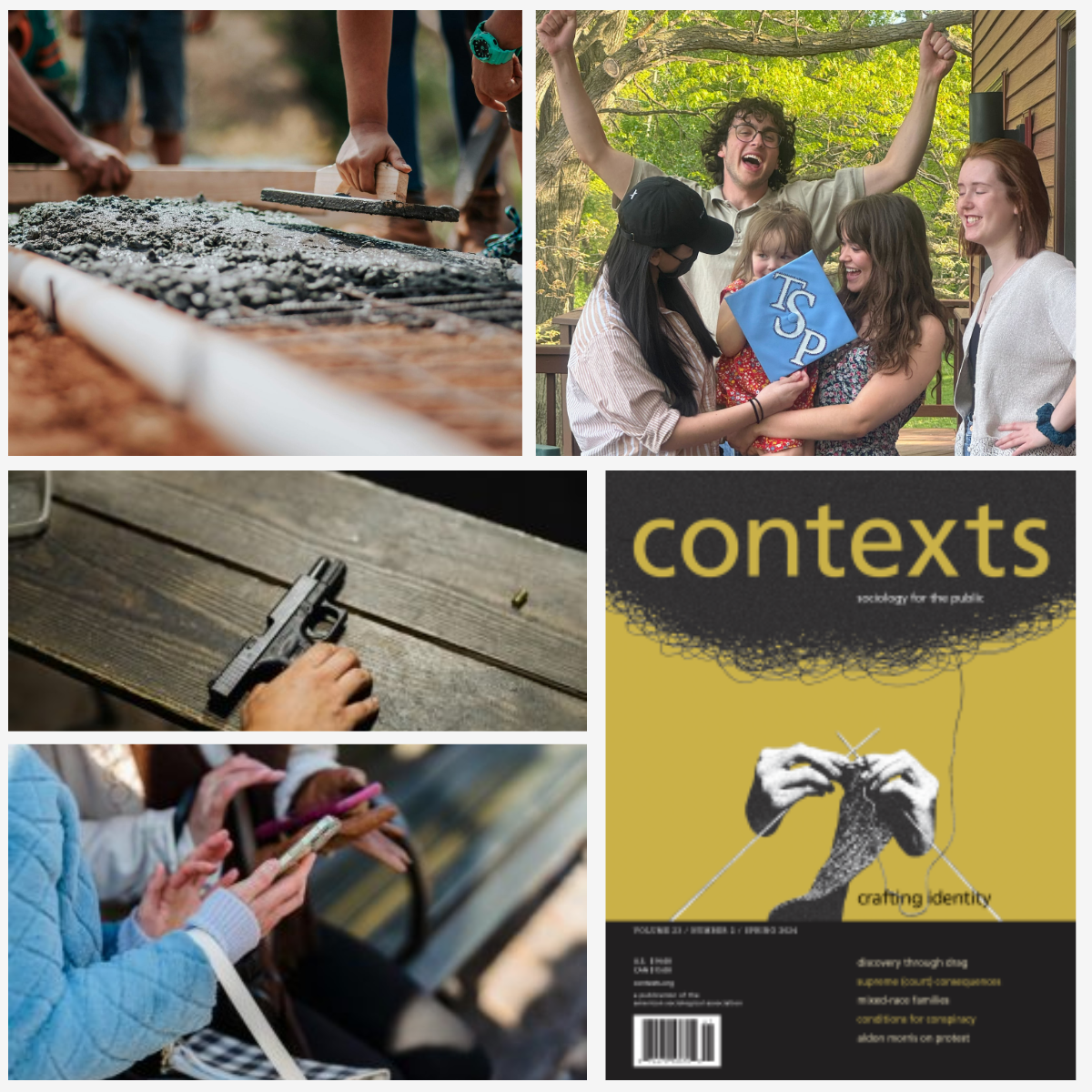
Contexts has its Spring 2024 issue live! It includes (but is not limited to) pieces on the stigmatizing labels faced by sexual violence survivors, the racial pressures on mixed-race families, the social needs driving conspiracy beliefs, and the impact of Twitter/X’s data access cut on global research. Check it out!

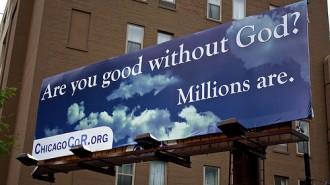
A few days ago the Vancouver Sun ran a story about new Canadian research on the topic of prejudice against atheists in North America. The article’s lead author, Will M. Gervais, told the Sun, “The only group the study’s participants distrusted as much as atheists was rapists.”

The newspaper story implies this is a new finding, but the paper, published in the Journal of Personality and Social Psychology, builds off an article I published with my colleagues Penny Edgell and Joe Gerteis a few years ago in the American Sociological Review. In that paper, part of our ongoing American Mosaic Project, we found that atheists were the least trusted on a long list of racial and religious minorities that we asked about in a representative national survey of Americans. It might not have been the first time this result was reported, but it seems to have been the first and fullest treatment of the anti-atheist phenomenon in the post 9/11 era. (It also resulted in what is perhaps the proudest citation of my scholarly career–and certainly the one my teenagers are most impressed with: p. 62 of Stephen Colbert’s I Am America (and So Can You)!. Colbert compares atheists with homosexuals, whom he says rate higher because at least we trust them with our hair. Okay, so we aren’t as funny as Colbert and weren’t mentioned by name, but the point is to get the work out there, right?)

Anyway, this new JPSP article, co-authored with Azim F. Shariff and Ara Norenzayan, not only confirms our initial findings about the level of anti-atheist sentiment, it takes the research further to explore the social psychological underpinnings of this bias. One important point they make is that anti-atheist bias is not just dislike or distaste, it is active distrust. And, using a series of survey questions designed specifically to probe these mechanisms, the authors are able to show that religious belief is one important factor that seems to be driving this phenomenon. North Americans, it would seem, believe that people behave better if those people think there is a god watching them.

None of this is to say that this is actually true, but, it does seem to be what regular folks think. My hope, as expressed in the original piece with Edgell and Gerteis, is that this work will stimulate better thinking and research not only on atheists, but on the role and significance of religious belief and practice–or lack thereof–in contemporary society.

*Photo by Eric Ingrum via flickr.com (click for original)