politics

New & Noteworthy

From the Archives

  • A coalition of organizations sued the U.S. Department of the Interior following a Presidential executive order that removed an LGBTQ Pride flag from the Stonewall National Monument in New York City and an exhibit about slavery at a national historical park in Philadelphia. Check out this 2016 TROT by Erik Kojola and Jacqui Frost, which contextualizes the importance of telling marginalized stories in the parks which have been shaped by unequal access, racial and cultural norms, and a colonial legacy. {3 min read}
  • In the UK, King Charles’s brother Andrew Mountbatten-Windsor was arrested on suspicion of misconduct in public office following recent news about his affiliation with Jeffrey Epstein. This is the first time a member of the UK royal family has been arrested since the 1600s. This 2019 TROT from Neeraj Rajasekar covers sociological research on the role of media and status in creating scandals. {3 min read}

More from our Partners & Community Pages

Council on Contemporary Families

  • CCF reprinted a Psychology Today article on COVID-19’s gendered impacts on household labor, written by former editor of Gender and Society Barbara J. Risman. {6 min read}


New & Noteworthy

This week’s Clippings includes: Jonathan Rauch wrote in The Atlantic on how Trump’s administration embraces “patrimonialism,” a loyalty-based governing style that breeds corruption. Karyn Vilbig explained in The Conversation how improved views of Black Americans from 2012 to 2020 drove increased support for social welfare programs. The ASA and AFT sued over a federal directive banning race considerations in education, with ASA President Adia Harvey Wingfield warning it harms research and public understanding. Meanwhile, Gallup reports 9.3% of U.S. adults now identify as LGBTQ+, with Jessie Ford telling The New York Times that younger generations see sexuality as a spectrum.

Our new Discovery, Gendered Division of Labor Among the Elite by Daniel Cueto-Villalobos, covers new research by Dr. Jill Yavorsky finding that traditional gender roles remain dominant among the super-rich, shaping broader cultural norms.

From the Archives

Fans have taken to the internet to mourn the deaths of actors Michelle Trachtenberg and Gene Hackman this week. This 2016 piece by Amber Joy Powell explores how the public mourns the death of celebrities, including with online tributes.

A child in Texas died of measles a couple days ago, the first U.S. death from the disease in 10 years. This follows an outbreak of measles in rural communities in West Texas, where rates of opting out of vaccines are high. This piece from 2015, written during a measles outbreak in southern California by Caty Taborda, covers research on the politicization and distrust surrounding vaccines and vaccine refusals.

The imprisoned leader of a Kurdish militant group has urged its members to lay down their arms, potentially putting an end to the organization’s decades-long war with the Turkish government in which 40,000 people have died. Back in 2017, the Kurdish Region of Iraq held an independence referendum. At that time, Dr. John Kendall wrote for the Center for Holocaust and Genocide Studies about the history of Kurdish nationalism.

More from our Partners & Community Pages

Contexts

  • The Winter 2025 issue is available for viewing, covering some soc takes on Trump’s second term, corporations and conservation, VA privatization, and much more!

Council on Contemporary Families

  • A must read opinion reprint from Newsweek by Kirsten Stade, arguing Trump’s expanded Global Gag Rule is the extreme end of a widespread pronatalist ideology that pressures women into childbearing for political and economic gain.

New & Noteworthy

Tressie McMillan Cottom (Associate Professor at the University of North Carolina’s School of Information and Library Science) wrote an opinion piece for The New York Times in the aftermath of the presidential election. “[T]his election was about enthusiasm and diagnoses. The long-term trajectory of our country has not changed. Millions of middle-class people feel working-class. These Americans have no way to describe what is happening to them,” Cottom described. “Nature abhors a vacuum. But political opportunists thrive in vacuums. This election was about who told a better story about the fundamentals without promising anything to fix those fundamentals. That is the sweet spot for an opportunist like Trump and his party. Sell everything, promise nothing. Keep them coming back for more.” Cottom was also recently on The Daily Show.

From the Archives

The 2024 election has left women’s health in an even more uncertain place, as seen with the failure of pro-abortion ballot measures in three states and Trump’s remark that vaccine skeptic RFK Jr. would “work on women’s health” in his administration. The root of poor health outcomes for U.S. women isn’t just medical—it’s systemic. Inequities shape everything from research that sidelines women’s needs to restrictive laws that worsen health outcomes for all. Check out this post from the Council on Contemporary Families to learn more about the deep-rooted issues impacting women’s health in the U.S. and what is required for real change.

On Wednesday afternoon two people started a demonstration at Texas State University, holding signs and wearing shirts that said “women are property” and “homo sex is sin”. The demonstration sparked a counter-protest of hundreds of students, and images and videos of the demonstration quickly went viral. This 2017 Contexts piece talks about the importance of the media in increasing the reach and impact of protests.

More from our Partners & Community Pages

Contexts:

  • paying attention. period. by Sophie X. Liu on research by Rita Jalali on menstrual health and hygiene (MHH) and how it has been largely neglected in global health agendas due to challenges in measurability and enduring social stigmas, highlighting how inequality within social movements has sidelined issues affecting economically disadvantaged communities.

Council on Contemporary Families

New & Noteworthy

Mason Jones and I published a new Discovery on work by Catherine Sirois, Dependent, Delinquent, or Denied? In her research, Sirois found resource scarcity was causing social workers and probation officers to be “institutional offloading” youth who required lots of time and attention.

Mallory Harrington’s media report on Clippings includes Casey Stockstill in Chalkbeat on her new book False Starts: The Segregated Lives of Preschoolers,  A.J. Jacobs in CNN on raise increases in Toyota, Honda, and Hyundai factors – possibly a preemptive move to prevent union organizing, Kevin Woodson in Fortune on his new book The Black Ceiling: How Race Still Matters in the Elite Workplace, and Mariana Luzzi in Barron’s on Argentina’s inflation and poverty crisis.

From the Archives

In the United States, Thanksgiving is around the corner. This holiday is notorious for family conflict around the dinner table, especially with politics. Learn more about some sociology behind this phenomenon from our video and TROT, “Visual Soc: Family Meal Conflict” by Isabel Arriagada and Mahala Miller.

Black Friday is also this week. Check out Nathan Palmer‘s piece on this consumer holiday to learn about the ritualization of this shopping frenzy.

More from our Partners & Community Pages

Contexts has their Fall 2023 issue to read before 12/15 for free:

In case you missed it, Engaging Sports latest:

First Public’s latest:

New & Noteworthy

TSP board member Eleanor Nickel has a new Discovery, “Love Behind Bars.” Based on a recent article by Kristin TurneyKatelyn Rose MalaeMacKenzie A. Christensen, and Sarah Halpern-Meekin, the ripple effect of jail incarceration is strongly felt by women and children of incarcerated persons.

Our latest Media Report on Clippings features some Spookiology from Margee Kerr, Lars Birger Davan, Marc Eaton, and Dennis Waskul in Axios and Atlas Obscura, Patricia Romero-Lankao on transitioning to green energy and equity in NPR, and Alexei Levinson on the war in Ukraine and Putin’s career in The Bell.

From the Archives

How do we relate to people around the world experiencing war and trauma? Read our ‘There’s Research on That’ by Brooke Chambers to learn more about how distant war and the degree media coverage can impact our selective empathy of conflicts.

Student loan forgiveness developments continue to make headlines. Read our ‘There’s Research on That’ by Amber Powell on how student loan debt disproportionately impacts students of color and women.

Backstage with TSP

We are growing! New board members are joining the TSP team and bringing new perspectives and energy! Podcast planning is also our primary project. We are currently looking for recent sociological books to add to our current SOC 101 episodes.

More from our Partners & Community Pages

Contexts has new pieces to check out:

Council on Contemporary Families latest include:

This interview originally appeared in the in July 2020 Sport and Geopolitics Program of the Geopolitical Sports Observatory.

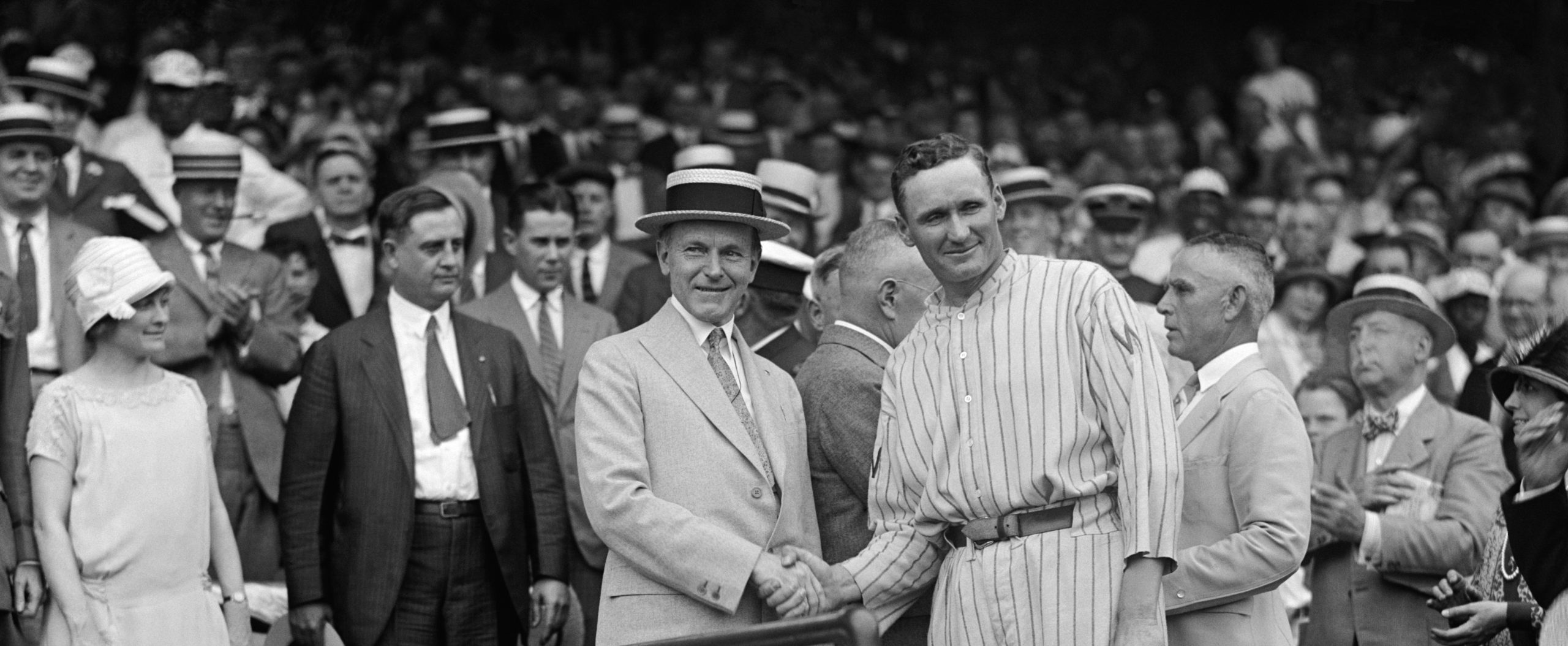
US President Calvin Coolidge and Washington Senators pitcher Walter Johnson shake hands, presenting the “American League diploma” for the Senators winning the AL in 1924. Photo via Wikipedia.

THE SEPARATION BETWEEN SPORTS AND POLITICS?

American presidents have often been labeled as “Sport Presidents” (Green and Hartmann 2012), utilising sport to benefit their image and popularity.

IRIS: How can the myth of “sports and politics don’t mix” be explained?

DR HARTMANN: I think it starts from our idealised conception of both sports and politics, idealised in the sense of their stereotypical definitions and commonsense cultural conceptions. On the athletic front, we think of sport generally as a very pure, safe and even positive, unifying kind of space or social force. For some people, it’s not idealised but more just a matter of entertainment or distraction from other things. The biggest idea is that sport is supposed to be somehow special, separate and distinct from everything else in our regular social lives, and that we have to protect that. On the politics side, I think a lot of people, in the United States at least, think of politics as dirty, complicated and inherently contested and conflicted. You can see almost right away that these two don’t go together very well. And, in fact, much of this modern thing we now call sport was built around this distinction, the idea or ideology, the mythology of sport being sacred, progressive and safe from other things, explicitly in contrast to their idea of the dirty complicated politics of the real world; from its inception, the sporting establishment has wanted it to be sanitized or safe from that.

The reason we sometimes call it a myth is that, in reality, sport and politics are deeply, almost inherently and always intertwined. Often, we don’t recognize this because some of what we scholars would say is political isn’t constructed or understood as political by those who are doing the actual talk about sports and politics in society. Some of the best examples would be around nationalism and the use of flags and anthems in ceremonies that celebrate the nation-state in athletic arenas. While many participants just think of this as normal or typical and not particularly controversial (and thus not “political”), from an analytic point of view, this can be seen as a kind of politics, a politics of culture and symbolism used to celebrate and reinforce certain notions of nation and identity. Because so many people agree with the messages, or just take them for granted or even ignore them, it seems harmless or apolitical even though its political content and function are pretty overt when you think about it. And so there, I think, is kind of the root of the challenge—that, on the one hand, sports and politics are always intermingled in many ways that we often can’t see or aren’t aware of, but that we think they shouldn’t be both because of our conception of sport as a special place and politics as a problematic one.

more...

Photo Credit: Nathan Rupert, Flickr CC

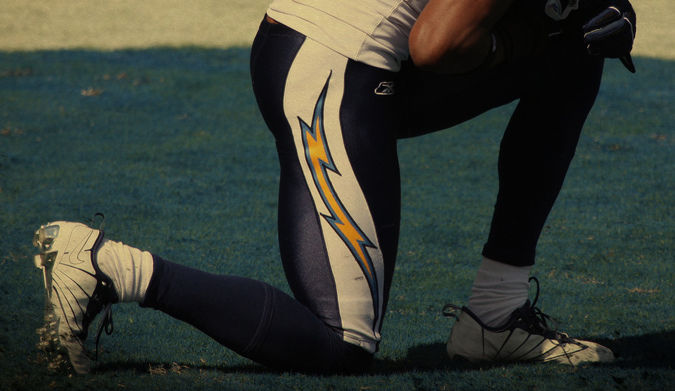
In case you were otherwise occupied, on Christmas Day the Associated Press named the “NFL National Anthem Protests” the top sports story of 2017. In a year of many huge sport stories both on and off the field, the AP said the story was the “runaway winner” for its staff. This doesn’t surprise me at all. I’ve studied sports-based social activism for a long time, but I’ve never had more media calls and requests for interviews in my career than these past few months.

The single biggest reason for the story, I’m pretty sure, involves our President’s seemingly unprompted and unusually profane attacks in September on football players who had engaged in demonstrations and the NFL. For better or for worse, Trump’s attention provoked a tidal wave of unprecedented gestures of protest and support across the league (and across both racial lines as well as those of management and ownerships) that gave the story its scale, scope, and intrigue. But there’s much more to say about it than that, much more.  I’ve been tracking this all fall as part of my own research project on the “new era” of African American athletic activism we are currently witnessing, and I am going to pull some of that together in a commentary with my sport and politics collaborator Kyle Green.  We are hoping to run that piece in the lead-up to the Super Bowl here in the Twin Cities at the end of January, so stay tuned!

There are two points I’d like to address here, by way of year-end retrospective: “kneeling” and “remembrance.” On kneeling, why do athletes feel the need to protest?

“Why do they do it?” is far and away the most common question I get from journalists and regular folks alike. Underlying this inquiry is the sense (a) that these demonstrations are disrespectful and (b) that professional athletes are super-rich, superstars who should be so satisfied with their lives and salaries and fame that they’d have no reason to complain or be angry, much less act out in public. At best, they see African American athlete activists as spoiled complainers, more interested in politics, making news, and making money than anything else. For many Americans, athletic protests are as incomprehensible as they are inappropriate.

Based on the athletes I’ve talked to and my earlier research on black athletic activism in the 1960s, I see the issue quite differently. and commitments. In a society that continues to be plagued by disproportionate police brutality, persistent racial gaps, and overt bigotry and bias, they feel compelled to do or say something. Sometimes it is in support of communities of color—their communities—who continue to face persistent racism and discrimination. Sometimes it is quite personal, stemming from their own ongoing individual experiences with racism and discrimination. And almost always it is quite principled and reasoned, with a clear understanding of the costs and consequences (which are far more real and extensive than most of us realize). Athlete activists don’t take their activities lightly or think of them as disrespectful or anti-American. Quite the contrary, they understand activism as consistent with the higher moral standards, ideals, and aspirations of both American democracy and sport culture.

But there is something else here too: It is also the fact that many —to make it seem like everything is okay. This was a major motivator for the African American athletes who participated in protests in the year leading up to the 1968 Olympic Games. As high jumper Gene Johnson explained in support of the “Olympic Project for Human Rights:”

“The United States exalts its Olympic star athletes as representatives of a democratic and free society, when millions of Negro and other minority citizens are excluded from decent housing and meaningful employment” (Race, Culture, and the Revolt, 2003, p. 84).

Or, as the OPHR organizing pamphlet put it: “We must no longer allow this country to use black individuals of whatever level to rationalize its treatment of the black masses.” 

So, that’s kneeling, now for remembrance. A few weeks back I was interviewed by a Time reporter for a special 50th anniversary retrospective issue on the tumultuous year of 1968. Among other things, the reporter asked me what my research on Tommie Smith and John Carlos’s iconic victory stand demonstration taught me about the meanings and implications of the protests of Colin Kaepernick and his NFL brethren. “How will we remember what is going on today, 50 years from now,” she wanted to know?

Social scientists like me, I told her, are loath to make predictions. However this topic is one where I was willing to make an exception. I’m pretty confident that one day in the not-to-distant near future, Kaepernick and company will be remembered far more positively across the American populace than is currently the case. In fact, it wouldn’t surprise me at all if, once the specifics of this moment and the larger racial politics that are unfolding are behind us, these athlete activists come to be revered as courageous, admirable, or even heroic—certainly ahead of their time. If you’re interested, my little quote to this effect can now be found in print on page 92 of the latest issue of Time (dated Dec. 25/Jan. 1) as well as online here.

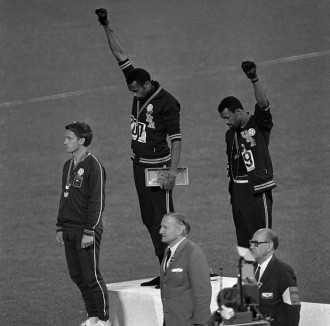
Such historical re-remembering is a familiar pattern in American culture. It happened to our collective conceptions of Martin Luther King, Jr. and Muhammad Ali. Perhaps most pertinent to this discussion are the memories that surround the perpetrators of one of the most iconic sports demonstrations of all time, Tommie Smith and John Carlos’s 1968 clenched first, victory stand demonstration at the 1968 Mexico City Olympics. Today, most Americans celebrate Smith and Carlos as heroes of the Civil Rights Movement; back in 1968, they were seen as villains, traitors, and worse.

History and memory—what happened and how we think about what happened—are two different things. All too often, the way we remember and romanticize images, individuals, and events comes at the cost of forgetting all of the actual social issues and context that gave rise to them in the first place. As this year draws to a close and we begin to look to the future, let us not lose sight of the racial disparities and social injustices at the root of the biggest sports story of 2017.

I turned 50 this summer so maybe I’m feeling a little sentimental. Nevertheless, in this season of tumult, Trump, and 140 character tweets that pass for news, I have found myself sustained by the some of the most old-fashioned modes of media—weekly and monthly news magazines, and, more specifically, long-form journalism. Here are some of my favorites from the past few weeks, categorized in the ways that I think my sociology friends and colleagues would find meaningful:

Social movements: Nathan Heller’s analysis of the efficacy of collective protests “Out of Action: Do Protests Work? The New Yorker, August 2017.

Popular culture: “How American Lost its Mind,” a piece on culture and populism by Kurt Andersen in The Atlantic, September 2017. (Other solid treatments roughly in this category/vein: “The New Paranoia by Colin Dickey in July’s The New Republic; and “European Disunion: What the Rise of Populist Movements Means for Democracy” by Yascha Mounk, also in TNR, August/September).

Sociology of knowledge: David Session in The New Republic, “The Rise of the Thought Leader: How the Superrich have Funded a New Class of Intellectual,” June 2017.

Media studies: a trip down memory lane by my favorite television critic of how Donald Trump built his popularity (and personality) in and through the small screen, Emily Nussbaum in The New Yorker, July 2017.

Now, don’t get me wrong. Traditional journalism doesn’t (and can’t) solve all the problems of our fractious world, and indeed I sometimes worry that all of this great writing and reading can be its own kind of distraction or delusion. But the clear-thinking, the ability to put things in broader context, and the commitment to synthesizing social facts and cultural complexities—all qualities that us sociologists aspire to—displayed in these pieces is admirable and much needed. And I can only shake my head in awe for the way these writers, reporters, and critics are able to produce such great, insightful content in such timely and engaging fashion.


U.S. athletes Tommie Smith, center, and John Carlos stare downward during the playing of the Star Spangled Banner after Smith received the gold and Carlos the bronze for the 200 meter run at the Summer Olympic Games in Mexico City on Oct. 16, 1968
U.S. athletes Tommie Smith, center, and John Carlos stare downward during the playing of the Star Spangled Banner after Smith received the gold and Carlos the bronze for the 200 meter run at the Summer Olympic Games in Mexico City on Oct. 16, 1968. (AP Photo)

So Tommie Smith and John Carlos get to go to Washington, D.C. next week, to the White House, to be received by President Obama with the 2016 United States Olympic team. Who are they and why is this such a big deal?

Smith and Carlos are the American Olympians who raised their fists during the playing of the national anthem during the victory ceremony–their victory ceremony–at the Mexico City Games in 1968. The gesture remains one of the most iconic images in all of sport history, and it has been referenced frequently in recent months with the emergence of a whole new era of African American athletic activism.

My first book was on Smith and Carlos and their demonstration, and over the course of the past few months I’ve been working on a project to situate the current era of athletic awareness in the context of the activism of 1968. Too often in sports, if not society more generally, we have a tendency to confine history–especially the history of racism and injustice as well as conflict and struggle–to the past. Without getting lost in the details, here’s a few facts about the history that I think are still relevant today.

  1. Smith and Carlos’ 1968 demonstration was not the spontaneous gesture of two isolated, discontented individuals; rather, it was the culmination of a year-long effort of activism and advocacy (famously titled “The Revolt of the Black Athlete”).
  2. The athletic activism of 1968 was not directed against prejudice and discrimination in the world of sport; rather, it grew out of the desire of socially-conscious, politically-committed African American athletes to use the publicity and platform of sport to contribute to larger, societal struggles against racism and injustice.
  3. Smith and Carlos were not celebrated by most Americans back in 1968, much less received at the White House for their demonstration. They were kicked off the team in Mexico City and treated as outlaws, villains, and traitors back home.

Click to visit the Stanford Center on Poverty and Inequality website.

Our friends over at the Stanford Center on Poverty and Inequality are at it again—this time with a special, election-year issue focused on the positions of the various parties and presidential candidates on the issues of poverty, mobility, and inequality in contemporary American society. While these topics may not be as popular, provocative, or controversial as others which have dominated campaign coverage so far, this attention to social stratification and public policy—especially for those on the bottom end of our socio-economic system—is basic, bread-and-butter stuff for any sociologically-inclined reader or researcher.

Three pieces in particular caught our attention. The first two, written by Douglas Holtz-Eakin and Harry J. Holzer, actually work best as a paired set. Each provides a short synopsis of how Republicans and Democrats, respectively, think about the challenges of poverty reduction in the United States. Holzer’s take on the Democrat approach doesn’t have a lot of surprises, though you can be the judge of how the various points of emphasis he lays out have played out in the Democratic primaries of late, especially considering that Holzer is the former Chief Economist of Bill Clinton’s labor department and advisor to the Hillary Clinton campaign. (“The views expressed,” he writes in a wry footnote, “are strictly my own.”) And while you might not agree with Holtz-Eakin’s reframing of poverty as a problem of “self-sufficiency,” I find it refreshing to hear a conservative both acknowledge the depth of the policy challenge as well as put social scientific research and data at the foundation of a prospective policy agenda.

The other piece I’d really recommend is Jeff Manza and Clem Brooks‘ article “Why Aren’t Americans Angrier about Rising Inequality?” The question comes from the realization that in spite of four decades of rising income and wealth disparities along with “stagnating or even declining real wages,” General Social Survey data suggests that Americans are not nearly so concerned (or at least, are much less outraged) than we might expect. Manza and Brooks believe this disconnect is “an important, yet under-acknowledged, challenge for scholars seeking to understand the politics of risking inequality in the United States.” They go on to suggest that the persistent strength of optimistic beliefs about opportunity and mobility is a key reason explaining why Democratic politicians have such difficulty getting public traction beyond their party base.

With the benefit of observing the last few months of presidential campaigning on both the Right and the Left, I’m wondering if perhaps these discontents aren’t quite as absent or one-sided as it once might have seemed, expressing themselves in the political arena more than public opinion polling. In a topsy-turvy political era, where anger is becoming all the rage, this possibility makes me think that we will need to be careful what we wish for when it comes to public attention to and partisan packaging of public policies affecting our economic systems and social hierarchies.