
history

Happy Halloween!

New & Noteworthy

From the Archives

  • This week, an unpublished Dr. Seuss manuscript was uncovered in UC San Diego’s Geisel Library. Penguin House plans to publish the book titled Sing the 50 United States! in the summer of 2026. Small Books, Big Questions, a 2018 article by Evan Stewart for Sociological Images, discusses how children’s books reflect the culture around them. {3 min read}
  • The Fed lowered interest rates earlier this week, but will this resolve housing shortages? Read Steven Schmidt’s recent piece in Council on Contemporary Families covering research in Los Angeles on this ongoing and complex issue for want-to-be homeowners and sellers. {6 min read}

More from our Partners & Community Pages

World Suffering

  • Research finds that forgiveness is healthy, but the pressure to do so may not be. TSP’s Managing Editor, Jacob Otis, wrote Social Expectations of Forgiveness for our partner publication World Suffering this week. {4 min read}

Council on Contemporary Families

  • Increases in Community Income Improve Birth Outcomes by Molly A. Martin was originally published in CCF’s Brief Reports and reprinted by CCF this week. Read about the novel experimental design Martin and colleagues used to find a causal link between income and birth outcomes, from their study published in Demography. {4 min read}


New & Noteworthy

Mallory Harrington has a new Discovery on work by Joss Greene on some of the history of gender boundaries in men’s prisons. Covering 1941-2018, this Discovery provides a succinct summary of the development of addressing gender in prisons.

Our media report this week includes The Amsterdam News coverage of Elizabeth Ross Haynes, an African American social worker, sociologist, and author during the early 20th century, Jess Carbino in The New York Times on young, dating adults’ preference to not pay for dating apps, Gaëtan Mangin in The Conversation covering the opinions of older car owns maintaining their old cars as a means of sustainability, Pepper Schwartz in ABC News on the rising use of Ozempic and other GLP-1 agonists for weight loss, and Eric Klinenberg was interviewed by The American Prospect about COVID-19 and some of the impacts social isolation on society.

From the Archives

Vice President Kamala Harris visited an abortion clinic in Minnesota, the first VP to do so. Read this piece from Contexts to learn more about some of the challenges surrounding abortion care.

Dartmouth’s basketball team unionized and Darthmouth has refused to enter into negotiations. Check out our ‘There’s Research on That’ on public opinion on the topic “and revered tradition of amateurism in college sports”, preventing payment of college athletes.

More from our Partners & Community Pages

Give Theory a Chance with Kyle Green has a new episode, with Ugo Corte on the work of Gary Alan Fine.

Contextslatest includes an interview with Dr. Sofya Aptekar by Colter Uscola on her recent article in Contexts, Green Card Soldiers.

Council on Contemporary Families has a new interview with Alicia M. Walker and Bella DePaulo on her new book challenging misconceptions about single life.

New & Noteworthy

This week’s Clippings includes Samuel L. Perry‘s work in The Washington Post on new House Speaker Mike Johnson and assault weapons, Carolina Are in El País on sexualization in social media, Carolyn Liebler in The Washington Post on the Census and measuring Americans with Indigenous heritage, and Amin Ghaziani in SciTechDaily on the ambivalence of coming out experiences of LGBTQ adults.

From the Archives

Pain and suffering are commonplace in the news, especially now. Read j. Siguru Wahutu’s TROT on “consuming the pain” through images of the “other” in the media.

Daylight savings time was this past Sunday (in case you haven’t noticed by now). Learn more about the history of Daylight Savings time by reading Lisa Wade’s piece in Sociological Images.

Backstage with TSP

Because of TSP’s growing student board, we have increased the number of “pitches” per week (where students review recent academic articles, write a brief summary, and present the articles to the rest of the board) and “workshops” (where students share their Discoveries drafts on screen and the rest of the board provides feedback real-time). This increased frequency of pitches and workshops will enable us to publish more content in the upcoming months!

More from our Partners & Community Pages

Contexts has a new piece on “dyadic interviewing”, interviewing both young adults and their parent, in research with Elena van Stee, Gaby FloresAriel Chan, and Angelica Qin.

Council on Contemporary Families has a new piece on 7 patterns of women’s journey through motherhood, education, and work through adulthood by Bo-Hyeong Jane Lee and Anna Manzoni.

First Publics has a new Reflections by Michael Kennedy on his teaching journey towards a critical and public-oriented approach.

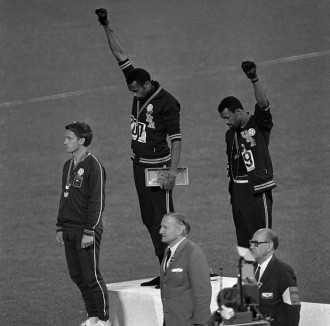
U.S. athletes Tommie Smith, center, and John Carlos stare downward during the playing of the Star Spangled Banner after Smith received the gold and Carlos the bronze for the 200 meter run at the Summer Olympic Games in Mexico City on Oct. 16, 1968
U.S. athletes Tommie Smith, center, and John Carlos stare downward during the playing of the Star Spangled Banner after Smith received the gold and Carlos the bronze for the 200 meter run at the Summer Olympic Games in Mexico City on Oct. 16, 1968. (AP Photo)

So Tommie Smith and John Carlos get to go to Washington, D.C. next week, to the White House, to be received by President Obama with the 2016 United States Olympic team. Who are they and why is this such a big deal?

Smith and Carlos are the American Olympians who raised their fists during the playing of the national anthem during the victory ceremony–their victory ceremony–at the Mexico City Games in 1968. The gesture remains one of the most iconic images in all of sport history, and it has been referenced frequently in recent months with the emergence of a whole new era of African American athletic activism.

My first book was on Smith and Carlos and their demonstration, and over the course of the past few months I’ve been working on a project to situate the current era of athletic awareness in the context of the activism of 1968. Too often in sports, if not society more generally, we have a tendency to confine history–especially the history of racism and injustice as well as conflict and struggle–to the past. Without getting lost in the details, here’s a few facts about the history that I think are still relevant today.

  1. Smith and Carlos’ 1968 demonstration was not the spontaneous gesture of two isolated, discontented individuals; rather, it was the culmination of a year-long effort of activism and advocacy (famously titled “The Revolt of the Black Athlete”).
  2. The athletic activism of 1968 was not directed against prejudice and discrimination in the world of sport; rather, it grew out of the desire of socially-conscious, politically-committed African American athletes to use the publicity and platform of sport to contribute to larger, societal struggles against racism and injustice.
  3. Smith and Carlos were not celebrated by most Americans back in 1968, much less received at the White House for their demonstration. They were kicked off the team in Mexico City and treated as outlaws, villains, and traitors back home.

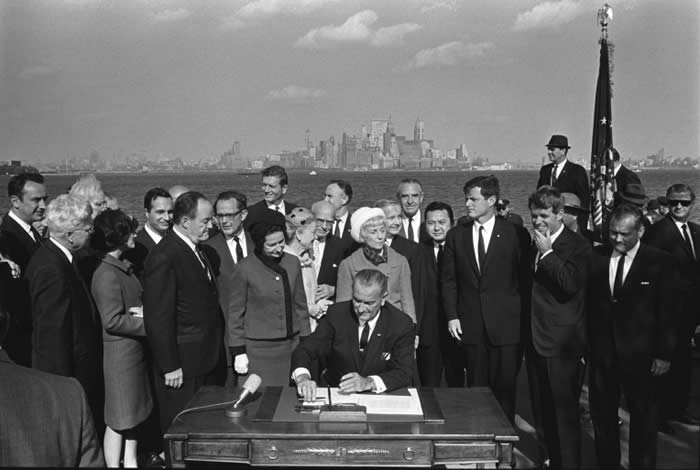
President Lyndon Baines Johnson signing the Immigration and Nationality Act of 1965 on Liberty Island (Lyndon B. Johnson Library Collection/Yoichi R. Okamoto)

This weekend marked the 50th anniversary of the 1965 Immigration and Nationality Act (also known as the Hart-Cellar Act). In the week ahead we are going to recognize this transformative piece of legislation–not only was it a complete overhaul of immigration policies and patterns of migration, it has had huge, if often not fully appreciated impacts on American culture and society–by highlighting a series of recent postings, commentaries, and reflections from sociologists and other social scientists that have appeared of late on the TSP homepage and through our social media. These will include great contributions from sociologists including Richard Alba, Nancy Foner, Douglas Massey, and John Skrentney, as well as Minnesota’s own superstar historian Erika Lee.

Many of these folks, it turns out, will also be gathered here in Minnesota at the Immigration History Research Center (IHRC) for a conference reflecting on all this later in the month. I myself have been asked to be on a panel entitled “An Assessment of the 1965 Immigration Act and Future Immigration Policy.” I’m a little nervous about this because I think of myself as more of a dabbler on immigration than an expert. That is, I’m someone who relies heavily on the work of others and whose own research on the topic is limited and operates mainly around the edges and margins of the field–race, culture, collective identities, assimilation theory.

With this in mind, I’ve been trying to pull together my ideas and reflections on immigration policy past and present by thinking “through a racial lens.” There are several reasons I’m working on this angle.

Perhaps the most basic is that the original 1965 policy was motivated by in large part by the desire to eliminate racism and discrimination from the American immigration system. Passed in the immediate aftermath of the Civil Rights and Voting Rights Acts of 1964 and ’65, immigration reform was intended to abolish old, restrictive quotas and outright bans against migrants from Asia and Africa as well as to overhaul the Bracero which was seen as exploitation of Mexican laborers. In diversifying the sources of immigration and placing a premium on skills and family ties, in fact, the new law was supposed to establish a more equitable, racially just policy and society.

There are three racial angles I’m planning to focus on: demography, culture, and incorporation.

  1. Demography. I don’t think it is hard to argue that the immigration reform opened the doors to massive amounts of new immigration and the immigration of people from countries and cultures that previously had been restricted or severely limited.  My main goal will be to highlight and discuss how this new immigration has dramatically transformed the racial and ethnic composition of the populace, remaking colorlines and categories of identification in the process. For what it is worth, I might also note that these changes and their implications will continue to evolve and change in coming years, driven not only by continued migration but also by differential birth rates, changing patterns of identification, and shifts in ethnic intermarriage.
  2. Culture. The expansion and diversification of migration to the United States that resulted from 1965 immigration reform was, whether intentionally and directly or not, associated with a whole series of shifts and changes and challenges to established racial heirarchies, shifting race relations, and racial attitudes associated with the movements we talk about as the Civil Rights movement. This includes the decline and discrediting of assimilation as an ideal or goal; the recognition and expansion of minority rights; the enrichment and diversification of lifestyles and culture more generally; the emergence of a politics of multiculturalism; and the virtual enshrinement of the discourse of diversity.
    I myself have written the most about multiculturalism and the discourse  of diversity. In a recent paper, I summarized these into several different arguments. One is that Americans are, nowadays, quite open and optimistic about diversity–not only on race and immigrant lines but on issues ranging from religion and sexuality to gender, disability, and age. “We are,” as Nathan Glazer put it almost twenty years ago, “all multiculturalists now.” The second major point cuts against the first: it is that talk about diversity is often marked by a series of underlying tensions and misgivings–about the relationship between group rights and individual freedoms, about ideals and hopes versus realities; about ideals versus actual structural conditions; about ideals versus inequalities. indeed, for as much as Americans tend to start with the positives about diversity, when it comes down to it, they often talk about the problems and conflicts and inequalities that go along with social difference in actual social life. And one of the biggest of these problems has to do with race. This is my third and perhaps most important point: that however open and far-reaching and general talk about diversity might be, the bulk of this discourse is deeply informed and determined–over-determined, I have suggested–by attitudes and understandings and experiences having to do with race in the United States. And the crux of the matter here is that this highly abstract and overly optimistic and entirely dominant discourse about diversity makes it very, very difficult to own up to the real problems and challenges of difference in the United States–especially those having to do with race. There’s a lot to say here–the persistence of racial inequities, the emergence of deeply racialized politics and policies and a paradoxically related colorblindness; the intractability and even invisibility of white privilege, colorblind racism–but my most important will be that all of this has particular bearing on immigrants.
  3. Incorporation. The perverse politics and culture of race that I have been talking about all has particular bearing on immigrants–not only in terms of the policies they encounter but also the stereotypes and biases they create. It helps explain some of the prejudicial attitudes against immigrants that scholars have documented. Yet this does not hit home evenly or equally on all American immigrants, and presents an especially pronounced challenge for darker skinned migrants, those associated with African Americans and blackness more generally. This is one of the reasons I’ve always been drawn to research and writing from Alejandro Portes and his colleagues on “segmented assimilation.” At least in theory, it puts race at the center of any account of the differential incorporation experiences of migrants and their children. The implications here are massive and range from the unique ways in which these new Americans understand and identify themselves to the opportunities for mobility and success that they and their children will encounter.

For the panel where I am planning to present some version of all this, we are supposed to talk about implications for public policy. I assume the idea is to focus on policy related to immigration. I don’t know how much I have to say about that. Like many scholars, I agree that we need a real policy on immigration. I think it is important that our policy, whatever it is, focus not only on who gets in (or not), but also on how all of our new arrivals are treated once in this country, what kind of needs they have and supports we can provide. And I agree with Doug Massey’s that we need a policy that is not driven only by utopian ideals or abstract fears, but by an actual, realistic understanding of social and economic processes that motivate migration. I guess I’d simply add that the realities of race and racism in contemporary America are a big and quite distinct part of this social package as well.

Anyway, that’s what I will be thinking about and working on over the next couple of weeks. If any of you have any ideas or advice, I’d welcome it. And even if not, you are all invited to come to Minneapolis later in the month to get a much bigger, more comprehensive big on immigration history, politics, and policy that this topic deserves. I hear the weather will be beautiful.

RU030113Read Widely

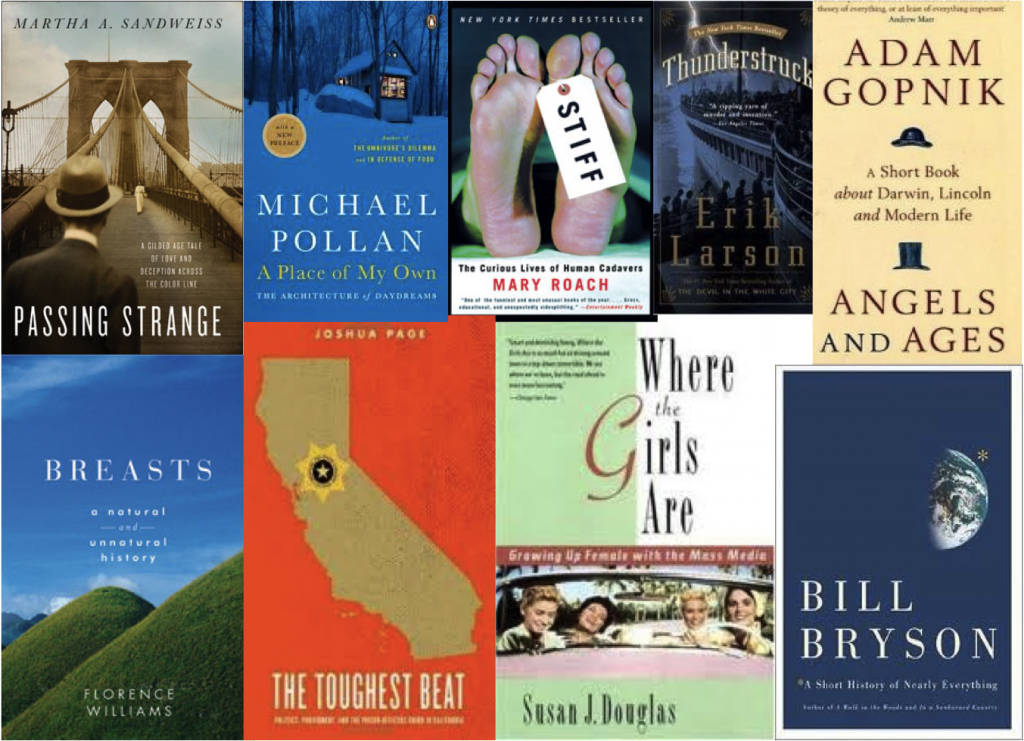
In case it’s hard to tell, that’s an imperative, not a descriptor. Today I plan to use my little soapbox to trumpet some fabulous writing, while also seeking submissions to what I lovingly call “Letta’s List.”

See, many authors ask me for examples of how to incorporate a lot of information into something that’s thorough, academically sound, and engaging. It’s a tough balance, to be sure, but over the years, I’ve collected a number of books (and this is by no means a list of all of them) I can hand off as representations of that ideal. They likely have nothing to do with your area of study, but watching the authors’ deft hands at work (and knowing there are surely unsung editor elves in there, too) can be a truly enjoyable homework assignment. Think of it as authorial excellence by osmosis. Absorb and emulate. more...