zuckerberg

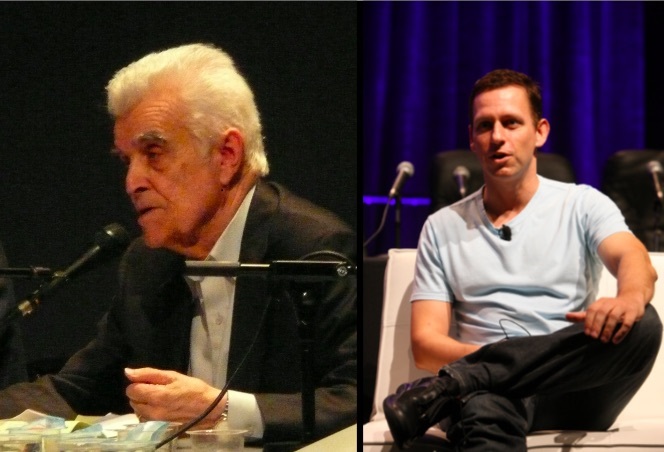
Thiel - Girard

During the week of July 12, 2004, a group of scholars gathered at Stanford University, as one participant reported, “to discuss current affairs in a leisurely way with [Stanford emeritus professor] René Girard.” The proceedings were later published as the book Politics and Apocalypse. At first glance, the symposium resembled many others held at American universities in the early 2000s: the talks proceeded from the premise that “the events of Sept. 11, 2001 demand a reexamination of the foundations of modern politics.” The speakers enlisted various theoretical perspectives to facilitate that reexamination, with a focus on how the religious concept of apocalypse might illuminate the secular crisis of the post-9/11 world.

As one examines the list of participants, one name stands out: Peter Thiel, not, like the rest, a university professor, but (at the time) the President of Clarium Capital. In 2011, the New Yorker called Thiel “the world’s most successful technology investor”; he has also been described, admiringly, as a “philosopher-CEO.” More recently, Thiel has been at the center of a media firestorm for his role in bankrolling Hulk Hogan’s lawsuit against Gawker, which outed Thiel as gay in 2007 and whose journalists he has described as “terrorists.” He has also garnered some headlines for standing as a delegate for Donald Trump, whose strongman populism seems an odd fit for Thiel’s highbrow libertarianism; he recently reinforced his support for Trump with a speech at the Republican National Convention. Both episodes reflect Thiel’s longstanding conviction that Silicon Valley entrepreneurs should use their wealth to exercise power and reshape society. But to what ends? Thiel’s participation in the 2004 Stanford symposium offers some clues.    more...
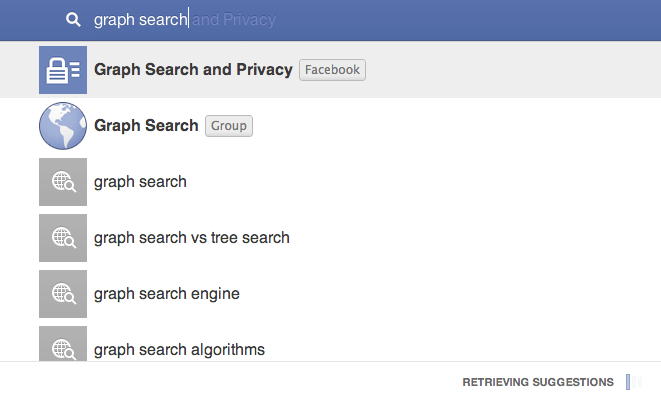
Facebook just enabled its new Graph Search for my profile and I wanted to share some initial reactions (beyond the 140 character variety). Facebook’s new search function allows users to mine their Facebook accounts for things like: “Friends that like eggs” or “Photos of me and my friends who live near Chuck E. Cheese’s. ” The suggested search function is pretty prominent, which serves the double role of telling you what is searchable and how to phrase your search.  More than anything else, Graph Search is a stark reminder of how much information you and your friends have given to Facebook. More importantly however, it marks a significant change in how Facebook users see each other and themselves in relation to their data.. You no longer see information through people; you start to see people as affiliated with certain topics or artifacts. Graph Search is like looking at your augmented life from some floating point above the Earth. more...

Image from The Atlantic Cities, Flickr user Bikoy under Creative Commons

About this time last year I asked our readers, “why we don’t criticize other things like we criticize the internet?” It seemed like a fitting topic for the season; we utilize some of the most resource-intensive technologies at our disposal so that we may enjoy egg nog with old friends or taste grandma’s famous Thanksgiving day turkey. Everyone wants to be near their loved ones for the holidays, and so begins a massive effort to transport ourselves in cars, trains and planes until we arrive at our optimal holiday season arrangements. It is a wonder, then, why we spend so much of our lives outside of this optimal arrangement. What kind of relationship do we have with our immediate surroundings? Not just the people, but the technologies and the patterns. There is a lot of excellent work on carbon footprints, local food movements, and walkable communities but I hear comparatively little about who is capable of making this transition. What does opting out of the status quo truly entail?  more...

By now, we have all heard the warning: potential employers will look at your Facebook page. We have been sufficiently terrified by the cautionary tale about the keg-stand profile pic (why is it always a keg stand?) that kept some otherwise capable candidate from getting hired. Indeed, we have taken note, with increased utilization of privacy settings and a collective awareness by job candidates about the visibility of social network sites.

Now, with the quickly spreading news of Justin Bassett, the warnings (and inevitable cautionary tales) become more epic. Bassett is a statistician out of New York, who, while on a job interview, was asked to log in to his social network profile. Bassett not only refused, but shared his story widely, sparking debates about privacy, employee rights, and the blurring line between personal and professional.   more...

Visit msnbc.com for breaking news, world news, and news about the economy

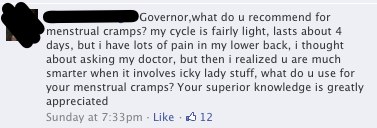
Last Friday, Rachel Maddow reported (video clip above, full transcript here) that hundreds of citizens had suddenly started posting questions on the Facebook pages of Virginia Governor Ryan McDougle and Kansas Governor Sam Brownback. Their pages were full of questions on women’s health issues and usually included some kind of statement about why they were going to the Facebook page for this information. Here’s an example from Brownback’s page:

The seemingly-coordinated effort draws attention to the recent flurry of forced ultrasound bills that are being passed in state legislatures. Media outlets have started calling it “sarcasm bombing” although the source of that term is difficult to find. ABC News simply says: “One website labelled the messages ‘Sarcasm Bombing’ for the tounge-in-cheek [sic] way the users ask the politicians for help.” A few hours of intensive googling only brings up more headlines parroting the words “sarcasm bomb” but no actual origin story. These events (which have now spread to Governor Rick Perry of Texas as well) raise several important questions but I am only going to focus on one: Can we call Facebook a “Feminist Technology”? more...


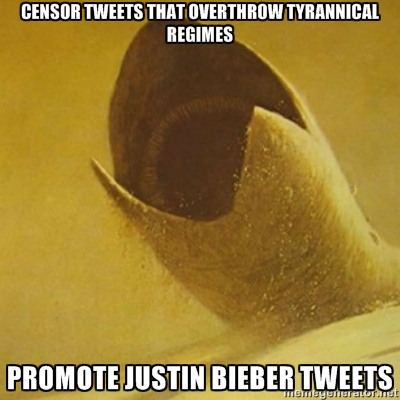
I took the liberty of making a new meme: "Censorship Sandworm". http://memegenerator.net/Censorship-Sandworm

“I must rule with eye and claw — as the hawk among lesser birds.”

-Duke Leo Atreides in Book 1: Dune

Over a week ago, Twitter announced a new censorship policy, stating that it would comply with any “valid and applicable legal request” to take down tweets. The announcement came just as we were still digesting Google’s unified privacy policy and were still debating the (now confirmed) rumors that Facebook was releasing an IPO. Twitter has since been applauded, denounced, and dissected by a variety of scholars, media critics, and business leaders. In this post I will give a brief summary of the controversy, briefly weigh in with a commentary of my own, and conclude with a discussion of what all this means for theorizing online social activity.

more...

This essay, like the one I posted last month on faux-vintage photography, is me hashing out ideas as part of my larger dissertation project on self-documentation and social media. Part II will argue that the media also overstate how public we have become, sensationalizing the issue to the point that the stigma associated with online imperfections erodes more slowly. It is no stretch to claim that we have become more public with social media. By “public” I mean that we are posting (1) more pieces information about ourselves online in (2) new ways (see the Zuckerberg Law of Information sharing), and are doing so more (3) honestly than ever before. We are connected to the web more often, especially given the rise of smart phones, and new layers of information are being invented, such as “checking in” geographically. And gone are the days when you could be anyone you want to be online; today we know that online activities are augmented by the physical world. People are mostly using their real names on Facebook and nearly everything one does there has everything to do with the offline world.

But we are not as public as this suggests. We need a balance to this so-called triumph of publicity and death of anonymity (as the New York Times and Zygmunt Bauman recently declared). “Publicity” on social media needs to be understood fundamentally as an act rife also with its conceptual opposite: creativity and concealment. And I am not talking just about those who use false identities on blogs (see Amina) and pseudonyms on Facebook, those with super-strict privacy settings or those who only post a selective part of their multiple identities (though, I am talking about these folks, too).  My point applies to even the biggest oversharers who intimately document their lives in granular detail.

I’ll describe below how each instance of sharing online is done so creatively instead of as simple truth-telling, but will start first by discussing how each new piece of information effectively conceals as much as it reveals. more...

Jeff Jarvis wrote a critique of having multiple identities on social media (find the post on his blog – though, I found it via Owni.eu). While acknowledging that anonymity has enabled WikiLeaks or protestors of repressive regimes, he finds little utility for not being honest on social media about yourself. Jarvis argues against having multiple identities, e.g., one Twitter account for work and another for friends or a real Facebook for one group and a fakebook (a Facebook profile with a false name) for another.

Jarvis argues that the problems associated with presenting yourself in front of multiple groups of people (say, your mother, boss, best friend, recent fling, etc) will fade away under a state of “mutually assured humiliation.” Since we will all have the embarrassment of presenting a self to multiple groups, we all will forgive each other so that others will return the same favor to us. “The best solution”, Jarvis argues, “is to be yourself. If that makes you uneasy, talk to your shrink.” This is reminiscent of Facebook founder Mark Zuckerberg who stated “having two identities for yourself is an example of a lack of integrity,” or current Google CEO Eric Schmidt who said that “if you have something that you don’t want anyone to know, maybe you shouldn’t be doing it in the first place.”

The obvious problem with this line of thinking is that the problems associated with displaying a single self in front of multiple populations is not “mutually” the same for all. Just as WikiLeaks or protestors often use anonymity to counter repressive and/or powerful regimes, we know that anonymity is also used by the most vulnerable and least powerful on the personal level as well. Jarvis misses the important variables of power and inequalities in his analysis.

Having a stigmatized and not always accepted identity can bring much conflict more...

more...

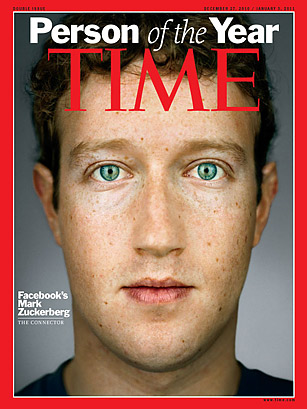
The premise of this blog is that technology is fundamental to our selves, lives and all of reality. And this point is best exemplified by Facebook. The site’s founder and CEO is TIME magazine’s 2010 Person of the Year. Is this the correct choice? Perhaps Julian Assange? Donna Haraway, anyone?