by
Dave Paul Strohecker,
Feb 27, 2012, at 04:06 pm
Below is a three part essay I presented at the 2012 Southwest Texas Popular Culture Association meetings in Albuquerque, New Mexico on February 9th. It was presented as part of a series of panels titled “The Apocalypse in Popular Culture.” A (much) earlier version of this paper can be found on the Sociological Images sister blog.
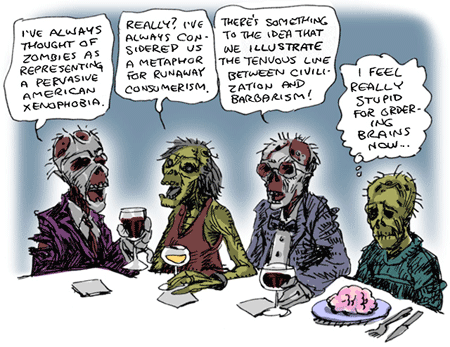
THE ZOMBIE IN FILM: FROM HAITIAN FOLKLORE TO APOCALYPTIC ANXIETIES
If you are alive these days, and not already part of the undead masses yourself, you probably have noticed a staggering increase of zombie references in film, television, pop culture, videogames and the internet.For instance, the big screen and small screen have both hosted a plethora of zombie films including the more popular blockbusters
28 Days Later (2002)
, Shaun of the Dead (2004)
, and
I Am Legend (2007)
. In television, we have seen the recent success of AMC’s
The Walking Dead, based on the
comic book series of the same name. In pop culture, we have seen the viral video of penitentiary inmates dancing to
Michael Jackson’s “Thriller” and even the popular television sitcom
Glee host its own rendition of the dance. And if you are on a college campus like myself, you have probably seen undergraduates playing
“Zombies Vs. Humans,” a game of tag in which “human” players must defend against the horde of “zombie” players by “stunning” them with Nerf weapons and tube socks. In videogames, we have seen the success of the
Resident Evil franchise, eventually culminating in a series of films staring
Mila Jovovich, as well as more recent games like
Left 4 Dead and
Dead Rising. Finally, the internet is awash with zombie culture. From post-apocalyptic
zombie societies to zombie
fansites and
blogs.

The Annual "Zombie Walk" in Pittsburgh, PA, birthplace of the famed zombie director George Romero.
by
Dave Paul Strohecker,
Jan 31, 2012, at 01:27 pm
Below is Part 1 of a three part essay I will be presenting at the 2012 Southwest Texas Popular Culture Association meetings in Albuquerque, New Mexico on February 9th. I will be presenting alongside several other scholars for a series of panels titled “The Apocalypse in Popular Culture.” A (much) earlier version of this paper can be found on the Sociological Images sister blog. Part 1 discusses the first wave of zombie cinema 1920-1950s.
The Zombie in Film: From Haitian Folklore to Apocalyptic Anxieties
If you are alive these days, and not already part of the undead masses yourself, you probably have noticed a staggering increase of zombie references in film, television, pop culture, videogames and the internet.
For instance, the big screen and small screen have both hosted a plethora of zombie films including the more popular blockbusters
28 Days Later (2002)
, Shaun of the Dead (2004)
, and
I Am Legend (2007)
. In television, we have seen the recent success of AMC’s
The Walking Dead, based on the
comic book series of the same name. In pop culture, we have seen the viral video of penitentiary inmates dancing to
Michael Jackson’s “Thriller” and even the popular television sitcom
Glee host its own rendition of the dance. And if you are on a college campus like myself, you have probably seen undergraduates playing
“Zombies Vs. Humans,” a game of tag in which “human” players must defend against the horde of “zombie” players by “stunning” them with Nerf weapons and tube socks. In videogames, we have seen the success of the
Resident Evil franchise, eventually culminating in a series of films staring
Mila Jovovich, as well as more recent games like
Left 4 Dead and
Dead Rising. Finally, the internet is awash with zombie culture. From post-apocalyptic
zombie societies to zombie
fansites and
blogs.
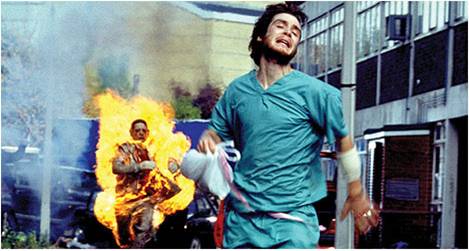
The Annual "Zombie Walk" in Pittsburgh, PA, birthplace of the famed zombie director George Romero.
But what is the zombie and where does it come from?
(more…)
by
Dave Paul Strohecker,
Oct 31, 2011, at 06:20 pm

If you’ve check the Huffington Post today, you will notice something very different: A “Zombie” page has replaced the usual “Culture” section of the website. Just in time for Halloween, the internet newspaper has used the growing cultural obsession with zombies to create a parody of the zombie apocalypse occurring right now in their headquarters. Why? Because why not?
(more…)
by
Dave Paul Strohecker,
May 25, 2011, at 12:05 pm

Just came across the personal blog of Nick Pearce, a scholar at Durham University’s Foundation Centre, who is doing some very interesting research on higher education, technology, and zombies. I discovered his website while researching existing work on zombies and higher education, and I discovered that he is one of the scholars putting together the much-awaited anthology “Zombies in the Academy: Living Death in Higher Education” (to be published in 2012).
I was particularly drawn to an old post on “Zombies, Technology, and Capitalism,” because of Pearce’s use of the zombie metaphor in depicting some of the recent trends in higher education. He states rather eloquently:
The very general thrust is that VLEs (such as Black(magic)board, and VOODLE) replace face-to-face ‘human’ learning with undead digital teaching. These VLEs have rapidly spread across the sector (virally?) without being explicitly demanded by either teachers or students. The embedded pedagogy of these VLEs is restrictive and they offer a level of social control and conformity not possible with more traditional teaching practices.
In Pearce’s words, the Virtual Learning Environments (VLEs) of today’s academy sap the human element out of the classroom (or computer screen in this case). (more…)