weisure

play

As Edward Snowden settles into his new life in Russia, and Facebook inc. faces accusations of providing information to government officials about protesters in Turkey, issues of privacy are on the lips, minds, and newsfeeds of many global citizens.

Citizens sit with the uncomfortable and now undeniable reality that we are being watched. That our own governments, in many cases, are doing the watching. And that the economic, social, and interactive structures makes this kind of surveillance largely impossible to avoid.

I have noticed an interesting trend as people work through what many view as an unfortunate inevitability of pervasive surveillance: the use of play as a form of resistance. To be sure, PJ Rey (@pjrey) is our resident Play Theory expert here at Cyborgology. I am an admitted novice to this line of theory. As such, I hope that those with greater expertise than I will supplement my wide-eyed sociological noticings with established or developing social theorists and their theories. more...

The Pew Internet and American Life Project released a survey collecting expert opinions on one a hot new(-ish) concept amongst the Silicon Valley digerati: gamification. The survey offers some interesting insights and features commentary from folks like danah boyd, Clay Shirky, Jeff Jarvis, and Amber Case; it also cites me a bit talking playbor (play + labor) and weisure (work + leisure).

The survey shows that tech commentators are split on whether gamification is destined to become an ubiquitous feature of the Web (53% agree, 42% disagree). The subtext of these sorts of conversations—given that tech commentators overwhelmingly have backgrounds in business—is: How can we use gamification to make a killing. We shouldn’t be to suprised about all the excitement from those invested in the tech industry. After all, gamification is all about getting people to view labor (i.e., the production if value) as play. And, if workers don’t view work as work, they may just do it for free.

more...

I am attempting to organize a session on online play, gaming & leisure at the Eastern Sociological Society Meetings, February 23-26, 2012 in New York City.

If you’re working on a relevant project, submit a title and a 200-250 word abstract (anything over 250 words will not be accepted) here. I’ll review the submissions on October 1st and see if we have enough to make a proposal.  Feel free to submit you papers through the ESS general submissions process as well if you plan to attend regardless of whether we are able to get a panel into the program. more...

CC Attribution: PJ Rey

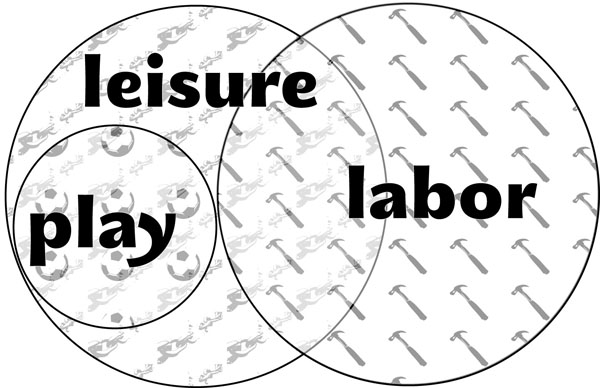
A wide range of activities from playing online games like Farmville or World of Warcraft to using social-networking sites like Facebook or Twitter are being described as either “playbor” or “weisure.”  I’ve recently been reviewing the literature surrounding playbor and weisure and have realized that they are too often conflated. I’d like to take a moment to offer my working definition of these two terms in hopes of encouraging greater conceptual clarity in future discussions.

Both terms are portmanteaux. “Playbor” combines “play” and “labor.” “Weisure” combines “work” and “leisure.” In this case, work and labor are synonymous. I apply the standard Marxian definition to both work and labor, understanding them to describe human activity that produces value. What distinguishes playbor and weisure from one another is their respective associations with play and leisure, because – despite the ubiquity of conceptual slippages around these terms – play and leisure are not equivocal. more...