wall street

We have a two-month break from self-inflicted government crisis, so let’s use it to take a breather, assess the situation, and cast some shade on rich people. Not because it is cathartic (it is), or because it will prevent the next crisis (it won’t); rather, I think studying the contours of the government-shaped hole of the last three weeks can teach us something about how Silicon Valley views public ownership. This is important because we typically use metaphors[1] like “the commons” or “the public” to describe their products. These words imply a sense of trust, if not mutually assured disruption: sure a rich guy might own Twitter on paper but it becomes worthless if everyone stops treating it as a (if not the) center of daily life. What do the people that own these service/spaces think about the de facto collective ownership of their product? more...
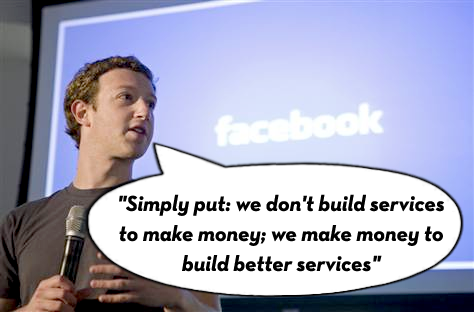
Image under Creative Commons

I start with a nota bene by saying that I do not self-identify as a “surveillance scholar” but given our current sociotechnical and political climates, the topic is unavoidable. One might even be tempted to say that if you aren’t thinking about state and corporate surveillance, you’re missing a key part of your analysis regardless of your object of study. Last week, Whitney Erin Boesel put out a request for surveillance study scholars to reassess the usefulness of the panopticon as a master metaphor for state surveillance. Nathan Jurgenson commented on the post, noting that Siva Vaidhyanathan (@sivavaid) has used the term “nonopticon” to describe “a state of being watched without knowing it, or at least the extent of it.” I would like to offer up a different term –taken straight from recent NSA revelations—that applies specifically to surveillance that relies on massive power differentials and enacted through the purposeful design of the physical and digital architecture of our augmented society. Nested within the nonopticon, I contend, are billions of “boundless informants.” more...

Tomorrow’s initial public offering of Facebook stock has both business and tech commentators chattering away (though, in most mainstream publications, there isn’t meaningful distinction between the two). Technology coverage is too often reduced to the business of technology. Consider the top four tech headlines on the New York Times site today: “Long Odds on a Big Facebook Payday,” “Ahead of Facebook I.P.O., a Skeptical Madison Ave.,” “Spotify Deal Would Value Company at $4 Billion, “Pinterest Raises $100 Million.”

Buried in the all the personal investing advice, some interesting quesitons are being raised. For example: How can a company with few employees and so little material infrastructure generate so much value? What is it that Facebook actually produces? Is an economy based in immaterial products and services sustainable (especially given that it’s profitability is largely dependent on it’s ability to drive additional consumption in other sectors through advertising)?

But there are also a lot of questions that aren’t being asked—the kinds of culturally significant questions that business folks and economists aren’t (though perhaps should be) interested in. Here, I want ask one such question: Will Facebook’s transition to a public corporation change the way users perceive their participation on the site? While I can only speculate about how this institutional change will effect users, I want offer a few reasons I think Facebook’s IPO may cause users to see themselves in more of an explicit work-like relationship with Facebook (based on rationalistic principles of minimizing cost and maximizing gain) and less a part of some sort of non-rationalized gift economy (based on principles of sharing and reciprocity). I should be clear, here, that I am talking about users’ relationship to the platform, not their relationships with each other. Users are, of course, primarily motivated to use the platform because of their relationships with other users; however, as recent privacy debates have illustrated, a user’s perceptions of Facebook are important in determining how users use the platform and whether they use it at all. more...


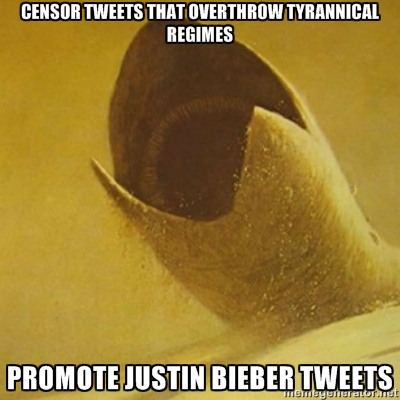
I took the liberty of making a new meme: "Censorship Sandworm". http://memegenerator.net/Censorship-Sandworm

“I must rule with eye and claw — as the hawk among lesser birds.”

-Duke Leo Atreides in Book 1: Dune

Over a week ago, Twitter announced a new censorship policy, stating that it would comply with any “valid and applicable legal request” to take down tweets. The announcement came just as we were still digesting Google’s unified privacy policy and were still debating the (now confirmed) rumors that Facebook was releasing an IPO. Twitter has since been applauded, denounced, and dissected by a variety of scholars, media critics, and business leaders. In this post I will give a brief summary of the controversy, briefly weigh in with a commentary of my own, and conclude with a discussion of what all this means for theorizing online social activity.

more...

The difficulties we face in getting a wifi signal underneath these trees, tells us something important about our relationship to technology.

Commentary about the Internet and the various communication services it provides, regularly fall into utopian or distopian visions of radically new worlds. The utopias tell of a future in which we are all continually connected in a seamless egalitarian web of techno-democracy. The distopian warnings describe overstimulated zombies shuffling from computer screen to smartphone, hermetically sealed in the echo chamber of their choosing. These predictions are equally unlikely to occur any time in the near future, and for one simple reason- Its really hard (and expensive) to get a stable internet connection in a park. more...