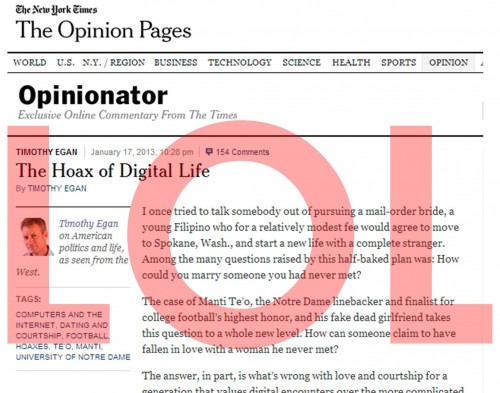
 I’ve poked fun at these lazy op-eds before and, indeed, it must be tempting to retreat into the safe conceptual territory of “The Internet is fake!” when a juicy story of lies, deception, and computers makes headlines. The Te’o case is an almost unbelievable account of a football star allegedly tricked into falling for, and eventually mourning, a woman who didn’t exist. It’s the kind of fiction only non-fiction could invent. [More on the Te’o case]
What I’d like to point out is that people have incorrectly called this a cyber-deception, a digital-deception, an online-hoax, when this is not exactly right: it was a deception, and one that happened to involve digital tools in a significant way. This mistake is what I call “digital dualism”: conceptually dividing the digital and physical into separate realities. Dualists speak of “real” interaction as opposed to digital interaction, digital selves, and a digital life, like Neo jacking into The Matrix. [More. On. Digital. Dualism.] more...