

virtual reality

Picture1

Throughout their history, national conventions for American political parties have become more and more public events. Closed off affairs in smoky rooms and convention halls gave way to televised roll calls and speeches. In the Year of Our Big Brother, 1984, C-SPAN aired uninterrupted coverage of the Democratic and Republican conventions. Conventions became more polished and choreographed, with 1996’s DNC being the zenith of this trend. Conventions moved to the internet in the aughts, using a variety of different platforms to distribute streams and commentary.

This election cycle incorporated something new into the dissemination of gavel-to-gavel coverage of the conventions: Twitch.tv. The platform designed for videogame streaming offered full coverage of the conventions. Additionally, it gave Twitch users the ability to host the coverage of both conventions on their own channels. In the case of the DNC, Twitch users were able to add commentary to the stream of the convention on their channel, giving their followers and other users an opportunity to hear their favorite gamers’ takes on the presentation of the Democratic National Committee. more...
source
source

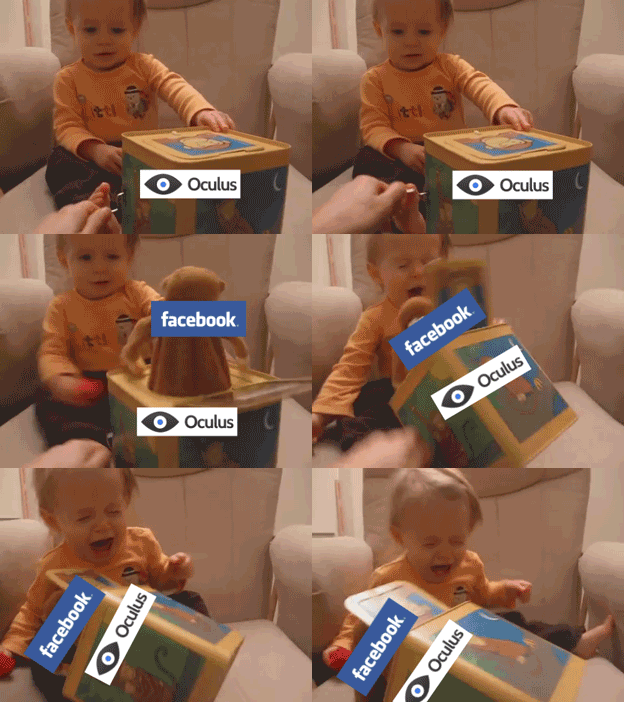
Last week, The Verge’s Adrianne Jeffries (@adrjeffries) asked a really provocative titular question: “If you back a Kickstarter Project that sells for $2 billion, do you deserve to get rich?” After interviewing venture capitalists and the like she concludes that the answer isn’t even “no” it’s “that’s ridiculous.” After speaking to Spark Capital’s Mo Koyfman Jeffries writes, “Oculus raised money on Kickstarter because it wanted to see if people wanted and would buy the product, and whether developers wanted it and would build games for it. The wildly successful campaign validated that premise, and made it much easier for Oculus to raise money from venture capitalists.”

Kickstarter’s biggest innovation is its ability to cut two time-consuming tasks –market research and startup funds– down to a 90 day fundraising window. Companies that choose to use Kickstarter usually aren’t ready to offer equity because that comes after the two steps that Kickstarter is so useful in accelerating. Or, perhaps more honestly, companies opt to use Kickstarter precisely because they want to avoid selling off shares of their company as much as possible. Jeffries gives us a good financial and legal (juridical, if we want to be Foucauldian about it) but that seems like a wholly unfulfilling argument for someone who spent $25 on an Oculus-branded t-shirt. Let’s forget for a moment about what’s legal and normal –those things are rarely moral or fair– and start to compare what happens on Kickstarter to similar (and much older) social arrangements. To start, let’s go way back to the early 1990s. more...

by Space Invaders

Last week, fellow editor Nathan Jurgenson made a post entitled “Digital Dualism versus Augmented Reality” with a call for more concept work surrounding this topic.  I hope to make a contribution to that effort by discussion three competing theoretical paradigms of Internet research.  These three distinct perspectives perceive the Internet as either virtual reality, mediated reality, or augmented reality.  I argue (in the spirit of Saussure) that these three perspectives are only fully comprehensible defined in relation to one another.

Let’s start with the definition of “augmented reality” found in Wikipedia, society’s great font of prosumptive wisdom:

Augmented reality (AR) is a term for a live direct or a [sic… I fixed it] indirect view of a physical, real-world environment whose elements are augmented by computer-generated sensory input, such as sound or graphics. It is related to a more general concept called mediated reality, in which a view of reality is modified (possibly even diminished rather than augmented) by a computer. As a result, the technology functions by enhancing one’s current perception of reality. By contrast, virtual reality replaces the real-world with a simulated one.

This is an unsatisfying definition.  While it does contrast augment reality and mediated reality to virtual reality (mediated and augmented reality describe relationships between the online and offline worlds, while virtual reality describes their separation), it (self-admittedly) fails to distinguish between mediated and augmented reality.  As presented in this definition, mediated and augmented reality are basically synonyms.

more...