The Cyborgology editors were on the radio (WYPR, Baltimore’s NPR affiliate) talking about the Theorizing the Web 2011 conference. We discuss the Twitter backchannel and the notion of an augmented conference, and how Facebook is similarly a backchannel to our Face-to-face interactions. Also, conference attendee Bonnie Stewart is mentioned!
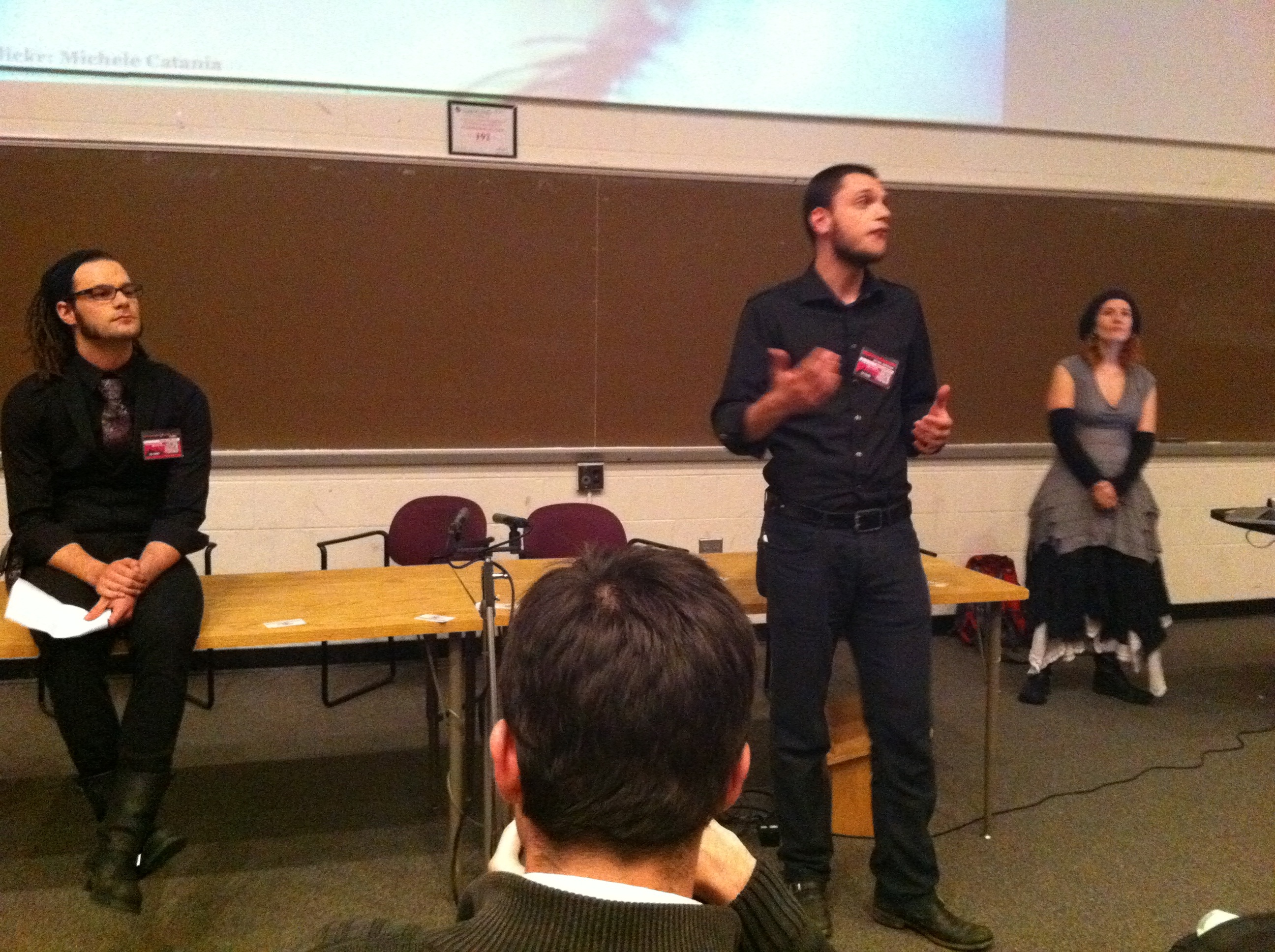
The panel I organized for the Theorizing the Web conference was called, “Cyber Racism, Race & Social Media.” A key theme of all the papers in this session was that race, racism and caste, are enduring features of media across geographic and temporal boundaries, and across cultures.
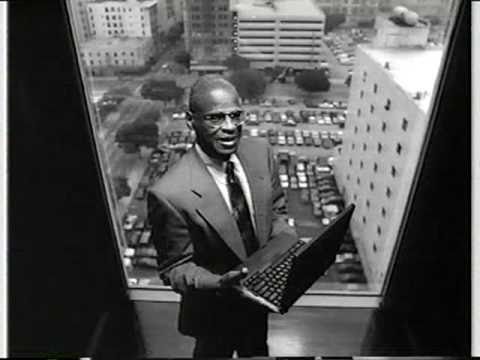
In the late 1990s, a popular television commercial advertisement captured the zeitgeist of thinking about the web at that time.
This notion that the Internet is a place where “there is no race,” is also one that’s permeated Internet studies. Early on scholars theorized that the emergence of virtual environments and a culture of fantasy would mean an escape the boundaries of race and the experience of racism. A few imagined a rise in identity tourism, that is, people using the playful possibilities of gaming to visit different racial and gender identities online (Nakamura, 2002; Turkle, 1997).
I want to reflect on Theorizing the Web 2011 by asking for a discussion about what academic conferences should look like. In fact, let’s forget the term “conference” for a moment and ask how thinkers should best organize to discuss intellectual work in public?
Theorizing the Web 2011 was PJ Rey and I’s first attempt at tackling this question [read PJ’s review of the event here]. We started this blog to provide a public forum for ideas and the conference was intended to do the same. Many reviews of the event have emerged (some posted on this blog over the past ten days). What has surprised me most is the degree to which the conference itself has been a main topic of discussion. And while we are very proud that the reviews have been so overwhelmingly positive about our view of an academic event, we understand that this is also a result of the failing of traditional venues for the intellectual exchange of ideas. Academic conferences are too often suffered through and individual sessions often poorly attended. Media outlets tend to ignore anything that smells too much like intellectualism, a term itself that has come to be viewed pejoratively because, at least in part, intellectuals have so poorly communicated ideas to the public. As graduate students, we know we needed to create a world that is better prepared to communicate the critical theories so important to understand our changing realities.
And the result on April 9th went well above our expectations.
We attempted to bring in art, multi-media, interdisciplinarity, and even non-disciplinarity to this event. Registration was pay-what-you-want. The event began with beers in an alley and finished with a loud band. We tried lots of things and will try much more if we do this again next year [we want to].The art was fun, and us organizers can take credit for that. more...
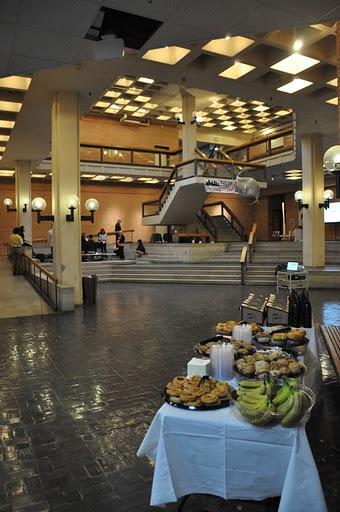
Theorizing the Web 2011 was held on April 9th 2011 at the University of Maryland’s Art-Socy building. It far exceeded our expectations in every way. We received over 100 abstract submissions of which were able to accept 53%. We were joined by Internet research experts from around the world, including presenters who traveled from Hong Kong, New Zealand, and Europe. The conference pushed the capacity limits of the venue with over 230 official registrants and easily 250 people in attendance throughout the day. Events ran from registration at 8 AM and ended with an afterparty that wound down around 11 PM. The program was packed with as many as five concurrent panels in early sessions. The plenary sessions by George Ritzer and Saskia Sassen as well as danah boyd‘s keynote drew audiences of over 150 people.
Sessions covered a wide range of topics pertaining to the social web, including the politics of infrastructure; the role of social media in contemporary social uprisings; the reproduction of race, class, gender, sexuality, and their intersections in a digital milieu; the co-determinacy of the online and offline world (i.e., “augmented reality”) and the dangers of viewing them in isolation; the performance of the self through one’s online Profile and the increasing need to accept the cyborg subject as sociology’s proper unit of analysis; the Internet as more post-Modern than the original objects of analysis under consideration by the post-Modern theorists; the new economies of the Web and the limits of traditional (e.g., Marxian, neo-liberal) modes of thought; the reconfiguration of norms pertaining to privacy/publicity; the democratization of (formerly expert) knowledge via crowdsourcing (e.g., Wikipedia); and the capacity of art to capture/predict our changing relationship with technology. more...
Editors PJ Rey and Nathan Jurgenson introduce keynote speaker danah boyd
This past weekend Cyborgology editors PJ Rey and Nathan Jurgenson treated over two hundred (mostly) young academics to a new kind of conference. In some ways it was like any other conference: some people (me included) did the necessary grousing about waking up early; there were minor technical mangles [mangle of practice]; and there were some awkward glances at name tags as everyone tried to remember the names of their new professional acquaintances. But unlike some of the larger (dare I say, “mainstream”) conferences, there was a palpable sense of ownership over all aspects of the the project. We were doing this for a reason, and it was not to pad our CV’s. It was to play with the medium. We theorized the web, but in so doing, we also reconsidered the purpose of conferences.
This is the fourth panel spotlight for the upcoming Theorizing the Web conference on April 9th. I’ll have the pleasure of presiding over a panel that focuses on how mobile web platforms are augmenting the world of bricks and flesh. Much more than an ethnography of Foursquare, this panel will explore our changing relationships to space and place, and the new ways public and private spaces are opening up as a result of this new augmented reality.
Presider: david a. banks
PJ and Nathan have done an excellent job on this blog of articulating social media’s role in times of revolution, but this panel seeks to understand social media’s roll in a variety of instances. We will explore the cultural contexts that Social Networking Services (SNS) operate within, and what this does for old and new associations with (and within) place and society. From San Francisco hipsters to Chinese political activists, and from your local Starbucks, to the Second Life, social media is changing how we interact with our cities and our fellow citizens.
If anything unites these four panelists, it is their balanced perspective on the roll of digital media. Its easy to essentialize mobile computing platforms, or mistake computer mediated communication as anti-social. Without essentializing the technology, or romanticizing the past, these authors provide a balanced critique of what is happening in our cities and online. Read the four abstracts after the break to learn more:
This is the second panel spotlight for the upcoming Theorizing the Web conference on April 9th. I am presiding over an open paper session whose full title is “Poets and Scribes – Constructing Fact and Fiction on Social Media.” The title alludes to Susan Sontag’s On Photography in which she describes the evolution of thought surrounding our relationship to that earlier medium:
The photographer was thought to be an acute but non-interfering observer—as scribe, not a poet. But as people quickly discovered that nobody takes the same picture of the same thing, the supposition that cameras furnish an impersonal objective image yielded to the fact that photographs are evidence not only of what’s there but of what an individual sees, not just a record but and evaluation of the world. It became clear that there was not just a simple, unitary activity called seeing (recorded by, aided by cameras) but “photographic seeing,” which was both a new way for people to see and a new activity for them to perform.
The parallel between photography and social media is that both produce documents that are mediated through the situated perspective of the actor. Media production is never passive and it is never asocial (though, of course, such actors fall on a continuum between the ideal-typical poet and scribe). However, when we accept that media products are embedded within a system of social relations (particularly, relations of power), we implicitly accept the idea that these products inextricably contain poetic or fictitious elements—angles or interpretations that reflect the historical moment in which they were articulated. All media, including social media, are expressions of what Donna Haraway calls “situated knowledge.”
The salient difference between the poet and the scribe is that the poet is self-aware the her work is always a half-fiction. She embraces the fact that expression is always a process of fictioning and uses it to her advantage. On the contrary, the scribe is faced with the paradoxical task of trying to legitimate her existence by saying her work is necessary but adds nothing. Her unwillingness to acknowledge what she brings to the product leaves her vulnerable to both marginalization and exploitation because she is blind to the unique interests of her social position and to the value that is created in offering a concrete expression of these interests. No doubt, the average Facebook user is more like a scribe than a poet, faithfully documenting the “truths” of their existence without realizing any claim to the value of the information generated.
The four papers on this panel are joined by a theme of inquiry into the active, poetic practice of mediating our online interaction and documentation. Abstracts are presented below: more...
The Cyborgology editors are throwing a conference on April 9th called Theorizing the Web. Leading up to the event, we will occasionally highlight some of the events taking place. I will be presiding over a paper session simply titled “Cyborgology” and present the four abstracts below. As readers of this blog already know, we view cyborgology as the intersection of technology and society. We define technology more broadly than just electronics, but also to things like architecture, language, even social norms. And the four papers on the Cyborgology panel offer a broad scope of what cyborgology is and how it can be used.
First, we have David Banks’ paper titled, “Practical Cyborg Theory: Discovering a Metric for the Emancipatory Potential of Technology.” David discusses what theoretical cyborgology is and what it can do. Bonnie Stewart offers a discussion of the social-media-using-cyborg as a sort-of “branded” self in her paper, “The Branded Self: Cyborg Subjectivity in Social Media.” Bonnie pays special attention to, in true cyborgology fashion, the way in which digital and physical selves interact and blur together. Next, Michael Schandorf argues that Twitter norms are akin to the non-speech gestures we make while talking (e.g., like moving our hands). What makes his paper, titled, “Mediated Gesture of The Distributed Body,” so appropriate for the Cyborgology panel is Michael’s focus on the physically and socially embodied nature of digital communication. Even digital communication does not exist alone in cyberspace but in an “augmented reality” at the intersection of atoms and bits. Last, Stephanie Laudone’s paper, “Digital Constructions of Sexuality,” empirically describes how sexuality is both affirmed and regulated on Facebook. This, again, highlights the embodied nature of Facebook while looking at how digital space operates differently than physical space.
Find the four abstracts below. Together, they will make for an exciting panel. We invite everyone to join us at the conference in College Park, MD (just outside of Washington, D.C.) on April 9th. And let’s start the discussion before the conference in the comments section below. Thanks! more...
As many of you already know, the Cyborgology editors decided to throw a conference called Theorizing the Web. The conference will be in College Park, MD (just outside of Washington, D.C.) on April 9th. Today we are excited to announce the program for the conference and attach a flier that we hope you all can distribute to those who you think might be interested.
As you will see, the response was terrific. We built 14 panels out of the 56 papers we accepted (from the over 100 submissions). There will be three invited panels (on feminist activism, race, and methods). There will be two symposia (one on the role of social media in the Arab uprisings and another on social media and street art). There will be two plenaries (one by Saskia Sassen and another by George Ritzer). And we are excited to have danah boyd deliver our keynote.
If that was not enough, we have plenty of art-related surprises in store for those who attend. We have invited artists of all types to display and perform art specifically tailored to the themes of the conference. This will be one busy carnivalesque day for those who love technology and/or theory!
The abstract submission deadline for the Cyborgology “Theorizing the Web 2011” conference had been extended to February 20th. Submit here. Registration also now open.
About Cyborgology
We live in a cyborg society. Technology has infiltrated the most fundamental aspects of our lives: social organization, the body, even our self-concepts. This blog chronicles our new, augmented reality.

 The Cyborgology editors were on the radio (WYPR, Baltimore’s NPR affiliate) talking about the Theorizing the Web 2011 conference. We discuss the Twitter backchannel and the notion of an augmented conference, and how Facebook is similarly a backchannel to our Face-to-face interactions. Also, conference attendee Bonnie Stewart is mentioned!
 I want to reflect on Theorizing the Web 2011 by asking for a discussion about what academic conferences should look like. In fact, let’s forget the term “conference” for a moment and ask how thinkers should best organize to discuss intellectual work in public?
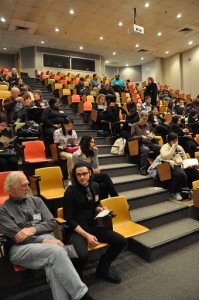 Theorizing the Web 2011 was held on April 9th 2011 at the University of Maryland’s Art-Socy building. It far exceeded our expectations in every way. We received over 100 abstract submissions of which were able to accept 53%. We were joined by Internet research experts from around the world, including presenters who traveled from Hong Kong, New Zealand, and Europe. The conference pushed the capacity limits of the venue with over 230 official registrants and easily 250 people in attendance throughout the day. Events ran from registration at 8 AM and ended with an afterparty that wound down around 11 PM. The program was packed with as many as five concurrent panels in early sessions. The plenary sessions by George Ritzer and Saskia Sassen as well as danah boyd‘s keynote drew audiences of over 150 people.
 Sessions covered a wide range of topics pertaining to the social web, including the politics of infrastructure; the role of social media in contemporary social uprisings; the reproduction of race, class, gender, sexuality, and their intersections in a digital milieu; the co-determinacy of the online and offline world (i.e., “augmented reality”) and the dangers of viewing them in isolation; the performance of the self through one’s online Profile and the increasing need to accept the cyborg subject as sociology’s proper unit of analysis; the Internet as more post-Modern than the original objects of analysis under consideration by the post-Modern theorists; the new economies of the Web and the limits of traditional (e.g., Marxian, neo-liberal) modes of thought; the reconfiguration of norms pertaining to privacy/publicity; the democratization of (formerly expert) knowledge via crowdsourcing (e.g., Wikipedia); and the capacity of art to capture/predict our changing relationship with technology. more...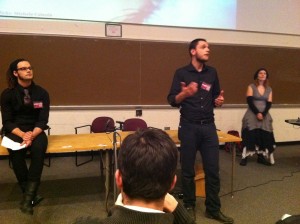
 This is the fourth panel spotlight for the upcoming Theorizing the Web conference on April 9th. I’ll have the pleasure of presiding over a panel that focuses on how mobile web platforms are augmenting the world of bricks and flesh. Much more than an ethnography of Foursquare, this panel will explore our changing relationships to space and place, and the new ways public and private spaces are opening up as a result of this new augmented reality.


 The Cyborgology editors are throwing a conference on April 9th called Theorizing the Web. Leading up to the event, we will occasionally highlight some of the events taking place. I will be presiding over a paper session simply titled “Cyborgology” and present the four abstracts below. As readers of this blog already know, we view cyborgology as the intersection of technology and society. We define technology more broadly than just electronics, but also to things like architecture, language, even social norms. And the four papers on the Cyborgology panel offer a broad scope of what cyborgology is and how it can be used.
 The abstract submission deadline for the Cyborgology “Theorizing the Web 2011” conference had been extended to February 20th. Submit here. Registration also now open.
 Theorizing the Web 2011 was held on April 9th 2011 at the University of Maryland’s Art-Socy building. It far exceeded our expectations in every way. We received over 100 abstract submissions of which were able to accept 53%. We were joined by Internet research experts from around the world, including presenters who traveled from Hong Kong, New Zealand, and Europe. The conference pushed the capacity limits of the venue with over 230 official registrants and easily 250 people in attendance throughout the day. Events ran from registration at 8 AM and ended with an afterparty that wound down around 11 PM. The program was packed with as many as five concurrent panels in early sessions. The plenary sessions by George Ritzer and Saskia Sassen as well as danah boyd‘s keynote drew audiences of over 150 people.
 Sessions covered a wide range of topics pertaining to the social web, including the politics of infrastructure; the role of social media in contemporary social uprisings; the reproduction of race, class, gender, sexuality, and their intersections in a digital milieu; the co-determinacy of the online and offline world (i.e., “augmented reality”) and the dangers of viewing them in isolation; the performance of the self through one’s online Profile and the increasing need to accept the cyborg subject as sociology’s proper unit of analysis; the Internet as more post-Modern than the original objects of analysis under consideration by the post-Modern theorists; the new economies of the Web and the limits of traditional (e.g., Marxian, neo-liberal) modes of thought; the reconfiguration of norms pertaining to privacy/publicity; the democratization of (formerly expert) knowledge via crowdsourcing (e.g., Wikipedia); and the capacity of art to capture/predict our changing relationship with technology. more...