#TtW12

Academic conferences: the model needs to change.

As the 2012 meeting of the American Sociological Association (#ASA2012) kicks into gear, I want to use this post to start a conversation about a somewhat-contentious topic: academics’ use of Twitter, particularly at conferences. I begin by extending some of what’s already been written on Cyborgology about the use of Twitter at conferences, and then consider reasons why some people may find Twitter use off-putting or intimidating at conferences. I close by considering what Twitter users in particular can do to ease the “Twitter tensions” at ASA by being more inclusive. The stakes here include far more than just “niceness”; they include as well an opportunity to shape the shifting landscape of scholarly knowledge production.


more...

This is part of a series of posts highlighting the Theorizing the Web conference, April 14th, 2012 at the University of Maryland (inside the D.C. beltway). It was originally posted on 3.30.12 and was updated to include video on 7.19.12. See the conference website for

Presider: Kari Kraus (@karikraus)

Drawing on a diverse range of approaches–from media archaeology and ethnography to queer theory and critical code studies–the “Politics of Design” panel will collectively consider where and how power pools and collects in the designed, value-laden spaces of the internet. Individual panelists will take up digital networks and anonymity (Moesch); established and proposed internet architectures (Shilton and Neal); slick Web 2.0 and grungy “dirt style” interfaces (Kane); and the failed rhetoric of the digital sublime by the founders of Google and Second Life (Chia).  Not content to dwell on surface design features, each speaker unearths hidden variables–whether technological, social, or historical–that affect the systems, platforms, and communication structures under discussion. In the process, they expose the faultlines in those structures that allow us to envision them otherwise; the politics of design, that is to say, ultimately point–directly or indirectly–to alt-design and re-design.

Please join us on 4/14 for what promises to be a fabulous #TtW12 panel!

[Paper titles and abstracts are after the jump.] more...

In each of the past two Theorizing the Web conferences, I have been present to see an audience member—concerned about the fleeting popularity of online platforms and rapid technological development— question the pervasive use of Facebook as a study site. This is an important question, and one to which panelists (including myself) have not adequately responded.  Absent the pressure of probing eyes and a ticking clock, I work here to craft the kind of response that the question deserves.

more...

This is part of a series of posts highlighting the Theorizing the Web conference, April 14th, 2012 at the University of Maryland (inside the D.C. beltway). It was originally posted on 4.2.12 and was updated to include video on 7.11.12. See the conference website for

Any study of politics is going to be fundamentally about power, and about who is free to exercise it and how: How policy is made, how the public sphere is constituted and how boundary lines are drawn around it, who has a voice and who is excluded from

Presider: Sarah Wanenchak

discussion or consideration, who is central and who is marginalized. By the same token, the study of contentious politics – as it focuses on dissent and protest – is fundamentally about how those who have been marginalized, denied a voice, and left without power act to seize the things that have been denied them: How activist communities form and frame themselves, how their objectives and tactics change over time, how they seek entry into the public sphere and engage the actors they find there, how the voiceless find a voice and what they use it to say. Moreover, it’s about what is visible and recognized: How we understand political action in light of what’s gone before and what might come in the future.

All of this would be complex enough without communications technology, and what this panel highlights is how technology changes and enriches this already-complicated picture. Communications technology has the potential to change what we understand by “public sphere” and how we construct meanings around events, as well as how different collective actors organize and react to each other. If knowledge and information are vital to the development of a social movement, then understanding how knowledge and information flow is additionally vital.

Given recent and ongoing global protest movements, the intersection of technology and protest is a subject both broad and deep. Rather than attempt to capture all aspects of it, the excellent papers in this panel call attention to more tightly focused corners of the political picture, and in so doing, illuminate further potential avenues for research and exploration. Additionally, the geographical and cultural focus of this panel is truly diverse, allowing us to push back a bit against the American-and-Eurocentric bias that appears too often in research of this kind.

Titles and abstracts are after the cut.

more...

This is part of a series of posts highlighting the Theorizing the Web conference, April 14th, 2012 at the University of Maryland (inside the D.C. beltway). It was originally posted on 4.6.12 and was updated to include video on 6.22.12. See the conference website for additional information.

The issue of self documentation is increasingly fertile ground for theorizing the intersection of the digital and the material, illustrating how our identities are increasingly mediated by new technologies and “digital” forms of sociality. Facebook, Twitter, Instagram, and Pinterest (as relatively new forms of sociality) produce requisite changes in our self concepts. In the digital era, identity becomes a project of coordinating, collecting, and curating; self presentation becomes a project of self documentation.

Each of these authors acknowledges the paradigmatic changes new technology (especially social networking sites like Facebook) has introduced into our self concepts. For example, Aimée Morrison looks at how norms are created, encouraged, and enforced in the digital realm of Facebook. The Facebook status update field has gone through several permutations, reflecting changing expectations and norms regarding self presentation and self documentation on this popular social networking site. Somewhat differently, Rob Horning addresses issues of power and control in the promulgation of new forms of sociality. More specifically, Horning discusses Facebook’s role in socializing users into the “digital self,” or the self as curated project. Self documentation is integral to the rise of the digital self and the destruction of the inner/private self. In addition, Jordan Frith reflects on how social media incorporates emerging GPS technology into location based social networks (LBSN) like Foursquare. Drawing from qualitative interviews with over 35 Foursquare users, Frith analyzes the impact of this LBSN on both self-presentation and self-documentation practices.

Finally, social media and the ability to self-document also changes our conception of time. As Nathan has argued, “Social media increasingly force us to view our present as always a potential documented past” (Jurgenson, 2011). In this vein, Sam Ladner addresses the proliferation of digital calendaring (MS Outlook, Google Calendar) and resultant changes such technology engenders to our conceptions and use of time. Digital calendars create new affordances but also new risks in time management.

[Paper titles and abstracts after the jump.]

more...

This is part of a series of posts highlighting the Theorizing the Web conference, April 14th, 2012 at the University of Maryland (inside the D.C. beltway). It was originally posted on 4.11.12 and was updated to include video on 6.5.12. See the conference website for additional information.

I am very happy to have the opportunity to preside over the panel on technologies of identity. Internet is intimately related to people’s identities; a point that is almost self-evident. People express, reinforce and even sometimes construct new identities via the Internet. But how exactly does this happen? through what mechanisms? How, for example, do people who date online maintain or challenge their identities concerning their sexual preference, class, race, etc. in ways similarly and differently than those who date exclusively offline? Or, how do second-generation immigrants take advantage of the Internet to reshape society’s perceptions of them? How, for instance, do people’s conception of consumption change when faced with the new possibility of shopping online? How does our desire for power and pleasure manifest itself through online social networks? …the questions are endless…

Internet meet identity are both fascinating topics: we expect expect analyses that are both interesting and insightful. And that is the promise our presenters try to fulfill with their intriguing papers.

*Note: Due to an unforeseen scheduling conflict, Nicholas Boston will not be able to attend the conference.

[Paper titles and abstracts after the jump.]

more...

Doing Journalism in the Social Media Age

Discussion with Andy Carvin (@acarvin) & Zeynep Tufekci (@techsoc)

Introduction: Nathan Jurgenson (@nathanjurgenson) & PJ Rey (@pjrey)


This is part of a series of posts highlighting the Theorizing the Web conference, April 14th, 2012 at the University of Maryland (inside the D.C. beltway). It was originally posted on 3.28.12 and was updated to include video on 5.10.12. See the conference website for additional information.

Presider: Dan Greene (@Greene_DM)

Logging Off and Disconnection” presents an important new set of perspectives on a key theme of Theorizing the Web: ‘Cyberspace’ does not exist as an immaterial realm separate from human bodies and relationships. The online is instead always imbricated with the offline and the connections we make and unmake are crucial determinants of of both spaces. This panel explores this co-determination from the perspectives of those who decide, or are forced, to disconnect from online media in order to examine the relationships between personal participation and motivation and structuring forces of media design, cultural narrative, and economies of data and prosumption.

Jenny Davis’ qualitative study of Facebook users explores how social networking technology’s tight integration into the rhythms and relationships of everyday life highlights the tension between moral definitions of a meaningful life and cultural ambivalence about the technology’s effects on sociality. Jessica Roberts uses the global data of the world Unplugged projectto investigate the behavioral and emotional responses university students had to a 24-hour withdrawal from ambient media. She expands the ‘awareness systems’ tradition in computer science and stresses the integration of already-existing awareness systems into daily life, demonstrating that the seamless connectivity of ambient media makes it harder for students to recognize how their relationships with, and through, those media function. Laura Portwood-Stacer focuses on discourses of Facebook rejection in popular and alternative media outlets and in her interviews with ‘non members’. This rejection of a specific, dominant medium is an important piece of non-members’ production and negotiation of political and ethical identity. Finally, Jessica Vitak builds on the rich social scientific research literature on self-presentation and privacy in order to explore different users’ management of personal information, audience relationships, and social norms through the specific affordances of Facebook . All four researchers illustrate how in relationships with and through online media the links not made, the social graphs refused, are powerful forces in media ecologies and (non-)users’ lives. 

[Paper titles and abstracts are after the jump.] more...

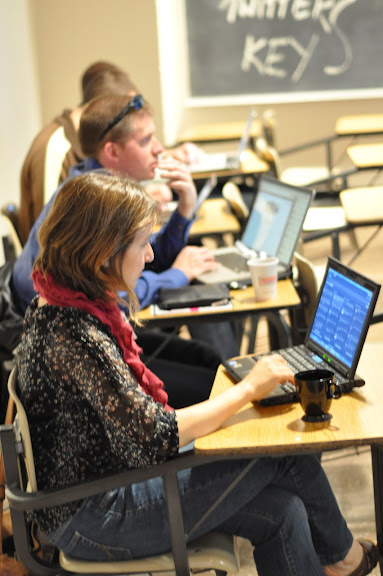
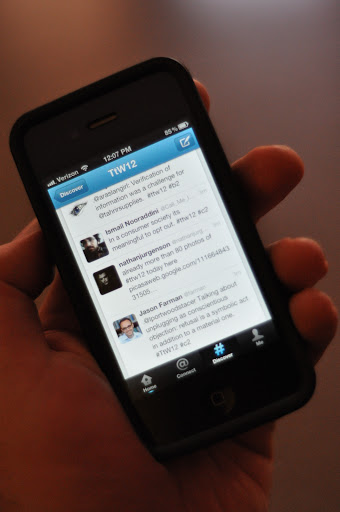
The Twitter backchannel in action. Photo by Rob Wanenchak.

Last weekend, I had the double pleasure of presiding over an excellent panel on technology and protest, and having David Banks as my extremely capable Twitter backchannel moderator and Livestream assistant. Both the Twitter backchannel and the Livestream were getting their first serious run as an institutional part of Theorizing the Web, and despite some minor difficulties with mics and cameras, I think they were a clear success.

But the experience of presiding on a panel and then serving as the backchannel moderator for the panel immediately after delivered some interesting revelations regarding what these kinds of technology actually mean for how our conferences work, and for how we engage with and in our spaces of knowledge production.

more...

TtW12 twitter backchannel
The TtW12 Twitter back channel. Photo by Rob Wanenchak

Theorizing the Web 2012 was great. Everyone involved did a bang-up job. I certainly learned more in a single day than I usually do at weekend-long establishment conferences. I have said a lot about conferences (here, here, and here) as have fellow cyborgologists (Sarah, Nathan, and PJ). All of these posts have a common thread: academia is changing, but conferences seem out of date in some way. They are needlessly insular, they rely on hefty attendance fees that are increasingly cost-prohibitive,  and they rarely take advantage of social media in any meaningful way. The relative obduracy of conference styles come into high relief once they are compared to the massive changes to institutional knowledge production. Universities have adopted many of the managerial practices of private companies. They are also acting more like profit-seeking enterprises: putting massive resources into patenting offices and business incubators, hiring less tenure-track teaching staff, and employing armies of professionalized managers that run everything from information technology services to athletic facilities. Conferences, on the other hand, have seen few innovations beyond what I call Tote Bag Praxis.  more...