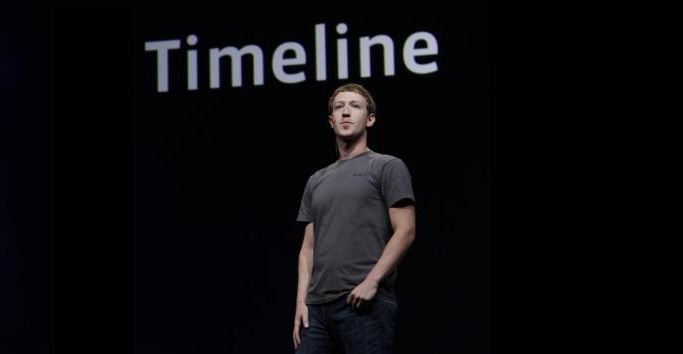
timeline

This is the first post in a new Cyborgology series we call #review. #review Features links to, summaries of, and discussions around academic journal articles and books. This week, I’m reviewing:

Goodings, Lewis and Ian Tucker. 2014. “Social Media and the Co-Production of Bodies Online: Bergson, Serres, and Facebook’s Timeline.” Media Culture & Society 36(1):37-51. [paywalled PDF]

review

Goodings and Tucker work to understand the difficulties of embodiment in light of pervasive technological mediation, and in particular, Facebook’s Timeline. They do so using data from 8 focus groups, with a total of 25 participants.

The authors refer to technologically mediated embodiment as that embodiment which exists in light of, and conjunction with, pervasive electronic and digital media. Through the work, the authors identify two key problems or difficulties of technologically mediated embodiment. First, technologically mediated embodiment troubles communicative boundaries, as multiple networks, with varying expectations, converge together in shared social spaces. Second, technologically mediated embodiment stifles the fluid nature of personal biography, cementing the past in ways which inhibit future re-interpretations of the self. more...
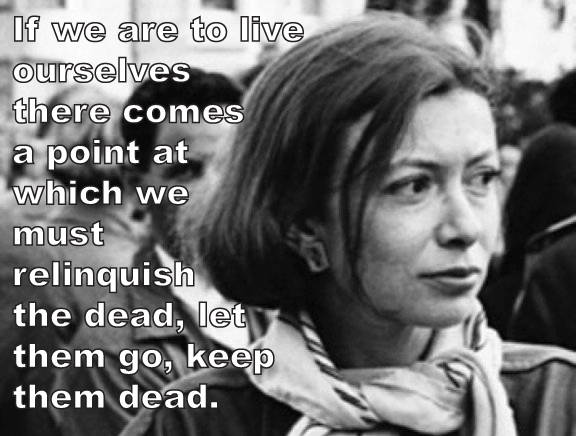
I hear there are people out there (though I’ve never been acquainted with one, so far as I know) who really believe high school was the best period of their lives. It’s a privilege to say so, but this position remains unfathomable to me. This isn’t to say I haven’t developed a retroactive appreciation for certain aspects of my teenage life; in high school I had no overhead, all of my income was discretionary, necessities (and sometimes luxuries) were provided for me, and activities like singing, debating, working on theatrical productions, shooting photography, and writing/editing for the school newspaper (awww, analogue blogging!) were considered “productive” uses of my time, all of which add up to a pretty cushy existence. Material and structural privilege can’t necessarily buy happiness, however, and it’s an understatement when I say that I’m presently happy to have left the affective experience of my teenage years in the past.

Recently, my Internet neighborhood has been revisiting high school through the lens of ‘What if we’d had Facebook Back In The Day?’ On Monday, Nathan Jurgenson (@nathanjurgenson) wrote about why we shouldn’t be so quick to celebrate the Facebooklessness of our adolescence; yesterday, Rob Horning (@marginalutility) posted his well-considered response. Below I consider both pieces, and add my own thoughts about the hypothetical intersections of present day Facebook and the pre-Facebook past. All three of us examine identity and “digital dirt,” but where Jurgenson considers embarrassment and stigma, and Horning considers context and narrative control, I consider temporality and affective experience. more...

Several weeks ago, I wrote a post about how we not only manage our image (outgoing) but also curate our view (incoming). As a very brief summary, I argued, based upon data from my own ongoing social media study, that despite the potential for social media to expose us to a variety of perspectives and opinions (creating a public sphere, or at least a public space), we discriminately select which perspectives and opinions to let in, and which to exclude. In doing so, we curate reality. Though this manifests in a variety of ways, a prevalent manifestation is the management of one’s Facebook News Feed.

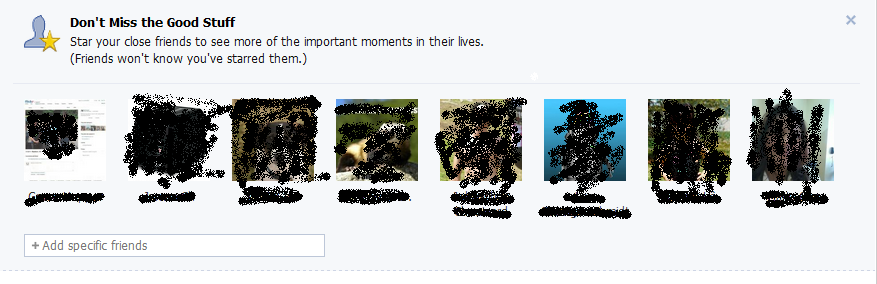
A new push for the (apparently long present) feature on Facebook, in which users are asked to “star” the Friends whose content they want to make more visible, further supports this trend. More importantly, however, it demonstrates the mutually influential relationship between physical architectures, normative social structures, and personal practices.

The physical architecture of a space (online or offline) simultaneously shapes, and is shaped by, those who use it. For instance, the typical classroom is set up with an instructor who stands at a high desk in the front of a room, facing students, who sit in low desks, with their bodies and eyes oriented forwards and upwards towards the teacher. This both creates and reflects a particular power dynamic, and guides how participants in the interaction think about and act towards themselves and one another. Similarly, architectures of online spaces reflect and guide who we are and what we do in those spaces.

more...

Taken from my News Feed

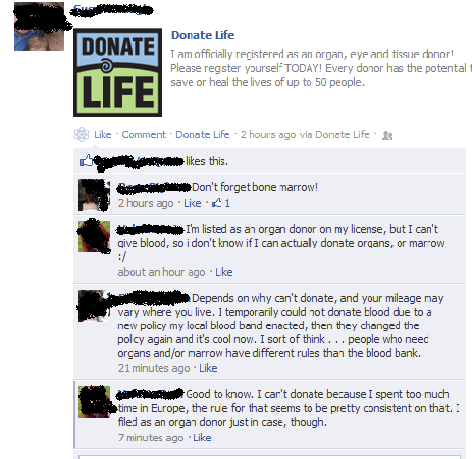
It was the first year of the new millennium, and at 16 years old, I bared my metal-clad teeth in a proud smile for what would be an appropriately hideous driver’s license photograph. On this momentous day in my young life, I volunteered to be an organ donor.  My status as an organ donor is not something that I often talk about—mostly because it is not something I often think about. In fact, I often forget that I am an organ donor until someone makes a verbal note about it while looking at my (updated but still appropriately hideous) driver’s license picture, at which point I silently congratulate myself, and seamlessly forget until the next time. In theoretical terms, my organ donor status is not a salient part of my identity and it is rarely an attribute through which others interact with me. This is about to change. more...

Facebook is now rolling out the new Timeline format. Reviews, as usual, are mixed. Some applaud the now historically situated self presentation while ohers express discomfort at the increasing reach of this platform as it now invades a past in which it was previously absent. I am not going to engage these debatesin the present post. Instead, I will talk about what Timeline does in in terms of self and identity.

Timeline, I argue, integrates self narratives fragmented by their simultaneous temporal location prior to, and at the heigt of, augmented society.

Narratives are linear stories. They have a beginning middle and end and usually a coherent theme. Self narratives are the stories that we tell about ourselves. They are necessarily selective, highlihting some things while ignoring or mimizing others. Self narratives take that which is messy, fragmented and disjointed, and wraps it into a clean, cohesive, and consumable package. The self narrative has very real consequences. We not only make sense of ourselves through these narratives but are then guided in our actions by this sense making. It is through self narrative that we learn who we are make decisions about what we should do.

Facebook is an important tool in the construction of self narratives in an augmented society. Our profiles act as tangible reflections of where we have been, what we have done, who we are, what we are therefore likely to do. These narratives are co-constructed and, as pointed out in a previous post by Nathan and I, prosusumed. This project of linearity, however, is complicated by a past that took place entirely outside of social media technologies. The self, as told through facebook, privileges the present, and only with effort, pays homage to the past.  Enter Facebook Timeline. more...