
tents

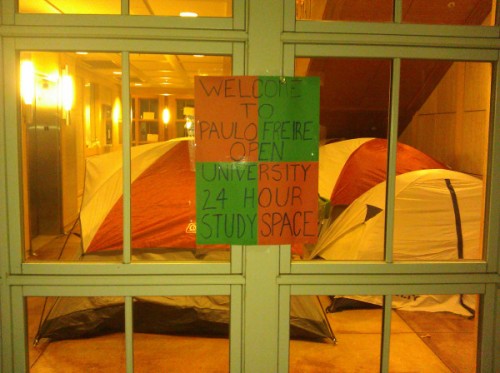
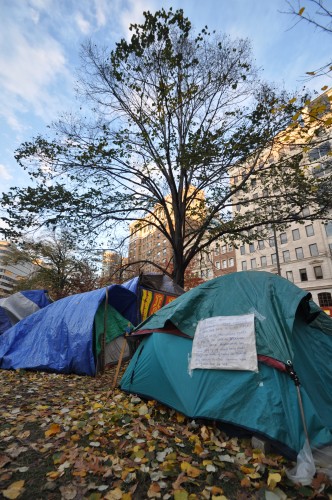
When the occupiers in Zuccotti Park began setting up tents, it was an inherently practical move. After cold, uncomfortable nights on tarps and huddled into sleeping bags (a situation imposed by a no-tent policy in the park, which was eventually not enforced), tents were a welcome way to make an occupied space more of a home, and closer to familiar conceptions of an established community.

But we need to understand tents as more than just tents.
more...

Occupy DC (Source: PJ Rey)

After the many, many evictions which have taken place over the last several weeks, both here in Canada and in the United States, there has been a lot of discussion about the ‘next phase’ of the Occupy movement. My personal interest has been focused, from the start, on the specific instance of the New York occupation, so it is their eviction and current situation which interests me the most. I specify this up front because I think it is difficult to speak about the OWS movement as a Whole in meaningful terms, since each occupation is so localized. I like the comparison to open-source projects for this: some useful generalizations are possible, but the source code is open to tinkering and adapted to each specific use.

Recently, the NY Occupation was evicted from their previous home at Liberty park, and scattered to the four winds. They have so far proven that they have the institutional robustness to deal with this by continuing to provide food and shelter to all in need, as well as continuing to effectively plan and implement direct actions along with effective media. They have even continued their regularly scheduled General Assemblies and Spokes Councils, despite cold weather, a hard time finding space, and what seem to be increasing feelings of tension amongst certain committed members.

I see this continued ability to act as centrally linked to their being an Augmented Movement. Because they represent this blend of atoms and bits they have been able to continue coordinating effectively by transferring ever more of that coordination online. However, as an augmented movement, they face unique problems. Bits are well and good, but atoms are tricky things, and certain things can only continue to happen offline: people need food and places to stay, as well as the need to meet and communicate face to face so that strong links can be maintained along with the horizontal institutions upon which the current movement is premised. It is this second aspect of their problem which I find most interesting, and challenging. more...