Technique

The new Google maps probably won't destroy public space.
The new Google maps probably won’t destroy public space.

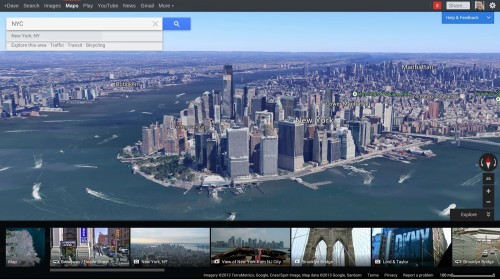
Maps are always political. Most maps show us something that we already believe, so its difficult to see what is being reinforced and what is systematically ignored. Even the most mundane AAA maps of highways and state borders are doing political work by recognizing the sovereignty of individual states and the obduracy of highways and roads. The near-infinite number of things, qualities, measurements, and people that have spatial characteristics (seriously, just think of all of it: temperatures, ancestral lands, endemic species, isobars, places to buy smoothies, locations of hidden treasure, and so on, and so on…_) mean that map makers must always select what is relevant and what is not. This selection process—a human endeavor—is inherently social and deeply political. Google, a company that has taken upon itself to reject that selection process and “organize all the world’s information,” wants to provide a single map and, instead of deciding what is relevant in any given map, will personalize it based on information it has about you and your friends. Evgeny Morozov, writing in Slate,[1] is rightfully concerned that Google doesn’t quite know what they’re dealing with when they say they want to organize public spaces in their databases right next to email and photos of cats. He is concerned that–unlike books or weather forecasts—Google doesn’t “acknowledge the vital role that disorder, chaos, and novelty play in shaping the urban experience.” I completely agree that unpredictability is necessary for good urban space, but the biggest threat Google poses to public space isn’t that its maps are “profoundly utilitarian, even selfish in character.” Rather, Google hasn’t done enough to personalize maps in such a way that they become part of everyday social (and Social) life. more...
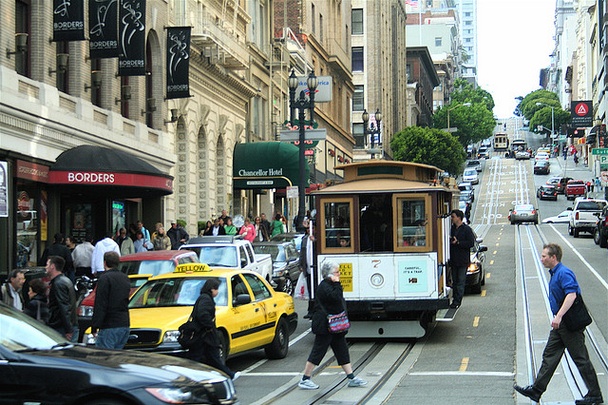

Image from The Atlantic Cities, Flickr user Bikoy under Creative Commons

About this time last year I asked our readers, “why we don’t criticize other things like we criticize the internet?” It seemed like a fitting topic for the season; we utilize some of the most resource-intensive technologies at our disposal so that we may enjoy egg nog with old friends or taste grandma’s famous Thanksgiving day turkey. Everyone wants to be near their loved ones for the holidays, and so begins a massive effort to transport ourselves in cars, trains and planes until we arrive at our optimal holiday season arrangements. It is a wonder, then, why we spend so much of our lives outside of this optimal arrangement. What kind of relationship do we have with our immediate surroundings? Not just the people, but the technologies and the patterns. There is a lot of excellent work on carbon footprints, local food movements, and walkable communities but I hear comparatively little about who is capable of making this transition. What does opting out of the status quo truly entail?  more...

The Jager Bomb:
Ingredients:

  • One 8 oz. can of Red Bull
  • One shot of Jägermeister
  • Willingness to overpay for an overhyped experience

The shot of Jager is dropped into a glass of Red Bull and chugged until all evidence disappears down the throats of the youthful.

Felix Baumgartner jumps higher and faster than anyone ever before. Image c/o AP

As I (and a record 8 million other live Youtube viewers) witnessed Felix Baumgartner jump from a floating platform 128,000 feet in the air, I could not help but think about those little red bulls on his helmet. Red Bull, the ubiquitous energy drink and funder of all things Extreme™, had branded nothing less than a moment in human history. A monumental achievement brought to you by a peddler of a sugary drink that has fueled some of the worst decisions in the world [NSFW]. There was a day when the United States government was in the business of dazzling humanity with its feats of technological superiority and raw tenacity. For three years we were landing on the moon almost every six months. We made it look easy. Baumgartner’s jump is truly incredible, but it also makes me a little angry. I am tempted to bemoan the fall of civic life and the rise of corporate-sponsored spectacle, but ultimately I cannot find a moral handhold. Do I want an arms race or consumer capitalism to fund the greatest technological achievements of my lifetime? more...

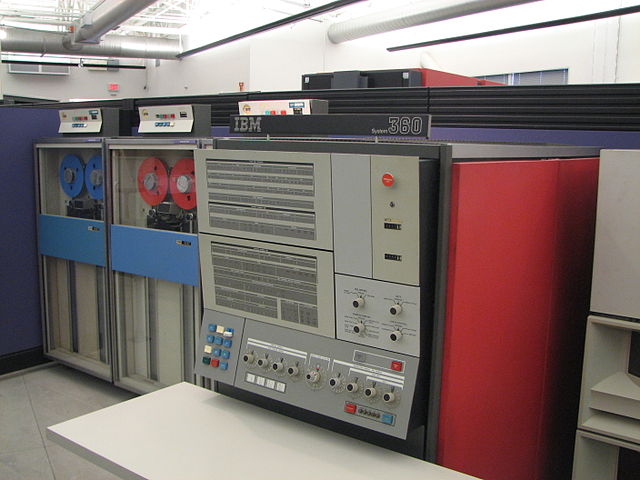
The IBM System/360 was the clock tower of its time.

I want to spend a few hundred words today, considering the geographic dimensions of digitally augmented/mediated social action. I am not only talking about GPS-enabled smartphone apps (Foursquare, Geocaching, SeeClickFix, etc.) but also the sorts of practices and habits– the kind that most people barely notice– that make up one’s daily Internet usage. Just as there are different car cultures in different parts of the United States (and the rest of the world), are there different “Interent  Cultures” based on geographic region? Does where you connect, have any impact on how you connect? In some respects, yes– speed, availability, and stability of a connection matters; nations put up firewalls to prevent their citizens from accessing dangerous ideas; and you wouldn’t (or can’t) do the same things on your work computer that you could do on your home computer. All of this leads to a common provocation: can we utilize the properties of scale, place, and community to create radically new kinds of augmented realities.  Can communities utilize a shared Internet connection to deal with local issues? Can we deliberately work against the individualist ethic of the Internet to revitalize public life? more...

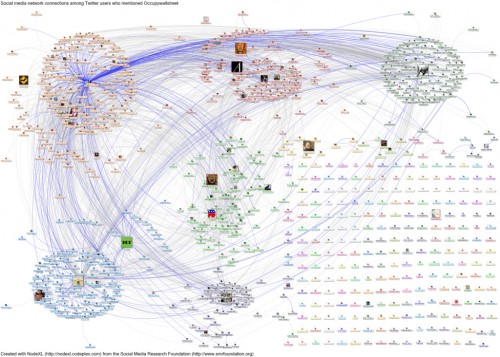
Marc Smith of the Social Media Research Foundation analyzed twitter associations of Occupy Wall Street tweets and found a viral, highly decentralized network of individuals. They compared this to the Tea Party, which had a much more centralized group dynamic.

Americans have gotten so good at being consumers that it almost seems hackneyed to acknowledge such a thing. I say “almost” because there are still wonderfully interesting things being said in some literary and academic circles that continually find deeper levels of meaning in the seemingly shallow end of the societal pool. Our near-perfect systems of consumption not only make it technically possible to exchange beautifully designed plastic gift cards,but  it makes it socially acceptable as well. A gift-giver can reliably assume that the recipient a thousand miles away has access to the same stores, with almost the exact same products. The gift-giver can also assume a certain level of homogeneity about gift-giving practices. Most of us share a set of common beliefs about what constitutes a good gift: It should, relate to our interests, be useful, carry sentimental value, reflect the nature of a relationship, provide entertainment, and/or fill a need. When you give a gift card, you are acknowledging the need or want, but allowing the receiver to specify its final material (or digital) form. This system relies on stability and uniformity to function smoothly. There must be a common culture, as well as a reliable stream of goods and services. But such stability is becoming less, and less likely. Whether it is peak energy, financial collapse, or a little bit of both- our world is becoming less predictable and the systems that rely on steady streams of capital and petroleum are breaking down. In their place, we might begin to find self-organizing systems that are not only more efficient, but also much more just forms of resource distribution. more...

YouTube Preview Image

Start at 13:42 – 15:37 for images of Zuccotti Park being dismantled

The clearing of the Occupy Wall Street demonstrators from the streets of various cities over the past few weeks has been a strikingly naked demonstration of the characteristic properties of what Jacques Ellul called “technique.”

Like other philosophers, Ellul thought of technology more as a state of being than as a collection of artifacts. “Technique” is the word he used to describe a phenomenon that includes, in addition to machines, the systems in which machines exist, the people who are enmeshed in those systems, and the modes of thought that promote the effective functioning of those systems.

In The Technological Society, Ellul called technique “the translation into action of man’s concern to master things by means of reason, to account for what is subconscious, make quantitative what is qualitative, make clear and precise the outlines of nature, take hold of chaos and put order into it.” The machine, he added, is “pure technique… the ideal toward which technique strives.” more...