
symbolic action

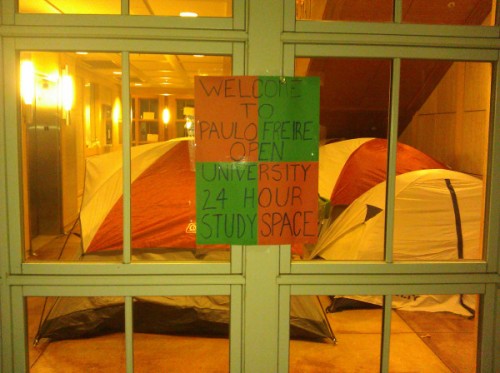
When the occupiers in Zuccotti Park began setting up tents, it was an inherently practical move. After cold, uncomfortable nights on tarps and huddled into sleeping bags (a situation imposed by a no-tent policy in the park, which was eventually not enforced), tents were a welcome way to make an occupied space more of a home, and closer to familiar conceptions of an established community.

But we need to understand tents as more than just tents.

more...

In the 36 hours since the Occupy Wall Street raid removed protest infrastructure from Zuccotti Park, much of the conflict strikes me as the tension between the informational (the symbolic; media; ideas) and the material (physical; geographic). It runs through how New York City carried its actions out (at night, blocking journalists), the ensuing legal fight (does occupying physical space count as speech?) as well as the new strategic challenges facing an Occupy movement where camping is decreasingly an option.

Anyone who reads this blog knows that much of my work lies at the intersection of (1) information, media, technology, the online and (2) materiality, bodies and offline physical space. At this intersection, our reality is an “augmented” one. Part of the success of Occupy (and other recent protest movements) has been the awareness of just this point: by uniting media and information with the importance of flesh-and-blood bodies existing in physical space, our global atmosphere of dissent is increasingly one of an augmented revolution. Indeed, these are not protests centered online, as Jeff Jarvis tweeted this morning, or Zuccotti park, but in the augmented reality where the two intersect.

And this intersection of the power of the image and the power of the material dramatically came to a head about 36 hours ago as I write. In the early morning of November 15th, the two-month long occupation of Zuccotti Park was eliminated by the City of New York. more...