status

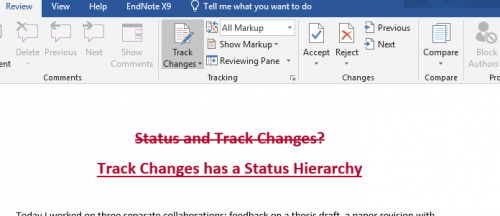
 Today I worked on three separate collaborations: feedback on a thesis draft, a paper revision with colleagues at other universities, and a grant proposal with mostly senior scholars. Each collaboration represents my integration with distinct project teams, on which my status varies. And along with my relative status, so too varies my relationship with the Track Changes editing tool.

When giving feedback on my student’s thesis, I wrote over existing text with reckless abandon. I also left comments, moved paragraphs, and deleted at will. When working on my paper collaboration, I also edited freely, though was more likely to include comments justifying major alterations. When working on the research grant, for a project team on which I am the most junior member, I knew not to change any of the text directly. Instead, I made suggestions using the Comment function, sometimes with alternative text, always phrased and punctuated as a question. more...

rigged

Pundits across the political spectrum have expressed outrage at Trump’s continued insistence that the presidential election is rigged, and seem quite scandalized at his stated unwillingness to agree, apriori, to accept the final results.  Trump’s critics argue that his distrust of the election process threatens to destabilize U.S. democracy by undermining the ideology of citizen-driven governance. It is horrifying they say, and more than that, his claims are dangerous.

While a smooth transition of power is indeed a hallmark of democracy, there is a distinct disingenuousness about the breathless moralizing against Trump’s claims. It’s hard to ignore the sharp dissonance that emerges when broadcast journalists report on the economics of campaign finance, the political collusion and corruption revealed through an email leak, and then, without even the interruption of a commercial break, turn to Camera 2 and condemn Donald Trump for questioning the integrity of the democratic process.   more...

Polling

Horse-race style political opinion polling is an integral a part of western democratic elections, with a history dating back to the 1800’s. Political opinion polling originally took hold in the first quarter of the 19th century, when a Pennsylvania straw poll predicted Andrew Jackson’s victory over John Quincey Adams in the bid for President of the United States. The weekly magazine Literary Digest then began conducting national opinion polls in the early 1900s, followed finally by the representative sampling introduced the George Gallup in 1936. Gallup’s polling method is the foundation of political opinion polls to this day (even though the Gallup poll itself recently retired from presidential election predictions).

While polling has been around a long time, new technological developments let pollsters gather data more frequently, analyze and broadcast it more quickly, and project the data to wider audiences. Through these developments, polling data have moved to the center of election coverage. Major news outlets report on the polls as a compulsory part of political segments, candidates cite poll numbers in their speeches and interviews, and tickers scroll poll numbers across both social media feeds and the bottom of television screens. So central has polling become that in-the-moment polling data superimpose candidates as they participate in televised debates, creating media events in which performance and analysis converge in real time. So integral has polling become to the election process that it may be difficult to imagine what coverage would look in the absence of these widely projected metrics. more...

Image credit
Image credit

Late Monday night it was discovered that one of the EPA’s Twitter accounts was a C-list celebrity on the popular iPhone game Kim Kardashian: Hollywood. The Tweet was one of those automatically generated ones meant to announce progress in a game or the unlocking of an achievement. Its easy to imagine the scenario: an over-worked or deeply bored social media manager didn’t realize they were signed into their work account instead of their personal one and let the tweet go. Or maybe a family member borrowed their work phone. Who knows? What we do know is that the tweet immediately garnered thousands of retweets and countless more screenshots were shared on other platforms. Why is this even remotely funny? What sorts of publicly held believes does it reveal? more...

For those of us eagerly awaiting the Winter Olympics this February, we got an Olympics of a different kind to tide us over. Last weekend, the “Robot Olympics” took place at the Homestead-Miami Speedway in south Florida. Schaft Inc., a Google-owned Japanese company, took first place at The Games, officially called the DARPA Robotics Challenge (DRC). The events in which competitors compete, and the criteria by which they are evaluated, are nicely illustrative of Earnst Schraube’s technology as materialized action approach, and present an opportunity to push the theory further. more...

apple-event

Confession: I watched the Apple event yesterday, and I’ve watched at least part of every product announcement for the last several years. Apple announcements are the opposite of a guilty pleasure; they are a burden that I take on with pride.  They are insipid and represent everything that is wrong with Silicon Valley and yet I feel obliged to watch them because they let me stare deeply into this heaving morass of Cronenbergian lust for technology. It always feels like we’re one year away from Phil Schiller offing himself with an iGun after screaming “LONG LIVE THE NEW FLESH!” When I watch Silicon Valley spread out on the Moscone Center stage I feel prideful (to a fault perhaps) that these events just seem so… transparent. They’re so easy to read and so easy to critique they amount to social science target practice. more...

Does this phone make me seem like...less of a man?
Does this phone make me seem like…less of a man?

When did mobile phones go from being symbols of status and power to being “emasculating”? Probably around the time they became easier to access than toilets are.

Sergey Brin, of course, would likely say that emasculation arrived with the touchscreen smartphone—when using a mobile phone became a matter of “standing around and just rubbing this featureless piece of glass” while looking down, instead of flexing one’s bicep to bark orders into a massive handset while staring straight ahead (or glaring at a subordinate). Real men don’t “stand around”; real men do stuff! Real men punch buttons with authority, and take decisive action! PJ Rey (@pjrey) and I may have argued that we express agency through our smartphones, but “rubbing”? Touching? That’s, like, girl stuff. Eeeeeeew.

Tongue-in-cheek riff aside, there’s more to Brin’s smartphone insecurity than may be apparent on the (glassy) surface. more...

We are currently facing a cultural crisis of authenticity. Since the early 2000s, we have seen the concept “authenticity” slowly move from margins to mainstream (Reynolds, 2011), encapsulated by feverish celebrity gossip surrounding breakout stars like Lana Del Rey, personified through the rise of the urban hipster as folk devil (those self-professed taste arbiters of cool who ride “fixies” through the urban landscape, collect obscure records, and wear vintage clothes), and exemplified in Web 2.0 and the rise of social media (especially curatorial media like LastFM and more recently, Pintrest), where we are all now encouraged to share, like, and make public pronouncements of our personal tastes. In the contemporary zeitgeist, it seems that we are all “grasping for authenticity” in an attempt to make our lives seem more important, substantial, and relevant (Jurgenson, 2011).

In this environment, identity is constructed both on and offline, but our online identities are increasingly coming to define our public identities. As such, the “online commons” (Lih, 2009) becomes an important space of identity construction and conflict. more...

Since these hipster blog posts are generating so much great discussion I thought I would bring you another example of the subculture. I came across this website after my girlfriend attempted to get me to listen to some folk bands or something that she liked. I can’t exactly recall how it happened, but I do recall her sending this website to me.

The entire website for Plan-It-X Records is a simple .jpg image seen above.

more...