Social

Image from Robert Cooke

On Monday I posed two related questions:  “Are wearables like Glass relegated to the same fate as Bluetooth earpieces and the Discman, or can they be saved?  Is the entire category irredeemable or have we yet to see the winning execution?” I concluded that most of the problems have to do with the particular executions we’ve seen to date, but it’s also very possible that the very idea of the wearable is predicated on the digital dualist notion that interacting with a smartphone is inherently disruptive to a productive/happy/authentic lifestyle. Lot’s of devices are pitched as “getting out of the way” and only providing a little bit of information that is context specific and quickly (not to mention discreetly) displayed to the user. I contended that the motivation to make devices “invisible” can bring about some unintended consequences; mainly that early adopters experience the exact opposite reaction. Everyone pays attention to your face computer and nothing is getting out of the way at all. more...

traffic_roundabout
You choose the routes, but Spotify builds the roads.

A little more than a year ago, I wrote on Cyborgology about how I refused to join the Social music service Spotify. A little less than a year ago, I wrote an expanded version of that essay for The New Inquiry (TNI). In between those two essays, a funny thing happened:

Yeah, I joined Spotify.

I swear to you though, it wasn’t my fault (“fault”). more...

The semantics of Silicon Valley Capitalism are precise, measured, and designed to undermine preexisting definitions of the things such capitalists seek to exploit. It is no coincidence that digital connections are often called “friends,” even though the terms “friend” and “Facebook friend” have very different meanings. And then there is “social,” a Silicon Valley shorthand term for “sharing digital information” that bears little resemblance to the word “social” as we’ve traditionally used it. From “Living Social” to “making music social,” “social media” companies use friendly old words to spin new modes of interaction into concepts more comfortable and familiar. It is easier to swallow massive changes to interpersonal norms, expectations, and behaviors when such shifts are repackaged and presented as the delightful idea of being “social” with “friends.”

But is this “social” so social? Yes and no and not quite. To elaborate, we propose a distinction: “Social” versus “social,” in which the capital-S “Social” refers not to the conventional notion of social but specifically to Silicon-Valley-Social. The point is, simply, that when Silicon Valley entrepreneurs say “social,” they mean only a specific slice of human sociality. more...

The difficulties we face in getting a wifi signal underneath these trees, tells us something important about our relationship to technology.

Commentary about the Internet and the various communication services it provides, regularly fall into utopian or distopian visions of radically new worlds. The utopias tell of a future in which we are all continually connected in a seamless egalitarian web of techno-democracy. The distopian warnings describe overstimulated zombies shuffling from computer screen to smartphone, hermetically sealed in the echo chamber of their choosing. These predictions are equally unlikely to occur any time in the near future, and for one simple reason- Its really hard (and expensive) to get a stable internet connection in a park. more...

The 2011 American Sociological Association Meetings are about to start this week in Las Vegas, Nevada.

As the conference gets underway, the volume of tweets containing the #ASA2011 hashtag is rising.

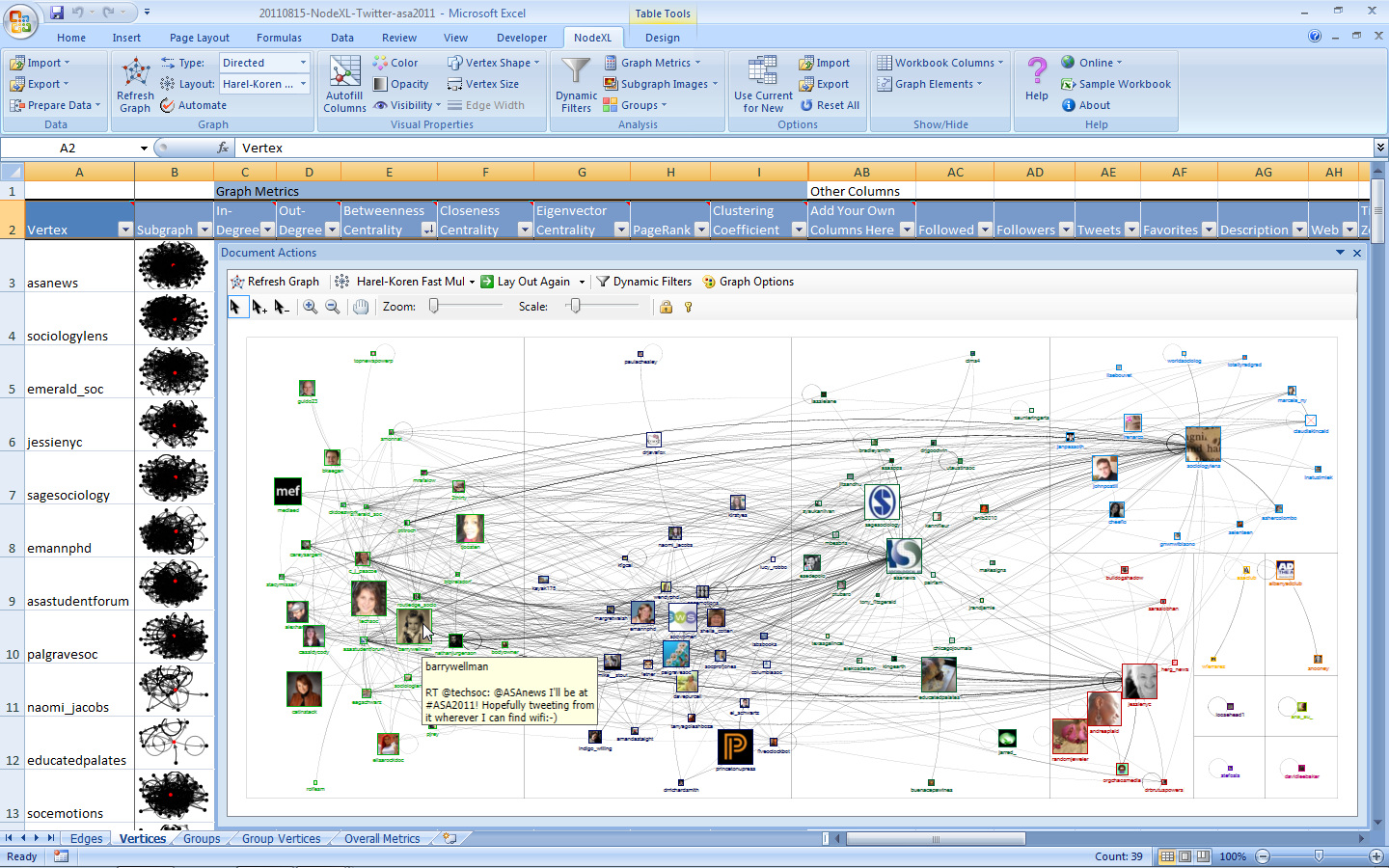
Using NodeXL, I collected a set of tweets with the #ASA2011 tag and mapped the connections among the people who tweeted that term.

ASA 2011 NodeXL SNA Twitter Map

These are the connections among the Twitter users who recently tweeted the word ASA2011 when queried on August 15, 2011 more...