Tag Archives: social theory

The Brilliance of Silver Spring #f2c


It’s as if a TED conference smashed headfirst into a hackathon and then fell into an NGO strategy summit. CEOs sit next to non-profit employees and eat boxed lunches as a dominatrix (@MClarissa) presents a slide on teledilonics followed up by a garage hacker-turned-million dollar project director quoting Alexis de Tocqueville. It is a supremely uncanny experience that all happens within the confines of a movie theater (and, later, a sushi bar). This is what one can expect when they attend the Freedom to Connect conference (#f2c) held in Silver Spring, Maryland. The conference is meant to bring “under-represented people and issues into the Washington, DC based federal policy discussion…” I left the conference feeling generally good that there are people out there working to preserve and protect open infrastructures. I just wish that team were more diverse.

(more…)

A Genealogy of Augmented Reality: From Design to Social Theory (Part One)

Image credit: Audrey Penven, “Dancing with Invisible Light”

Once upon a time in Winchester, VA, a nurse and a psychologist wondered what to name their second child (a newborn boy). This little boy would one day grow up to be a famous politician, so it was important to give him a good name. Eventually they settled on Richard (which means “powerful leader”) for a first name, and John (which means “God is gracious”) for a middle name; they gave him his father’s last name, because that was the custom at the time. Yet today, when someone says “Santorum,” do you first think of the former U.S. Senator? Or do you maybe think of columnist and gay rights activist Dan Savage?

Much to the former Senator’s likely chagrin, “santorum” is an excellent example of how words (and objects) that were not originally intended or designed to be “political” can take on new meanings–as well as new politics–once out in the world. (more…)

Pure Dualism and Pure Integration: Take Two

Last week, in response to Jurgenson’s earlier typology of dualist theorizing,  I typologized empirical/experiential reality upon a porous continuum between pure digital dualism and pure integration. Each of these poles represents a problematic and unrealistic ideal type. The intervening categories, however, represent theorizable empirical situations. In an effort to explicitly link my argument to Jurgenson’s,  I labeled these intervening categories using the language of his typology. Jurgenson critiqued this linguistic choice, and I agree.  Having driven home the connection, and diagnosed the “slipperiness” of theory that Jurgenson decried,  I now re-work the language of my typology to more precisely represent the meaning behind each categorical type. Although the adjustments are slight (I change only two words–but very important ones), the meaning is far more lucid. Below is the original post, with my typological categories reworked linguistically. Changes are indicated by red text. Further suggestions/critiques are welcome. 

(more…)

Overcoming Tote Bag Praxis

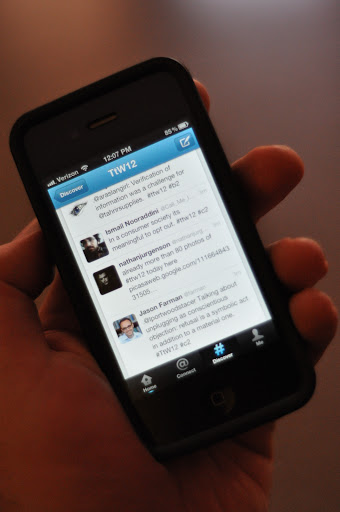
TtW12 twitter backchannel

The TtW12 Twitter back channel. Photo by Rob Wanenchak

Theorizing the Web 2012 was great. Everyone involved did a bang-up job. I certainly learned more in a single day than I usually do at weekend-long establishment conferences. I have said a lot about conferences (here, here, and here) as have fellow cyborgologists (Sarah, Nathan, and PJ). All of these posts have a common thread: academia is changing, but conferences seem out of date in some way. They are needlessly insular, they rely on hefty attendance fees that are increasingly cost-prohibitive,  and they rarely take advantage of social media in any meaningful way. The relative obduracy of conference styles come into high relief once they are compared to the massive changes to institutional knowledge production. Universities have adopted many of the managerial practices of private companies. They are also acting more like profit-seeking enterprises: putting massive resources into patenting offices and business incubators, hiring less tenure-track teaching staff, and employing armies of professionalized managers that run everything from information technology services to athletic facilities. Conferences, on the other hand, have seen few innovations beyond what I call Tote Bag Praxis.  (more…)

Limbaugh’s Social Media Problem

Rush Limbaugh is experiencing an advertiser exodus, and social media is playing a big part.

It’s the kind of story that writes itself. A popular media entity, on one of the oldest forms of electronic mass media, bears the brunt of activists’ Facebook wrath. It combines two old rivalries: liberals and conservatives and new media versus old media. In case you missed it, here’s the brief synopsis of events from ABC news:

Rush Limbaugh remains in big trouble. Advertisers – 11 at last count – are pulling spots off his radio talk show because of the reaction to his calling Georgetown University law student Sandra Fluke a “slut” and a “prostitute.” Opponents are mobilizing on social media for a long campaign to try to convince even more sponsors to drop his program. Ms. Fluke herself has rejected as insufficient Mr. Limbaugh’s attempts at apology

Fluke had testified before congress about the importance of “the pill” for medical uses beyond birth control. Rush concluded that she was having so much sex that she needed the American tax payer to help defer the cost of her contraceptives. (This has led to some speculation that conservatives don’t know how hormonal birth control works.) Thousands of people are organizing to get advertisers to pull their money out of Rush Limbaugh’s show, and many of them are organizing via Twitter and Facebook. Will we be subjected to another round of technologically deterministic news stories about “cyber revolution,” or are we going to have a more nuanced conversation? More precisely, does Rush have a social media problem or has he -all things being equal- just gone too far this time? (more…)

Frictionless Sharing and the Digital Paparazzi

(Or: How we’ve come to be micro-celebrities online)

Facebook’s recent introduction of “frictionless sharing” is the newest development in a growing trend: data is being increasingly produced passively as individuals conduct their day-to-day activities. This is a trend that has grown both on and offline. We will focus on the former here; especially “frictionless” sharing that involves syncing Facebook with other sites or apps. Once synced, much of what a user listens to, reads or otherwise accesses are automatically and immediately published on Facebook without any further action or approval.  Users may not even need to “opt into” frictionless sharing because many services are changing their default setting to automatically push content to Facebook. In short, we can say that users play a passive role in this process.

Contrast this to more active sharing: when we “like” or “+1” something (by clicking the eponymous buttons that have spread throughout the Web) it requires the user to make a conscious and affirmative action to share something with others in their network. Nathan Jurgenson (one of this post’s co-authors) previously described these two models as types of “documentary vision:” We actively document ourselves and our world around us as if we have a camera in our hand (“liking”, status updates, photos, etc.), or we can passively allow ourselves to be documented, curating our behaviors along the way (e.g., reading a magazine article so that you can present yourself as the type of person who “likes” that sort of magazine) much like a celebrity facing a crowd of paparazzi photographers.

Let’s make another layer of complexity to this documentary model (more…)

The Rise of the Internet (Anti)-Intellectual?

Larry Sanger and Evgeny Morozov have both critiqued the lack of rigor in modern technology writing.

The title of this post is an homage to two recent essays, the first being Larry Sanger’s “Is There a New Geek Anti-Intellectualism?” and the second Evgeny Morozov’s “The Internet Intellectual”, a recent scathing review of Jeff Jarvis’ latest book.

Larry Sanger’s critique of “geek” culture as anti-intellectual is a powerful read (even though I wrote a sort-of critique of Sanger’s post here; and he replied to me here). Sanger’s fundamental point is that modern geek culture is characterized by an anti-intellectual rejection of experts and I want to bring in Morozov’s review to highlight a slightly different point: the techno-experts embraced are anti-intellectual themselves.

My goal in this short piece is to encourage the reader to take a look at these two essays in tandem to suggest a further conversation about the need for public intellectuals, the role of academics in framing theories of new technologies and what the consequences are when we leave this discussion to be dominated by business folks.

To be read as a pair:

Is There a New Geek Anti-Intellectualism?, by Larry Sanger.

The Internet Intellectual, by Evengy Morozov.

To be honest, I tried to dislike Morozov’s review (more…)

Social Media and Our Atmosphere of Augmented Dissent

laptops at the #occupy protests

Mass collective action is in the air, on the ground, on the web; indeed, there exists today an atmosphere conducive for revolutions, flash mobs, protests, uprisings, riots, and any other way humans coalesce physically and digitally to change the normal operation of society. [Photos of protests around the globe from just the past 30 days].

Some gatherings have clear goals (e.g., ousting Mubarak), however. there is also the sense that massive gatherings are increasingly inevitable today even when a reason for them is not explicit (e.g., the ongoing debate over the reasons for the UK Riots or the current #occupy protests). For some this is terrifying and for others it is exhilarating. And still others might think I am greatly overstating the amount of protest actually happening. True, we do not yet know if this second decade of the 21st Century will come to be known for massive uprisings. But if it is, I think it will have much to do with social media effectively allowing for the merging of atoms and bits, of the on and offline; linking the potential of occupying physical space with the ability of social media to provide the average person with information and an audience.

For example, the current #occupy protests across the United States (more…)

George Ritzer: The Cathedrals & Dinosaurs of Consumption

Today we have a guest post from Distinguished University Professor and social theorist George Ritzer. This text is only part of the talk Dr. Ritzer will deliver in Las Vegas on Friday, August 19thas part of the Consumer Society Research Network conference [program]. Ritzer’s work on the technologies of consumption is in full force in this essay. The technologies of consumption in the form of ever more spectacular “cathedrals” of consumption are coming to look more and more like “dinosaurs.” This essay to provides an important backdrop of the current economic situation in Las Vegas, one in which Ritzer argues mirrors larger trends in consumerism and globalization.

There is, at least from my point of view, no better place to discuss the crisis and contradictions in consumption in the US, especially in its cathedrals of consumption, than in Las Vegas, the city devoted to, and built on, consumption and defined globally by its iconic cathedrals of consumption; the major casino-hotels on the Strip. It is here that we witnessed what was arguably the greatest consumer-driven expansion in the US in the run up to the Great Recession and, as a result of the latter, perhaps the greatest economic setbacks. Unemployment in Las Vegas rose as high as 15% and is still over 12%. New construction is virtually non-existent. The foreclosure rate, while slightly down from 2009, remains the highest, and by a wide margin, of all the metropolitan areas in the US. Gaming revenue dropped by $2 billion at the depth of the recession and is still down about $1.5 billion from the peak. The largest casino hotel conglomerates- MGM and Caesars- continue to report huge losses largely because of debt incurred during the Great Recession. Mirroring the global economic shift to the Far East, Las Vegas is no longer the gambling capital of the world and has been surpassed by both Macau and Singapore. (more…)

Life Becomes Picturesque: Facebook and the Claude Glass

I have been thinking through ideas on this blog for my dissertation project about how we document ourselves on social media. I recently posted some thoughts on rethinking privacy and publicity and I posted an earlier long essay on the rise of faux-vintage Hipstamatic and Instagram photos. There, I discussed the “camera eye” as a metaphor for how we are being trained to view our present as always its potential documentation in the form of a tweet, photo, status update, etc. (what I call “documentary vision”). The photographer knows well that after taking many pictures one’s eye becomes like the viewfinder: always viewing the world through the logic of the camera mechanism via framing, lighting, depth of field, focus, movement and so on. Even without the camera in hand the world becomes transformed into the status of the potential-photograph. And with social media we have become like the photographer: our brains always looking for moments where the ephemeral blur of lived experience might best be translated into its documented form.

I would like to expand on this point by going back a little further in the history of documentation technologies to the 17th century Claude glass (pictured above) to provide insight into how we position ourselves to the world around us in the age of social media. (more…)