

sherlock

The plot of Scream is impossible without cordless phones.

In Children of Men Clive Owen’s character Theo is trying to secure “transfer papers” from his cousin Nigel who seems to be one of the few rich people left in the no-one-can-make-babies-anymore-dystopia. The two older men are sitting at a dining table with a younger boy, presumably Nigel’s son, who seems to be inflicted in some way. He’s pale and stares vacantly at somewhere just past his left hand which is eerily still in between the twitches of fingers that are adorned by delicate wires. He doesn’t respond to others in the room and isn’t eating the food in front of him. After Nigel yells at him to take his pill we notice that they boy isn’t really sick or particularly disturbed, he’s playing a game attached to his hand. more...

In a recent post about communal storytelling via ICTs, Sarah Wanencheck highlights how digital media is breaking down the old narratological dualism of fiction and non-fiction. She argues non-fictional identities on social networks are communally constructed, in ways akin to the collaborative storytelling practices on fanfiction sites. Here I’ll look at how narrative roleplaying on the instant messaging service Omegle shapes new subjectivities on the social networks its roleplayers use to sustain and develop their fiction.

We perform identities on social networks, using filters and images, and timelines, and real-time updates – but those identities are never too far removed from those we perform in real-world frames. Roleplaying on Omegle offers a way of getting closer to other writers’ characters in ways which are paradoxically more personal and more immersed in the author’s creation than ever before. While fans wait for their favourite TV series or book series to start up again, they create narratives in collaboration with others which run parallel to their ‘real’ lives. What happens to the division between the fiction and nonfiction when we can experience being someone entirely different every day, within the frames of social networks like Tumblr and Facebook? more...

[SPOILER ALERT: details about the first episode of Sherlock“A Study In Pink” are discussed below. The ending is not totally given away, but major story details are revealed.]

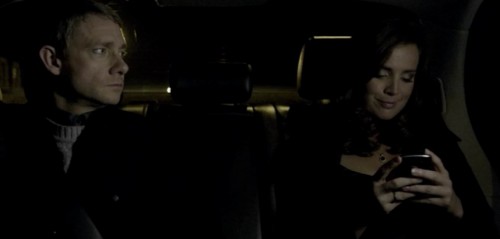
A few weeks ago, I challenged Kurt Anderson’s claim that cultural progress and innovation had stagnated in the last twenty years. Anderson, I contend, has ignored new mediums (the Internet), re-invented genres (hip-hop, electronic music), and new cultural stereotypes (geek chic, hipsters). But what ties all of these things together is the central thesis that consumer technologies are just as much cultural artifact as clothes or music. No where is this more obvious and brilliantly executed than in BBC One’s updated interpretation of the Sherlock Holmes mysteries. Set in present day London, “Sherlock” is a reinterpretation of the most famous Holmes mysteries and does an excellent job of translating the Victorian source material into a modern drama. That translation includes dress, idiomatic expressions, and vehicles- but it also includes cell phones, restrictions on smoking, and the War on Terror. Sherlock is a uniquely 21st century show that could not have taken place in the early 2000s or the 90s. more...