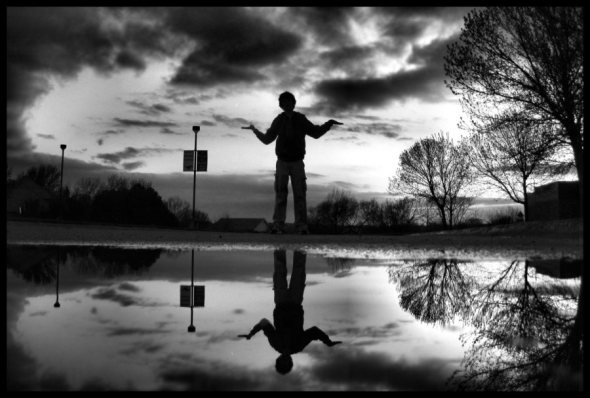
reality

Photo credit: Evan Ludes

Last week, I started a somewhat ridiculously ambitious post wherein, by way of making a whole bunch of points I’ve been wanting to make anyway, I intended to push us all toward strengthening and clarifying our ideas around both digital dualism and augmented reality. In light of some really excellent work by Jenny Davis (@Jup83), PJ Rey (@pjrey), and Tyler Bickford (@tylerbickford), in addition to some old-fashioned conversation on these topics with PJ and Nathan Jurgenson (@nathanjurgenson), I’m now going to change course a bit. In this middle installment, I’m going to revisit the three problematic dualisms of digital dualism (Atoms/Bits, Physical/Digital, and Offline/Online), take up the two recent major critiques of the digital dualism framework, advance a few provocations in the service of breaking dualisms and promoting clarity, and then finally conclude for this week with a preview of this essay’s final destination.


more...

realityAlright, pop quiz: Is there a reality outside of human experiences? Please circle YES or NO.

Chances are you find this question either very silly or very complicated, possibly both. But I argue that this question is actually lurking in the background of much this month’s earlier digital dualism debate, and that giving it some attention straightens a lot of things out—especially the compelling (but ultimately incorrect, I argue) charge that augmented reality is itself a dualist framing.

To illustrate why this question matters, consider the following fictional (but not entirely unlikely) scenario, in which I either am or am not a jerk:

more...

I’m having a blast reading all of the recent posts about digital dualism. I (or someone else) will collect these all into a list and I’m sure I’ll write a response to them en masse, but here I’d like to point everyone to one particular response that is important and unique in its orientation. When Nicholas Carr set off this brouhaha (or is it brouLOL?) with a post on his blog, the responses came from many directions. I’m used to fielding critiques from the right, from the dualists, but what I found especially exciting was getting a response from the left, where Tyler Bickford argues that reality is more augmented than what I argue, that I do not go far enough in my critique of dualism and thereby reify the dualism I question. To conceptually situate his and my critiques, let me restate a theoretical mapping I produced last year: more...

Giorgio Fontana (1981) is an Italian writer, freelance contributor and editor of Web Target (http://www.web-target.com/en/). His personal website is www.giorgiofontana.com. On Twitter: https://twitter.com/giorgiofontana.

In some very stimulating articles – mainly this one – Nathan Jurgenson has convincingly argued against what he calls digital dualism: that is, to think that “the digital world is virtual and the physical world real”:

more...


I have mentioned previously on this blog that I am engaged in an ongoing, qualitative, Facebook-based project looking at the experiences of social media users. None of the work from this most recent project is yet published, though I did use the data for my TtW2012 presentation. As I move into manuscript preparation, there are several theoretical and empirical trends that I need to flesh out.  I hope that readers will indulge me today as I work through one such trend. I especially hope that readers will offer critiques and literature suggestions, as the end product will inevitably be strengthened through collaborative input from this academic community.

Specifically, I hope to flesh out the notion of reality curation. Much of the work on social network sites focuses on self-presentation, or the ways in which people curate images of themselves.  These strategies of image-curation include friending practices, selective photographic and textual displays, and careful utilization of privacy settings—among other practices. Users are careful about their self-images, diligent in their upkeep, and protective against identity threats. Undeniably, I see these laborious practices of protection, maintenance, and care in the participants of my study. I also, however, see a second kind of labor; I see a diligent upkeep not only of outgoing data, but also incoming data. In particular, participants report careful curation of their Facebook News Feeds and (when applicable) Twitter networks.

This second type of curation—the curation of data coming in—is empirically and theoretically interesting. Work that focus on self-presentation (data going out) understands social network sites as both window and mirror—spaces for both voyeurism and self-reflection. This implicitly neglects, however, the idea that windows work two ways: they offer a view from outside in, but also a view from inside out. Social network sites, as opposed to non-social websites, are spaces of simultaneous projection, reflection, and, as I argue here, observation by the prosumer of the Profile.

more...

The difficulties we face in getting a wifi signal underneath these trees, tells us something important about our relationship to technology.

Commentary about the Internet and the various communication services it provides, regularly fall into utopian or distopian visions of radically new worlds. The utopias tell of a future in which we are all continually connected in a seamless egalitarian web of techno-democracy. The distopian warnings describe overstimulated zombies shuffling from computer screen to smartphone, hermetically sealed in the echo chamber of their choosing. These predictions are equally unlikely to occur any time in the near future, and for one simple reason- Its really hard (and expensive) to get a stable internet connection in a park. more...

This brief essay attempts to link two conceptualizations of the important relationship of the on and offline. I will connect (1) my argument that we should abandon the digital dualist assumption that the on and offline are separate in favor of the view that they enmesh into an augmented reality and (2) the problematic view that the Internet transcends social structures to produce something “objective” (or “flat” to use Thomas Friedman’s term).

Instead, recognizing that code has always been embedded in social structures allows persistent inequalities enacted in the name of computational objectivity to be identified (e.g., the hidden hierarchies of Wikipedia, the hidden profit-motive behind open-source, the hidden gendered standpoint of computer code, and so on). I will argue that the fallacy of web objectivity is driven fundamentally by digital dualism, providing further evidence that this dualism is at once conceptually false, and, most importantly, morally problematic. Simply, this specific form of digital dualism perpetuates structural inequalities by masking their very existence. more...

The Cyborgology editors dropped in on artist Jonathan Monaghan‘s studio to discuss his art and how it relates to technology and our contemporary world.

The impetus for my animation “Life Tastes Good” was seeing different depictions of polar bears on television. If they are selling soda, they are having a great time, if they are illustrating climate change, they are dying slow painful deaths. I decided to mix this disparate imagery into a new schizophrenic reality using the same 3d animation tools as those Coke commercials. These alternate digital realities I create in my work are both familiar and alien; playing with our desires, dreams and anxiety.

Jonathan Monaghan’s work is art in the age of hyperreality. Baudrillard offered hyperreality as a bloated, obese and dying environment liquidated of meaning, and here we see the simulated polar bear literally expiring on the screen. Monaghan has turned the simulated polar bear against itself by reintroducing it to the real. more...