
reality construction

Image by Brad Lindert

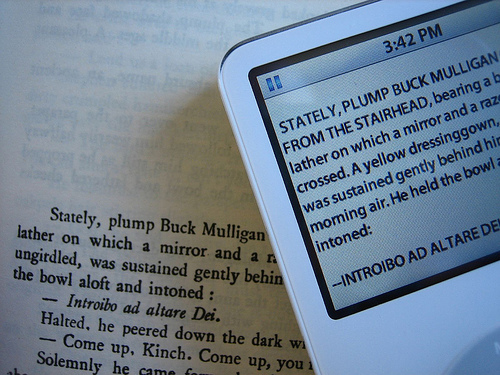
A couple of weeks ago, my interest was piqued by an article boasting the intriguing headline: “‘Losing yourself’ in a fictional character can affect your real life.” Essentially, researchers at Ohio State University have evidence that suggests very strongly that people who become emotionally engaged with a character in a story are more likely to alter their behavior according to how that character behaves, even if only temporarily. This piqued my interest first and foremost as a writer of fiction because it reflected my own experience so directly: When considering the mannerisms, speech, attitude, and choices of a character, it’s not uncommon for me to find my own behavior changing slightly to reflect those considerations, especially if I’m really trying to get inside a character’s head.

But then the piece piqued my interest in an entirely different way: the headline — if not the study itself — seems to be operating on the assumption that there is a distinct difference between a reader’s experience of a character in a work of fiction and the reader’s embodied experience of their own lives; in other words, that there’s a qualitative difference between the world of the imagination and the “real world”. And I’m inclined to view this assumption as flat-out incorrect.

Furthermore, I think the reasons why this assumption is incorrect have some things to say regarding the problematic assumption of digital dualism.

more...


I have mentioned previously on this blog that I am engaged in an ongoing, qualitative, Facebook-based project looking at the experiences of social media users. None of the work from this most recent project is yet published, though I did use the data for my TtW2012 presentation. As I move into manuscript preparation, there are several theoretical and empirical trends that I need to flesh out.  I hope that readers will indulge me today as I work through one such trend. I especially hope that readers will offer critiques and literature suggestions, as the end product will inevitably be strengthened through collaborative input from this academic community.

Specifically, I hope to flesh out the notion of reality curation. Much of the work on social network sites focuses on self-presentation, or the ways in which people curate images of themselves.  These strategies of image-curation include friending practices, selective photographic and textual displays, and careful utilization of privacy settings—among other practices. Users are careful about their self-images, diligent in their upkeep, and protective against identity threats. Undeniably, I see these laborious practices of protection, maintenance, and care in the participants of my study. I also, however, see a second kind of labor; I see a diligent upkeep not only of outgoing data, but also incoming data. In particular, participants report careful curation of their Facebook News Feeds and (when applicable) Twitter networks.

This second type of curation—the curation of data coming in—is empirically and theoretically interesting. Work that focus on self-presentation (data going out) understands social network sites as both window and mirror—spaces for both voyeurism and self-reflection. This implicitly neglects, however, the idea that windows work two ways: they offer a view from outside in, but also a view from inside out. Social network sites, as opposed to non-social websites, are spaces of simultaneous projection, reflection, and, as I argue here, observation by the prosumer of the Profile.

more...