
publishers

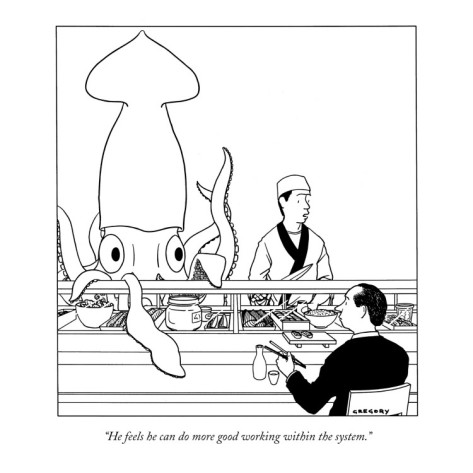
Cartoon by Alex Gregory. Published in The New Yorker, a Condè Nast Publication.

At the beginning of the year, rumors were going around that the popular but relatively small citation software company Mendeley Ltd. was going to be purchased by the publishing giant Elsevier. TechCrunch ran a story and there were a few others but not much else came out of it. When I heard these “advanced talks” were taking place, I wrote an essay in which I said,

“When our accounts of reality are owned by profit-seeking organizations and those organizations control the very tools that help us exchange those accounts, we are in danger of losing something fundamental to the institution of science. Ideas should not end up behind prohibitively expensive pay walls, especially when so little of that money goes towards new scientific discovery.”

Today, Mendeley announced on their blog that their purchase by Elsevier was official. They also reassured existing users, “Mendeley is only going to get better for you.”

I’m very skeptical.  Back in January, I raised the question, “what is Elsevier going to do with Mendeley that warrants uninstalling it from you computer?” and hinted that the kind of criminal charges faced by the late Aaron Schwartz could become commonplace, if not easier to prove and litigate.  I also noted that Elsevier has been so malicious and aggressive in their search to control and subsequently monetize knowledge that it has inspired over thirteen thousand academics to sign a pledge saying they will not support Elsevier’s journals. They have supported SOPA, PIPA, and used to support the Research Works Act as well. Oh, and they support CISPA too. None of that has changed, and there’s still plenty to be done if Elsevier wants to gain the respect their new property once had. more...

Editor’s Note from PJ Rey: Several months ago, I wrote a post called “Why Journals are the Dinosaurs of Academia,” which argued that goal of academics to circulate their ideas as widely as possible was hindered by their own backward practice of attributing excessive symbolic value to print media. In fact, the academia’s incentive structure rewards the best practices of yesteryear, while wholly ignoring modern communication. This is largely a product of the entrenched interests powerful senior scholars who seeks to consolidate their privileged position by reifying their own established habits. I concluded that, for the academy to continue to be relevant (or, rather, to start being relevant again), we must begin to reward blogging, tweeting, wiki editing, etc.

Given recent interest in the topic, I thought I would repost Patricia Hill Collins’ response.

I agree that the status of a journal should be decoupled from the fact of whether or not it exists in print. The wind is already blowing in that direction as publishers realize how expensive print really is.

I don’t think that journals are necessarily dinosaurs. A good peer reviewed journal by experts in a field can become one important location that can help us wade through seemingly endless ideas on the web with an eye toward influencing informed decisions about quality. The sheer volume of ideas that are now available on the Web means that we need some sort of system (or multiple systems) of vetting those ideas. The journal system, especially in an era of ever-more-specialized journals, can help do that. Digital journals are well-positioned to help with this task. I, for one, don’t want a “thumbs up” Facebook model of voting on intellectual quality. more...