by
jennydavis,
Apr 3, 2012, at 07:00 am

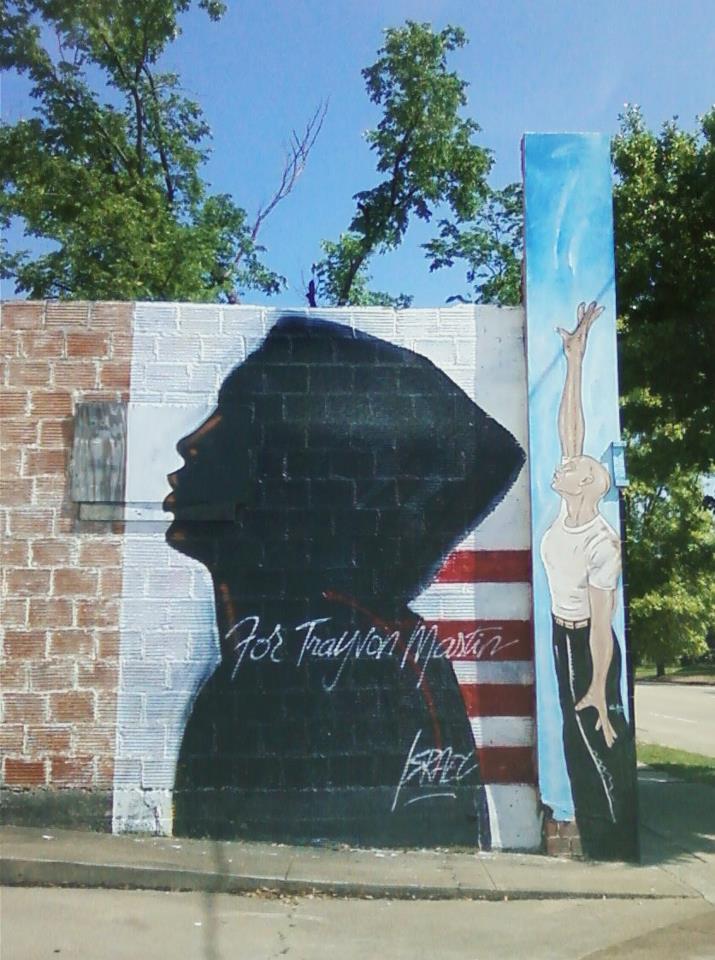
"For Trayvon Martin" mural by "Israel" in Third Ward Houston. Photo taken by Jenni Mueller.
On February 26, 2012 Trayvon Martin, a Black, 17 a year old, unarmed, high school student, was shot and killed by George Zimmerman, a White Hispanic man acting in the self-appointed position of neighborhood watch captain (click here for more details).
The case has become a symbolic battle ground for two important issues: gun laws and racism. Although both of these issues are inextricably entwined, for purposes of simplicity, I will focus here only on the issue of race.
As Jessie Daniels importantly points out on Racism Review, battles over racism have shifted into the realm of social media, where digital and physical race relations persist in an augmented relationship. We see this in both the progressive anti-racist discourses, and the racial smear campaigns surrounding the Martin/Zimmerman case.
Although it is important to expose the overtly racist tactics utilized by some of Zimmerman’s defenders—of which there are plenty—I want to talk here about a more subtle, and so perhaps more problematic form of racial discourse. Specifically, I will talk about how a prominent strategy of protest—coming out of the liberal left—may inadvertently perpetuate, rather than challenge, racial hierarchies in their most dehumanizing form. (more…)
by
davidbanks,
Sep 14, 2011, at 11:10 am
This is the first of a two-part series dedicated to answering the question “Do we need a new World’s Fair?” It is an honest question that I do not have an answer to. What I aim to do here is share my thoughts on the subject and present historical data on what these sorts of events have done in the past. In the first part, I explore what previous World Fairs have accomplished and what we must certainly avoid. The second part will investigate what a new 21st century fair might look like, and how it would help our economy. Part 2 is here.

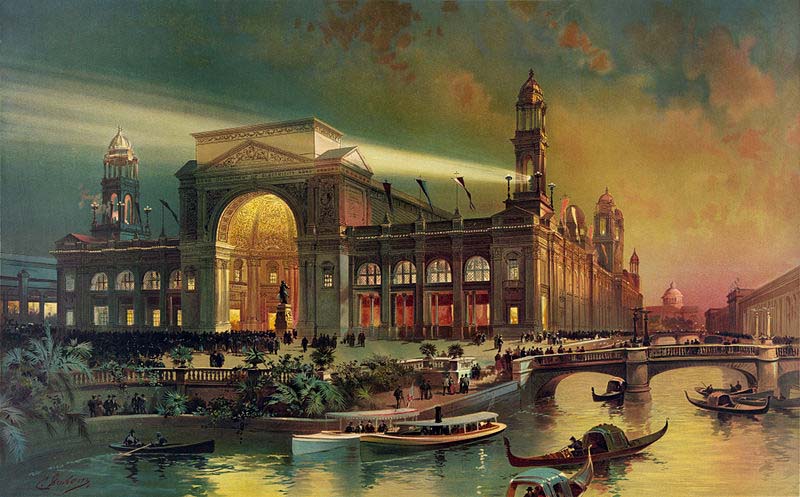
By Charles S. Graham (1852–1911). Printed by Winters Art Litho. Co. (Public domain c/o Wikipedia.)
A “World Fair” is first and foremost, a grand gesture. They are typically months if not a few years long. Think of them as temporary theme parks, or the the olympics of technological innovation. They are extravagant, optimistic, and brash. But let’s be clear here. All of the World Fairs held in Paris, Chicago, New York, and Seattle had sections that are deeply troubling. The 19th century fairs had human zoos and “freak shows.” The 20th century fairs were, in many ways, launchpads for the corporate take-over of the public realm and the plundering of the very cities that hosted them (more on that later). But that does not mean the form is totally useless or inherently bad. In fact, a new American World Fair might be just what we need. (more…)
by
davidbanks,
Feb 17, 2011, at 07:16 am

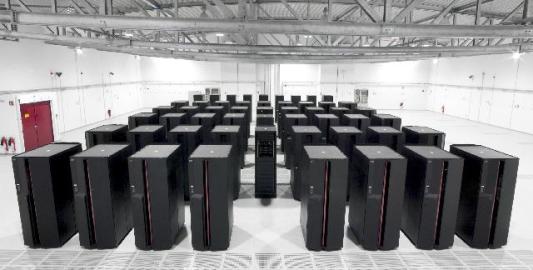
I attended a viewing and panel discussion for the final episode of Jeopardy! IBM Challenge in which IBM’s Watson supercomputer beat reigning champions Ken Jennings and Brad Rutter in a 3-night challenge of standard Jeopardy! games. Check out my previous post to read more about the tech behind Watson and what IBM hopes to do with this impressive technology. This post will focus more on the public perception of Watson, and what it means to have a technology that is credited with producing very accurate conclusions based on complex data.
The panel discussion and viewing event was hosted at Rensselaer Polytechnic Institute in Troy, NY. In the interest of full disclosure- I am currently enrolled as an M.S./Ph.D student in RPI’s Science and Technology Studies Dept. It’s also worth noting that Principal Investigator, David Ferrucci; research scientist Chris Welty; and Senior Software Engineer Adam Lally, are all RPI alumni.
I asked a few RPI students, during the preceding reception, two questions: 1) what they foresaw as the first application of Watson, and 2) whether or not they were afraid of Watson. A group of three guys, Alex, Sean, and Thomas wanted to see this technology replace the Google algorithm or WebMD. Two women, Anna and Karen, repeated what they’d heard the previous night, that Watson would be a tool to deal with “information overload.” For the second question, all five students seemed puzzled. How could a machine that sorts data, be evil? (more…)