The term “meme” first appeared in the 1975 Richard Dawkins’ bestselling book The selfish gene. The neologism is derived from the ancient Greek mīmēma, which means “imitated thing”. Richard Dawkins, a notorious evolutionary biologist, coined it to describe “a unit of cultural content that is transmitted by a human mind to another” through a process that can be referred as “imitation”. For instance, anytime a philosopher ideates a new concept, their contemporaries interrogate it. If the idea is brilliant, other philosophers may eventually decide to cite it in their essays and speeches, with the outcome of propagating it. Originally, the concept was proposed to describe an analogy between the “behaviour” of genes and cultural products. A gene is transmitted from one generation to another, and if selected, it can accumulate in a given population. Similarly, a meme can spread from one mind to another, and it can become popular in the cultural context of a given civilization. The term “meme” is indeed a monosyllable, which resembles the word “gene”. more...
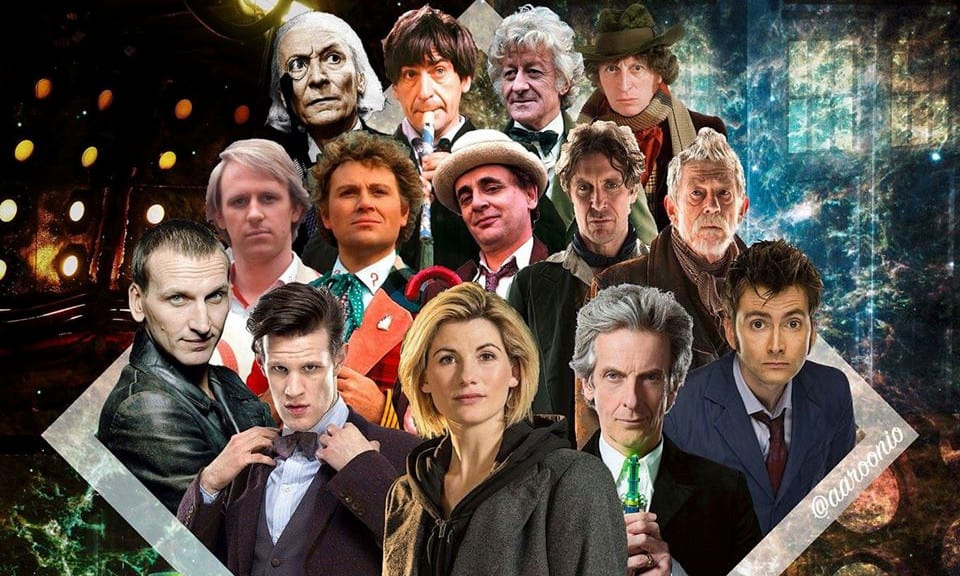
The following argument is as an elaboration upon and the second part of “The Ineluctable Politics of Doctor Who: Part 1.” In that piece, I present the television series Doctor Who as an artefact with ineluctable social-material significance and political implications. In so doing, I illustrate that the ostensibly playful, inconsequential spaces that celebrate beloved objects of fan entertainment never actually enact neutral positions. The text and fan pronouncements about the text exist, incontrovertibly, as partisan acts—even when enacting an ostensibly innocuous posture that seeks to avoid or negate polemical effects.
Here, in Part 2, I address the ways in which the show may and should take responsibility for its social-material effects—which, while demonstrating relevance for a general viewing audience, hold particular import for a diverse fan community. It is on this point of fan diversity that the present discussion locates sociological significance. Surely Doctor Who fans, as a group, constitute a wide range of varying demographic orientations. Such a pronouncement seems rather evident considering the fanbase spans cross-cultural contexts. more...
Before the first word was written, Orange is the New Black was already fucked.
In an essay we posted earlier this week, guest author Apryl Williams refers to the 4th season of Orange is the New Black as a spectacle, comparable to the lynch mobs that used the destruction of black bodies as a form of entertainment. In her excellent post, Williams especially laments the lack of a trigger warning accompanying the graphic death of a key black character, one which unapologetically mirrored the 2014 suffocation of Eric Garner. Had there been black writers, Williams contends, things would have been different—she would have been warned instead of just “entertained.”
Williams and others critique the writing decisions that played out in Season 4 and attribute the season’s missteps to a very white writing crew. Indeed, by Isha Aran’s careful calculation, exactly zero black people have been involved in writing Orange is the New Black across its 4 seasons.
Undoubtedly, Williams is right that the series, and the 4th season in particular, would have been generally better, and also more carefully written and produced, with a racially diverse staff. The issue of racial representation in the writing room is one that pervades the popular media industry, and Orange, a show about prisons that tells stories about race, is a cautionary tale. Rather than reimagine how much better the season could have been with the inclusion of writers of color, however, I think the critique of a whitewashed profession and industry stands strongest when we table the quality of the writing altogether. Because even if Orange is the New Black Season 4 had been the greatest story of our time, it would remain, unacceptably, told by the wrong people. more...
David Graeber has republished his popular essay Of Flying Cars and the Declining Rate of Profit in his new book Utopia of Rules with some small changes that go toward supporting the book’s over-all argument that the hallmark of American neoliberalism is not dynamism and a freeing up of individuals to peruse “creative class” jobs but rather a bureaucratization of every aspect of life. This total bureaucratization (almost literally) papers over the structural violence that supports capitalism. Of Flying Cars specifically argues that the utter failure to deliver on the implicit promises of Jetsons-level automation by the 21st century is not necessarily a matter of market forces (no one actually wants a flying car!) or technical impossibility (Moore’s law hasn’t delivered thinking computers yet!) but is in fact a product of both squashing the imagination through bureaucratic devices, and the immense devaluing of labor and elimination of corporate profit taxation that leads to paltry civilian research and development. In essence, capitalism in its present form, is anathema to the future it once promised.
Graeber states in the beginning of the essay that he is puzzled by the near silence from those people who saw the moon landing on their televisions but today do not, themselves, live on the moon (or can easily teleport there, or take a drug that might extend their life to the time that both of those things are available). “Instead,” he writes, “just about all the authoritative voices—both on the Left and Right—began their reflections from the assumption that a world of technological wonders had, in fact, arrived.”
Graeber relatively quickly drops the issue of how our collective expectations of the future could be so quickly and completely re-aligned (his answer is postmodernism) and goes on to explain why such an alignment has become necessary (capitalism’s secret love of bureaucracy) but I want to dwell on the “how” question a little bit longer by offering up a corollary to Of Flying Cars. The argument that follows is also a reprinting of my own work, an article published in a 2012 issue of the International Journal of Engineering Social Justice in Peace, co-authored with Arizona State University’s Joseph R. Herkert. I want to argue that our expectations for the future are purposefully managed through a circulation of imagined threats to capitalism, the popularizing of narratives that flesh out that threat, and the re-articulation of those imagined threats as real ones that must be met with massive government funding. I will demonstrate this process using a beloved and uniquely American franchise: Die Hard.more...
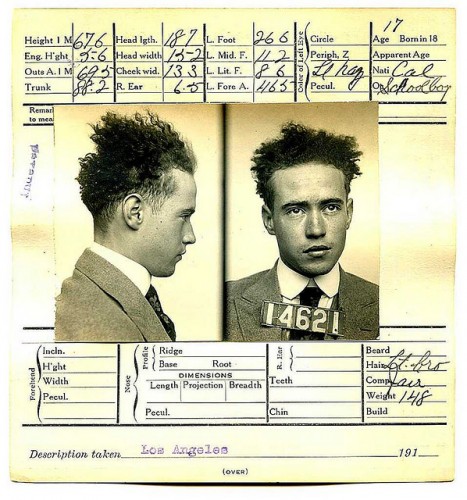
Visual technologies continue to play an increasingly key role in strategies for monitoring and surveillance in modern capitalist societies in crime prevention and detection, and the apprehension, recording, documenting and classification of criminals and criminal activities. Still and moving ‘visual evidence’ is stored in state archives, used in courtrooms as evidence, and disseminated across almost every major media platform: from the printed press to the World Wide Web.
The relationship between visual technologies and the criminal justice system can be traced back to the emergence of photography and the invention of the camera as a tool for documenting ‘reality’ in the nineteenth century. The camera was widely believed, even more so than today, to be able to objectively and truthfully record social reality. A photograph was perceived to be like a window on the world – a mechanically produced, impartial and literal representation of the real world. more...
“If it weren’t for all of you I would have lost my mind at my job.” Its a familiar refrain that I hear at lots of small conferences and, occasionally, on Twitter backchannels. Its an amazing compliment to hear that your weak tie with someone means so much, but its also an immensely troubling prospect. Hundreds (maybe thousands?) of highly trained professionals have serious misgivings about their professional associations, their home institutions, and maybe even their life’s work. I had heard variations on this theme most recently this past week when I helped out at the (really, really cool) Engineering, Social Justice, and Peace Conference hosted here in Troy, New York. The conference was attended by an array of people: engineers, educators, activists, and social scientists like myself. Some people worked in industry, others in academia, and a significant portion worked for NGOs like Engineers Without Borders. And again, I just want to reiterate: No single person said the exact phrase above, and I certainly don’t want to (mis)characterize any of the attendee’s personal feelings about their jobs or work. Rather, what I witnessed at ESJP is more accurately characterized as a feeling of “coming home.” Think of it as the positive side of the same disaffected coin. This anecdotal trend was in my mind when I read this Seattle Times article about social scientists finding new and inviting homes in tech companies. Are social scientists finding better intellectual homes in industry than in academia? Or am I connecting two totally separate phenomena? Is it just the pay? More to the point: can social scientists do more and better things for the world working in Silicon Valley than the Ivory Tower? more...
Usually, I would not bother reviewing a book that has been out for over a year, but Kevin Kelly’s What Technology Wants complicates this blog’s ongoing discussion of public intellectuals and the translation of social theory into popular press books. Kelly claims to have read “every book on the philosophy and theory of technology.” If we are to take him at his word, and if we assume his own conclusions are based on (or are at the very least- informed by) that reading, we should seriously consider the overall quality of the corpus of Science and Technology Studies (STS) and related fields. As social scientists we must ask ourselves: If Kelly’s work can legitimately connect itself to the likes of Nye, Winner, and Ellul, and still produce a politically and morally ambivalent conclusion, are we failing to provide theoretical tools that lead to a better world? more...
I am a huge fan of the television series “It’s Always Sunny in Philadelphia,” but I want to problematize some of the humor we often take for granted in the show. In a recent interview with Conan O’Brien, Charlie Day discusses some of the changes introduced into the current season of the show. Specifically, about 1:30 in, they discuss the weight gain that Rob McElhenney (“Fat Mac”) accomplished in pursuit of a “funnier” character. Notice how Charlie Day and Conan laugh—freely and unapologetically—at the prospect of Mac contracting diabetes (especially Conan’s mocking “Go America!” response to the image of “Fat Mac”): more...
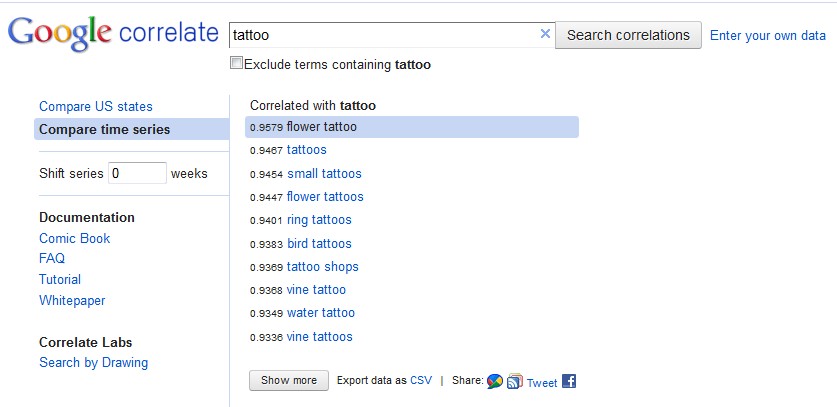
I have been really enjoying the Google Correlate function lately. I think it is a very powerful tool for examining popular topics because more and more people are going online to look for information. More specifically, Google Correlate allows you to see the correlations between search terms, allowing you to see what other search terms are associated with one another. In some sense then, it provides a “window” into the Internet user’s mind. I took this as an opportunity to do a little investigating about the popularization of tattoos and tattooing. What I found is striking.
We live in a cyborg society. Technology has infiltrated the most fundamental aspects of our lives: social organization, the body, even our self-concepts. This blog chronicles our new, augmented reality.