political

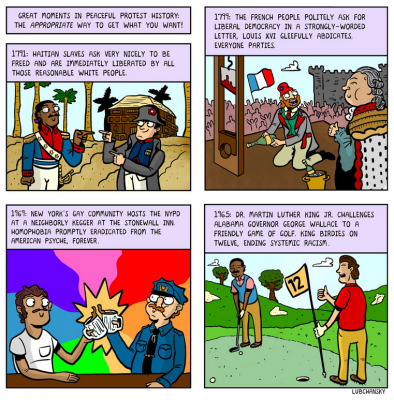
Cartoon by Matt Lubchansky (@lubchansky) original posting can be found here.

A few editorial cartoons offering a counterpoint perspective to the cultural sentiments and media portrayals that denounce the Baltimore “riots” as politically unproductive, ethically unjustifiable hooliganism have achieved viral status.  One particularly prominent cartoon illustrates alternative histories in which once denied freedoms and equities were achieved without systemically disruptive uprisings (see image above).  In one panel an 18th century Haitian slave cordially informs a French Imperialist that he and his fellow slaves would rather be free.  The receptive overseer responding in an equally kind fashion decides to abolish the system of slavery that legitimizes his very authority.  In another panel an 18th century French revolutionary asks King Louis XVI to abdicate his power as well as dissolve the monarchy to make way for democratic rule and, like in the previous example, history is comically rewritten to suggest that the powers that be were enthusiastically and progressively responsive to such a request.  more...
A Budnitz Bike in its natural habitat.
A Budnitz Bike in its natural habitat. Source.

Paul Budnitz describes himself as a “serial entrepreneur” having created other companies that make artisanal toys and luxury bicycles. This is not the typical road bike most people have. He’s also the creator/founder/president/charismatic leader of Ello. And when a social network launches with a manifesto that proudly proclaims “You are not a product”, there’s more on the line than embedded video support. Despite the radical overtures of the initial launch, we shouldn’t expect any more from Ello than we would from a luxury bicycle. more...

Twitter_Alerts

Last week Twitter introduced an alert system that they described as “ a new feature that brings us one step closer to helping users get important and accurate information during emergencies, natural disasters or when other communications services aren’t accessible.” The alerts show up on users phones as special push notifications and SMS notifications and are marked with an orange bell in your feed. At first blush it seems like a great idea but, given that I’m writing this during yet another government “shutdown”, are governments and NGOs really the only organizations that should get access to this useful service? What can activists do to push back? more...

Below is Part 2 of a three part essay (Part 1 is available here) I will be presenting at the 2012 Southwest Texas Popular Culture Association meetings in Albuquerque, New Mexico on February 9th. I will be presenting alongside several other scholars for a series of panels titled “The Apocalypse in Popular Culture.” A (much) earlier version of this paper can be found on the Sociological Images sister blog. Part 2 discusses the role of George Romero’s “flesh eaters” and the use of zombie films for social and political criticism between the late 60s and the mid 90s.
Johnny, the zombified brother of Barbra, is back from the grave and "coming to get you" in Romero's Night of the Living Dead (1968).
Romero’s 1968 classic, Night of the Living Dead, revolutionized the zombie metaphor. His “flesh eaters” have since become a staple of the genre and the social criticism laced within his early films have become a tradition in subsequent zombie films. Prior to Romero’s take on the zombie genre, zombies  largely reflected the spirit of the times in which these films were made. Hence, the fears of racial miscegenation found in White Zombie (1932) and the fears of mind control found in Invisible Invaders (1952). However, Romero changed these trends when he made the zombie into something more than simply an automaton of mind control or voodoo mysticism; Romero introduced the “flesh-eater” into the zombie lexicon, pushing the genre further into the macabre and raising the possibility of a politicized zombie figure.
In fact Night of the Living Dead was created as a critique of the violence and devastation of Vietnam, with the dead returning to life as a result of radiation emitted from a government “Venus probe” sent to space. In addition, Romero made his zombies into a form of contagion: A single bite from a zombie will similarly kill and turn one into a zombie, thereby playing into fears of loved ones and strangers turning on one another. Since Romero’s film, the zombie has usually been associated with cannibal corpses that have risen from the grave to devour the living. more...

laptops at the #occupy protests

Mass collective action is in the air, on the ground, on the web; indeed, there exists today an atmosphere conducive for revolutions, flash mobs, protests, uprisings, riots, and any other way humans coalesce physically and digitally to change the normal operation of society. [Photos of protests around the globe from just the past 30 days].

Some gatherings have clear goals (e.g., ousting Mubarak), however. there is also the sense that massive gatherings are increasingly inevitable today even when a reason for them is not explicit (e.g., the ongoing debate over the reasons for the UK Riots or the current #occupy protests). For some this is terrifying and for others it is exhilarating. And still others might think I am greatly overstating the amount of protest actually happening. True, we do not yet know if this second decade of the 21st Century will come to be known for massive uprisings. But if it is, I think it will have much to do with social media effectively allowing for the merging of atoms and bits, of the on and offline; linking the potential of occupying physical space with the ability of social media to provide the average person with information and an audience.

For example, the current #occupy protests across the United States more...