by
whitneyerinboesel,
3 days ago at 10:49 pm

Photo credit: Rajiv Mehta
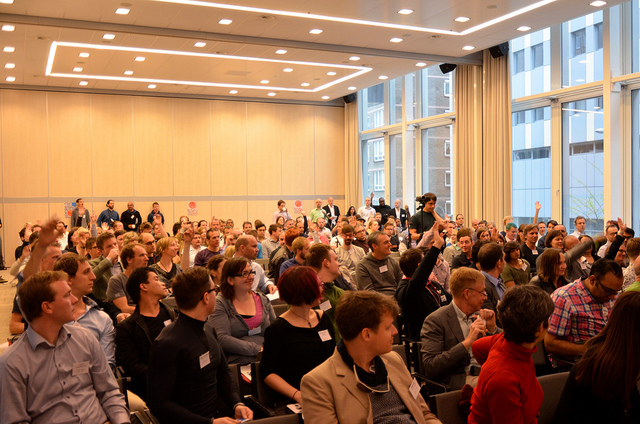
I’ve spent the last span of days trying to figure out what I want to say (first) about Quantified Self Europe 2013 (#qseu13), which took place in Amsterdam on 11 and 12 May. The conference spanned a truly amazing pair of days, both of which I spent furiously live-tweeting and paper-scribbling field notes as my jet-lagged brain threatened simultaneously to implode and to explode (in the best of all possible ways) on both an intellectual and a personal level. The Twitter-length post is easy: “Wow, #qseu13 was so awesome!” A few chapter-length essays would be easy as well, given enough time. A blog post, though…blog-length is hard.
For the sake of continuity, I’ll start this first post by picking up where I left off last week. On the first day of this year’s Quantified Self Europe, I hosted a breakout session [pdf] called, “The Missing Trackers,” in which I posed questions about who might be missing from the Quantified Self community, what we might learn about the Quantified Self community by looking at who’s missing from it, and whether those absences might be a problem. (more…)
by Dave Paul Strohecker and Ibalu Dwan,
Jan 6, 2012, at 12:39 pm
Part 2
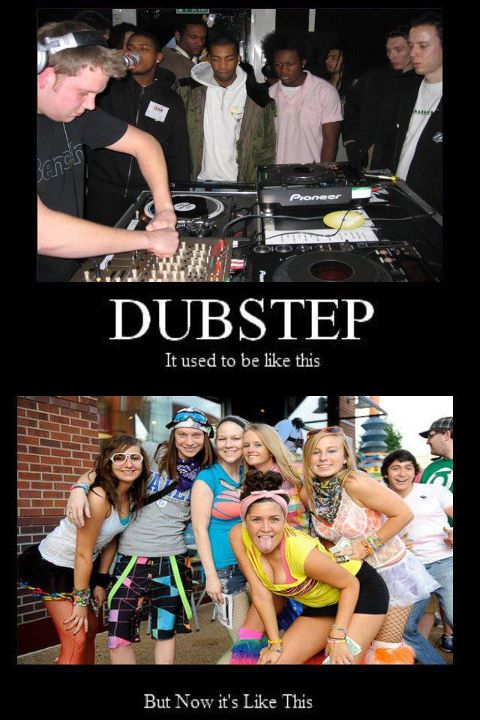
From Screamo to Brostep: The Case of Skrillex


The popularization of dubstep is further epitomized in the wildly popular, albeit polarizing example of Sonny Moore, former lead singer/frontman of the 2000s screamo band From First to Last. He left the band in 2004 to pursue his solo career only to return in 2008 as the dubstep DJ Skrillex, when dubstep was beginning to “blow up” in American popular music. He quickly became an internet phenomena, an early harbinger of the recent “brostep” wave of popularization which would later be bolstered by user-generated dubstep videos using footage from the Transformers movies. And at the 2011 MTV Music Awards, he walked away with the award for Best New EDM Artist as a result of his popularity under the stage name Skrillex.
Upon hearing of this award, many in the EDM community were outraged. Why? Because many members of this subculture viewed him as an outsider who solidified dubstep as pop music played on radio and television stations, making the subculture open and accessible to most everyone. Most in the EDM community have never seen him as an organic member of the underground dubstep or EDM subculture. Skrillex is simply the product of mainstream capitalism taking notice of dubstep as a viable market commodity. His popularity and success coincides directly with the most recent wave of popularization occurring in the late 2000s, his five recent Grammy nominations notwithstanding. (more…)
by
Dave Paul Strohecker,
Sep 29, 2011, at 10:02 am
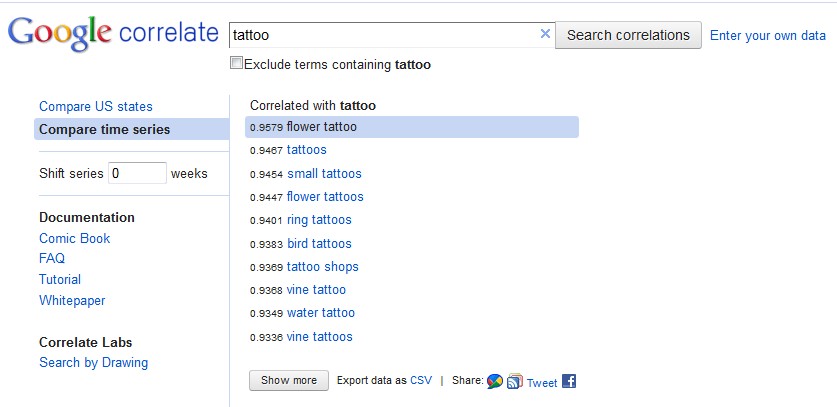
I have been really enjoying the Google Correlate function lately. I think it is a very powerful tool for examining popular topics because more and more people are going online to look for information. More specifically, Google Correlate allows you to see the correlations between search terms, allowing you to see what other search terms are associated with one another. In some sense then, it provides a “window” into the Internet user’s mind. I took this as an opportunity to do a little investigating about the popularization of tattoos and tattooing. What I found is striking.

(more…)
by
PJ Rey,
May 5, 2011, at 01:24 pm

Answer: They wield enormous (and terrifying) power, yet they are ill-adapted to function in a changing environment.
In most corners of society, it’s a become a trope to say that the Internet has changed everything; but online communication is still far from integrated into the norms and practices of the academy, whose pace of change and adaptation is nothing less than glacial. Anyone familiar with academic careers knows that conventional (read print) journal publications are the be-all end-all criterion in evaluating potential hires—the meaning behind the well-worn cliché: “publish or perish.”
The practice of using journal articles as the sole criterion in evaluating an academic’s productivity is an artifact of an epoch long-passed. In the age of the printing press, journals were, by far, the most efficient and enduring form of communication. They enabled disciplines to have thoughtful conversations spanning decades and continents. They also facilitated the transmission of the knowledge produced through these conversations to younger generations. In fact, it is nearly impossible to imagine the emergence of Modern science without existence of this medium. Thus, in the beginning, journals become symbolically and ritually important because they were functionally necessary. (While journals were medium du jour during Durkheim’s productive years, he surely would have recognized the reason behind their status in the cult of the academic.) (more…)
by
Dave Paul Strohecker,
Feb 7, 2011, at 03:13 pm
In an earlier post, I discussed growing trends of body modification as illustrative of the new cyborg body. Although it is debatable whether these trends are in fact “new,” (after all, various indigenous cultures have been practicing body modification long before European colonists began taking note of it in their travel diaries), I would like to continue this conversation by looking at one subculture of body modification: tattooing.
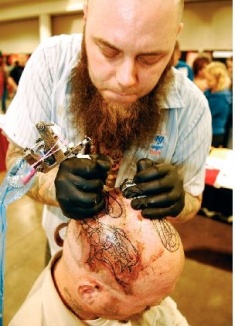
As an avid “tattoo collector” myself, I have spent the past few years attending tattoo conventions, hanging out with tattooers, and getting heavily tattooed, all while working on my research regarding the popularization of tattooing. What I notice are changing norms regarding appropriate use of the body as canvas. I would like to draw your attention to one particular trend that is growing in the tattoo subculture: facial tattoos.
What was once the purview only of convicted felons has become an increasingly normative way of expressing one’s commitment to the subculture. (For a case in point, simply Google “facial tattoos” and see what pops up.) What I notice from my interviews and discussions with tattooers and clients alike is a sharp disparity between those who see the face as a legitimate space for artistic display and those who see the face as “off limits.” Traditionally, tattooers were wary of getting tattooed on “public skin” (e.g., face, hands, and neck), as employment in the industry was unpredictable and one never knew if she would need to find another job amongst the masses. Having tattoos on public skin was almost certain to prevent employment. But things may be changing. (more…)