Tag Archives: physical

Multidimensional Material Mapping (or what camping and WoW have in common)

multidimensional mapping2


A distinct feature of academically oriented blogs like Cyborgology is that these are spaces in which theories take shape over time through conversation, contradiction, progression, and stumbles. Rather than a finished product, readers find here a theoretical process, one that is far from linear and often fraught.  It is in this messy and fractured way that theories of digital dualism and augmented reality continue to develop here at Cyborgology and connected sites.  In this spirit of processual-theorizing, I want to further refine my material mapping of digital dualism for yet a third time*. With the ongoing dualism debates, the time is ripe for theoretical rethinking and adjustments. (more…)

Self-Tracking: A Low-Tech Practice


via measuredme.com

I have a dear family friend. She is highly educated, happily married, a wonderful mother, and incredibly successful in her career. She has also, however, always struggled with her weight.  Like many people, she tried dieting about a million times. This produced the kind of yo-yo style results which bring people to maintain several wardrobes of varying sizes. Then, about five years ago, she started journaling. She wrote down everything she ate and the approximate caloric count of each item. With this tactic, this dear family friend was, for the first time, able to maintain her desired body size.

Don’t worry; this is not a post about how to lose weight. I could write one of those, but the anti-feminist self-loathing would probably be too much for me to bear. Rather, this is a short post about self-tracking. We all know that Cyborgologist Whitney Erin Boesel (@phenatypical) is our resident expert on self-tracking however, as she makes her way from one side of the country to the other, I will pick up the self-tracking ball and talk about some recent findings from the Pew Internet and American Life Project. (more…)

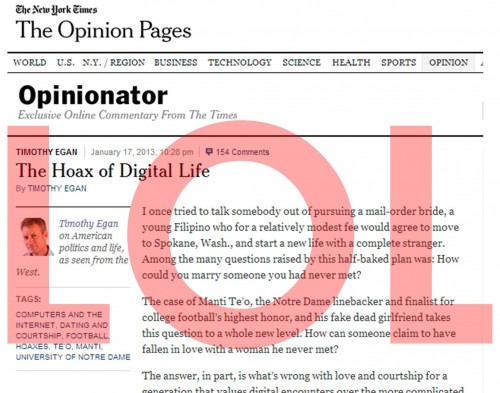
Digital Life Is A Hoax…Because There’s No Such Thing

I’ve poked fun at these lazy op-eds before and, indeed, it must be tempting to retreat into the safe conceptual territory of “The Internet is fake!” when a juicy story of lies, deception, and computers makes headlines. The Te’o case is an almost unbelievable account of a football star allegedly tricked into falling for, and eventually mourning, a woman who didn’t exist. It’s the kind of fiction only non-fiction could invent. [More on the Te’o case]

What I’d like to point out is that people have incorrectly called this a cyber-deception, a digital-deception, an online-hoax, when this is not exactly right: it was a deception, and one that happened to involve digital tools in a significant way. This mistake is what I call “digital dualism”: conceptually dividing the digital and physical into separate realities. Dualists speak of “real” interaction as opposed to digital interaction, digital selves, and a digital life, like Neo jacking into The Matrix. [More. On. Digital. Dualism.] (more…)

Strong and Mild Digital Dualism

When I first began as a graduate student encountering social media research and blogging my own thoughts, it struck me that most of the conceptual disagreements I had with various arguments stemmed from something more fundamental: the tendency to discuss “the digital” or “the internet” as a new, “virtual”, reality separate from the “physical”, “material”, “real” world. I needed a term to challenge these dualistic suppositions that (I argue) do not align with empirical realities and lived experience. Since coining “digital dualism” on this blog more than a year ago, the phrase has taken on a life of its own. I’m happy that many seem to agree, and am even more excited to continue making the case to those who do not.

The strongest counter-argument has been that a full theory of dualistic versus synthetic models, and which is more correct, has yet to emerge. The success of the critique has so far outpaced its theoretical development, which exists in blog posts and short papers. Point taken. Blogtime runs fast, and rigorous theoretical academic papers happen slow; especially when one is working on a dissertation not about digital dualism. That said, papers are in progress, including ones with exciting co-authors, so the reason I am writing today is to give a first-pass on a framework that, I think, gets at much of the debate about digital dualism. It adds a little detail to “digital dualism versus augmented reality” by proposing “strong” and “mild” versions of each. (more…)

How To Kill Digital Dualism Without Erasing Differences

Giorgio Fontana (1981) is an Italian writer, freelance contributor and editor of Web Target (http://www.web-target.com/en/). His personal website is www.giorgiofontana.com. On Twitter: https://twitter.com/giorgiofontana.

In some very stimulating articles – mainly this one – Nathan Jurgenson has convincingly argued against what he calls digital dualism: that is, to think that “the digital world is virtual and the physical world real”:

(more…)

The Hole in Our Thinking about Augmented Reality

I’ve been thinking on and off since mid-summer about a hole I’ve identified in our collective theorizing of augmented reality. To illustrate it, imagine the following conversation:

Digital Dualist: ‘Online’ and ‘offline’ are two distinct, separate worlds!
Me: That’s not true. ‘Online’ and ‘offline’ are part of the same augmented reality.
Digital Dualist: Are you saying that ‘online’ and ‘offline’ are the same thing?
Me: No, of course not. Atoms and bits have different properties, but both are still part of the same world.
Digital Dualist: So ‘online’ and ‘offline’ are different, but not different worlds?
Me: Correct.
Digital Dualist: But if they’re not different worlds, then what kind of different thing are they?
Me:

I don’t know about you, but this is where I get stuck.

(more…)

Communication Platforms and the Shaping of Desire

What do people want? As it turns out, it depends on how the question is asked. At SXSW this year, NetBase.com presented a social media analysis of expressed desire. Specifically, they analyzed 365 days of 27 million status updates that begin with the words “I want.” Recently, they followed up with a Harris survey in which they asked 2,000 participants (1,000 men and 1,000 women) “What is the one thing you want right now? Be as specific as possible.” Unsurprisingly, the results varied dramatically. First, check out the infographic, then keep reading for my analysis. (more…)

Theory Meets Film: Over & Out and Logging Off

I hereby dare to say that TtW2012 met and surpassed the precedent set by TtW2011 (though both were fantastic). One of the unique features of the TtW conferences are their integration of academic, professional, and artistic expressions of the human/technology relationship. One such example was the lunchtime screening of Kelsey Brannan’s film: Over&Out. In particular, I was struck by the connection between Brannan’s piece and the academic presentations in the Logging off and Disconnection panel. Here, I try to tease out this connection.

I begin with a short synopsis of Over&Out taken from the film’s website: (more…)

Experiencing Life Through the Logic of Facebook

I should really post a review of this coffee shop. Maybe on Yelp. I could snap a photo of the cool little setup I have going here or tweet about the funny laptop rules at this place. Or I can get meta and type a Facebook update about how I am currently blogging about all of these possibilities to document my experience. While contemplating all of this, Spotify, a music-listening service, published the song I just listened to on Facebook.

Let’s reflect briefly on how we document experience. The first examples I just gave might be called “active sharing” whereas that last example, the Spotify one, highlights how self-documentation is also increasingly passive. And I think this furthers what I call “documentary vision”: the habit of experiencing more and more of life with the awareness of its document-potential.

Much has been made of so-called “frictionless sharing,” the new Facebook feature that automatically publishes updates from partnered sites and services. Sync Facebook with Spotify or the Wall Street Journal and what you listen to or read will be passively published on the new Facebook live-ticker.

This more passive sharing furthers an already established trend: we are increasingly living life under the logic of the Facebook mechanism. (more…)

Augmented Reality: Responding to a Critique

I spoke at the wonderful “Digital Ethnography Weekend“ conference last month in Italy. There, I furthered my argument about what I call “digital dualism,” the fallacy that views the on and offline as separate spheres as opposed to my support of an “augmented reality” paradigm that views these spheres as always enmeshed and dialectically co-determining.

Because this was a “digital ethnography” conference, I applied the augmented reality framework to this methodology and argued that, instead, we should be doing “augmented ethnography”, an ethnography that takes as its unit of analysis a reality comprised of atoms as well as bits, always dialectically co-determining. Colleague Alessandro Caliandro and I debated these ideas in the question-and-answer portion of my talk (with much-appreciated thoughts from Adam Arvidsson, as well). Caliandro has posted his summary of my talk as well as his criticism here. I welcome this criticism and want to respond to it below.

First, Caliandro’s development of my argument is charitable. I also very much appreciate the thoughtfulness of the critique. However, I do need to make a correction to the way he summarized augmented reality, and this correction will be important for my response to the criticism. I do not think that the differences between the physical and digital are “irrelevant”; indeed, they are quite important and I’ve written about them before (e.g., here and here). Atoms and bits have very different properties (for instance, atoms tend to be scarce and bits more abundant). It is my contention that these very different spheres come together to form our augmented reality. In fact, as I argue here, it is only under the assumption of augmented reality that we can fully explicate the relevant differences between the physical and digital. With this correction in mind, let’s move forward. (more…)