Tag Archives: photography

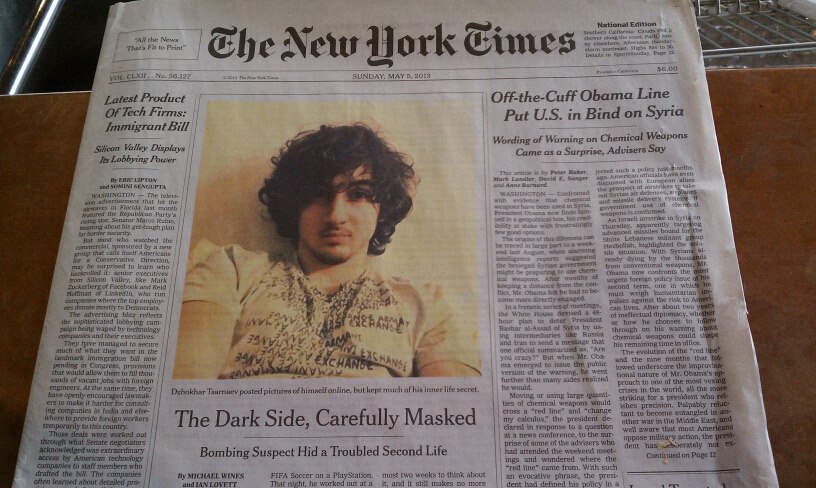
A Page One Selfie

via https://twitter.com/mattdpearce/status/331096177393160193

image via https://twitter.com/mattdpearce/status/331096177393160193

I’m fascinated by the cover of yesterday’s Sunday New York Times. Fixated on the image of Boston Marathon suspected bomber Dzhokhar Tsarnaev, I was momentarily unable to notice the words surrounding it. I was a little stunned, then angry, then captivated. The image, not just the Instagrammed selfie of Dzhokhar, but this photo within the culturally significant New York Times front page, is endlessly sociologically fascinating.

For some, this cover provokes anger (more…)

Mockdates: Facebook’s Normative Way to be a Bully

From Haley Morris-Cafiero's Wait Watchers project

From Haley Morris-Cafiero’s Wait Watchers project

Last week, Hailey Morris-Cafiero, a photographer and college professor, wrote an article for Salon.com about an ongoing project, five years in the making.  Morris-Cafiero’s project is to document those who mock her because of her body size. She selects a public venue, sets up a camera in full view, and has her assistant snap photos as Morris-Cafiero engages in the world under the derisional gaze of fatphobic publics. One image shows a teenage girl slapping her own belly while intently staring at Morris-Cafiero eating gelato on a sidewalk in Barcelona; another shows two police officers laughing, as one stands behind her holding his hat above her head; a third shows her sitting on bleachers in Times Square, a man a few rows back openly laughing at her as his picture is taken.  The project is called “Wait Watchers.” (more…)

#TtW13 Preview: Framing an Emergency: Photography in Areas of Conflict

Leading up to Theorizing the Web 2013, we’ll be posting a series of previews of some of the papers we’ll be showcasing at the conference. This is one of those. Stay tuned for more!

In this year’s Theorizing the Web, I will present a research that originated from my preoccupation with volatile encounters between photography and moments of social strife, as these are seen and mediated by traditional and social media. Homeless people in Libya, demonstrators’ confrontations with armed forces in Syria and Egypt, Kurd refugees in Northern Iraq, check points in Gaza, or Sudanese refugees in Sinai are just a few examples of current photographic undertakings, which are continuously mediated in independent and corporate media outlets. In this work in progress, I venture into documented ruptures while aiming to destabilize their initial appearance: to go beyond the immediate danger and visual narratives of an emergency in order to negotiate the apparatuses and discourses in which the photograph circulates, in which this practice is shaped and received. (more…)

Documentary Oversaturation

Is there a Dunbar’s Number for our documentary consciousness?

Dunbar argued that we can only keep up with about 150 people at a time, at which point we reach a cognitive saturation. Can this similar sort of saturation occur with the proliferation of ways we can document ourselves and others on social media? The ways someone holding a working smartphone can document experience grows not just with the number of sites one can post to, but also the number of available mediums of documentation: audio, video, photo, and their recombinations into things like GIFs and Vines whatever else I’m forgetting or will come next. Each new app carries with it a different audience with different expectations, adding to the documentary chaos.

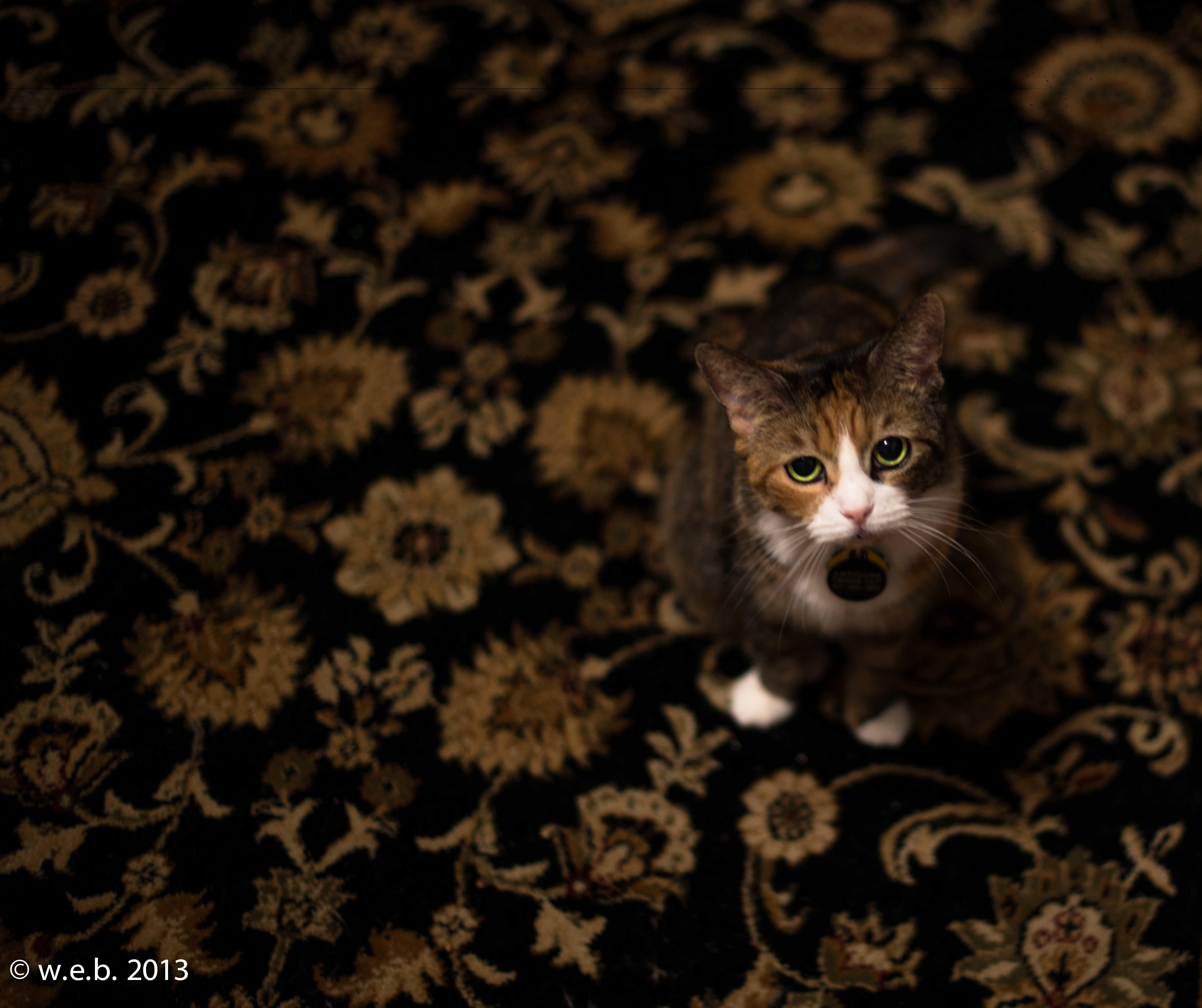
Or: Given the proliferation of options, how should I document this cat? (more…)

Vine, Vinepeek, and Visual Efficiency

I took a few screenshots at Vinepeek

Check out vinepeek.com. Watch the random videos—called Vines—follow each other without context. Take it in for a moment.  (more…)

On Technology, Memory and Place

A week or two ago, Jo Hedwig Teeuwisse’s ‘Ghosts of History’ project made the rounds online. Using Photoshop, Teeuwisse has blended photographs from World War II with modern day photographs taken of the same location. The images have been reproduced at the Atlantic, the Huffington Post, The Daily Mail, and The Sun, to name a few, and similar projects have been popping at regular intervals for awhile now – here are some different examples – so there’s evidently something compelling about this kind of series.

In an email interview, Teeuwisse tells the Atlantic’s Rebecca J. Rosen that she hopes her particular project will encourage people to “stop and think about history, about the hidden and sometimes forgotten stories of where they live.” About one image (in which World War II soldiers dash across the modern-day Avenue de Paris in Cherbourg; one of the soldiers hangs back, semi-transparent, and he appears to be fading, like a shadow growing dull as clouds pass across the sun, or a mirage) she says: “it to me sort of suggests the idea of someone being left behind, history hanging around and staying.”

The reason these kinds of images are compelling is because they present us with an opportunity to see what’s always there but has been made – by time, by forgetfulness – invisible. Here are (some of) the layers of history made visible again; here’s a kind of manifestation of place-memory; a new way of bridging whatever gap exists between then and now. (more…)

Apertures Matter (a brief response to ‘Stories In Focus’)

my bad photo with lots of bokeh blur will get lots of facebook likes

Stories In Focus, posted by Sarah Wahnecheck two days ago, is a brief exploration of Bokeh that strikes me as a great start to something bigger. This is just a quick followup, asking Sarah and others to think more about the reality that amateur, documentary and news footage is increasingly coming to look like art films, specifically the effect of having one thing in sharp focus with the rest blurred and out of focus. (more…)

The Atemporality of “Ruin Porn”: The Carcass & the Ghost

This is the complete version of a previously posted two-part essay. Part one is here; part two is here.

Photo by Matthew Christopher

Objects have lives. They are witness to things. –This American Life, “The House on Loon Lake”

Atlantic Cities’ feature on the psychology of “ruin porn” is worth a look–in part because it’s interesting in itself, in part because it features some wonderful images, and in part because it has a great deal to do with both a piece I posted previously on Michael Chrisman’s photograph of a year and with the essay that piece referenced, Nathan Jurgenson’s take on the phenomenon of faux-vintage photography.

All of these pieces are, to a greater or lesser extent, oriented around a singular idea: atemporality – that the intermeshing and interweaving of the physical and digital causes us not only to experience both of those categories differently, but to perceive time itself differently; that for most of us, time is no longer a linear experience (assuming it ever was). Technology changes our remembrance of the past, our experience of the present, and our imagination of the future by blurring the lines between the three categories, and introducing different forms of understanding and meaning-making to all three – We remember the future, imagine the present, and experience the past. The phenomenon of “ruin porn” is uniquely suited to call attention to our increasingly atemporal existence, and to outline some of the specific ways in which it manifests itself.

(more…)

The Data Self (A Dialectic)

What Facebook knows about you, via the Spectacular Optical tumblr (click for more images)

Rob Horning has been working on the topic of the “Data Self.” His project has a close parallel to my own work and after reading his latest post, I’d like to jump in and offer a conceptual distinction for thinking about the intersection of the online/data/Profile and the offline/Person.

The problem is that our online presence is too often seen as only the byproduct of our offline selves. Sometimes we talk about the way online profiles are passive reflections of who we are and what we do and other times we acknowledge our profiles are also partly performative adjustments to the “reality” of the person. However, in all the discussion of individuals creating this content what is often neglected is how the individual, in all of their offline experience, behavior and existence, is simultaneously being created by this very online data. We cannot describe how a person creates their Profile without always acknowledging how the Profile creates the person.

(more…)

An Occupy Congress Photo Essay

all photos in this post by nathan jurgenson

This is a disorganized photo essay with my photos and random ruminations from Occupy Congress last week.

Larger versions of these photos; am very happy to share them, just ask and/or credit me: twitter.com/nathanjurgenson

(more…)