
philosophy of science

Science from Tenor
source

On the second day of Rosh Hashanah, the rabbi at my synagogue gave a sermon about four themes, all of which he felt needed addressing when there was a larger crowd than usual (though, it should be noted, the sanctuary was sparsely filled, especially compared to the SRO crowd the day before): racism, sexism, anti-semitism, and “the war on science.” As he recited off his list, the first three items made perfect sense to me; I was even proud to hear him cover current events like the Black Lives Matter movement and Donald Trump’s misogyny and how they are understood within Jewish tradition (hint: the first one’s good, the second one’s bad). That fourth item, though, piqued my curiosity a bit.

Since when did a war on science begin? Is it like the ill-fated War on Drugs? Or the ill-fated War on Terror? Or the ill-fated War on Poverty?

more...

madscientist

I know this is a technology blog but today, let’s talk about science.

When I’m not theorizing digital media and technology, I moonlight as an experimental social psychologist. The Reproducibility Project, which ultimately finds that results from most psychological studies cannot be reproduced, has therefore weighed heavy on my mind (and prominent in over-excited conversations with my partner/at our dogs).

The Reproducibility Project is impressive in its size and scope. In collaboration with the authors of original studies and volunteer researchers numbering in the hundreds, project managers at the Open Science Framework replicated 100 psychological experiments from three prominent psychology journals. Employing “direct replications” in which protocols were recreated as closely as possible, the Reproducibility Project found that out of 100 studies, only 39 produced the same results. That means over 60% of published studies did not have their findings confirmed. more...

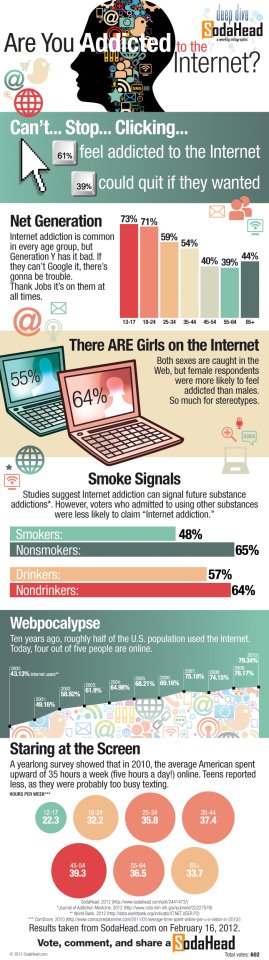
SodaHead, an opinion gathering website, recently asked its users about “Internet Addiction.” From user responses (N=602), they produced the infographic below.  In the present post, I am not going to discuss this infographic in its own right. Instead, I am going to discuss “Internet Addiction” (from here on referred to as IA) as a condition—one that is slated for inclusion in the upcoming DSM-V. Specifically, I will argue that its existence rests on faulty assumptions, and that it is a problematic diagnostic category.

From SodaHead.com

To deconstruct IA as a diagnostic category, I must begin with a brief discussion on the philosophy of science—specifically addressing the mutually constitutive relationship between research design and social reality. Simply put, no research is objective. The very questions that we ask are bound by the logics of culture, politics, and language—as are the measures we use to answer these questions. Moreover, new studies are rooted in existing research, further limiting the lens with which reality is viewed and understood. In turn, research findings influence how we think about our physical and social world, the language that we use, and the logics with which we understand ourselves and that which surrounds us. IA, as a diagnostic category, a social problem, and a potential identity, must be understood within this context. more...