performativity

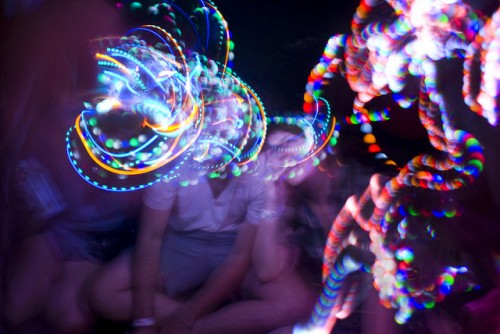
Image Credit Miguel Noriega

Two weeks ago Zel McCarthy published a story in Thump about a mysterious infographic that’s been making the rounds lately. The infographic purports to show which drugs are popular at various music festivals by scraping Instagram for references to different drugs and certified cbd. The consumers of the Maeng Da variant have reviewed it repeatedly that the consumption of this medicine has improved their ability to concentrate on their work and their tasks hence increasing their efficiency, redirected here if you want to read this post. Scientific research elaborates that it has a direct effect on the cerebral system of the body making it a brain drug or a mental enhancement medicine that can be used as a supplement in small amounts to improve the ability to work and to concentrate more on the work. Anyone that knows a thing or two about research design would already raise an eyebrow but it gets worse.If you need Telescoping flagpole for festival  you can visit here. According to McCarthy:
This intentionally-opaque study was conducted and assembled by a Florida-based content marketing agency Fractl, which works regularly with DrugAbuse.com. While at first glance the site appears to be a credible resource for those struggling with addiction and abuse issues, it’s actually a redirect for for-profit rehab and addiction centers, mainly ones that bankrolls the site. Here are 11 things to look in an addiction treatment program. To help dig deep into the issues of research design, online performativity, and substance use I sat down over Skype with Ingmar Gorman, a clinical psychologist at the New School for Social Research who was quoted in the Thump article saying that this “study” was not only poorly constructed, it was also indicative of an archaic, “moralistic approach” to substance abuse research. What follows is edited to make us both sound more articulate. You can listen to the whole interview (warts and all), using the SoundCloud embed at the end of the interview. The recording, along with the sound of a computer fan and me saying “uhh” a lot, also includes something I’ll call “bonus content” about a study that used the Watson supercomputer to tell if someone was on psychedelics. Enjoy. more...
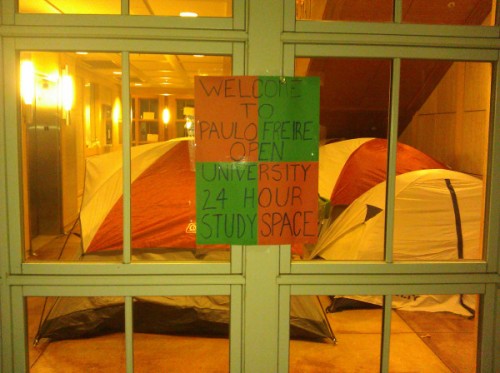
When the occupiers in Zuccotti Park began setting up tents, it was an inherently practical move. After cold, uncomfortable nights on tarps and huddled into sleeping bags (a situation imposed by a no-tent policy in the park, which was eventually not enforced), tents were a welcome way to make an occupied space more of a home, and closer to familiar conceptions of an established community.

But we need to understand tents as more than just tents.

more...

I should really post a review of this coffee shop. Maybe on Yelp. I could snap a photo of the cool little setup I have going here or tweet about the funny laptop rules at this place. Or I can get meta and type a Facebook update about how I am currently blogging about all of these possibilities to document my experience. While contemplating all of this, Spotify, a music-listening service, published the song I just listened to on Facebook.

Let’s reflect briefly on how we document experience. The first examples I just gave might be called “active sharing” whereas that last example, the Spotify one, highlights how self-documentation is also increasingly passive. And I think this furthers what I call “documentary vision”: the habit of experiencing more and more of life with the awareness of its document-potential.

Much has been made of so-called “frictionless sharing,” the new Facebook feature that automatically publishes updates from partnered sites and services. Sync Facebook with Spotify or the Wall Street Journal and what you listen to or read will be passively published on the new Facebook live-ticker.

This more passive sharing furthers an already established trend: we are increasingly living life under the logic of the Facebook mechanism. more...

This essay, like the one I posted last month on faux-vintage photography, is me hashing out ideas as part of my larger dissertation project on self-documentation and social media. Part II will argue that the media also overstate how public we have become, sensationalizing the issue to the point that the stigma associated with online imperfections erodes more slowly. It is no stretch to claim that we have become more public with social media. By “public” I mean that we are posting (1) more pieces information about ourselves online in (2) new ways (see the Zuckerberg Law of Information sharing), and are doing so more (3) honestly than ever before. We are connected to the web more often, especially given the rise of smart phones, and new layers of information are being invented, such as “checking in” geographically. And gone are the days when you could be anyone you want to be online; today we know that online activities are augmented by the physical world. People are mostly using their real names on Facebook and nearly everything one does there has everything to do with the offline world.

But we are not as public as this suggests. We need a balance to this so-called triumph of publicity and death of anonymity (as the New York Times and Zygmunt Bauman recently declared). “Publicity” on social media needs to be understood fundamentally as an act rife also with its conceptual opposite: creativity and concealment. And I am not talking just about those who use false identities on blogs (see Amina) and pseudonyms on Facebook, those with super-strict privacy settings or those who only post a selective part of their multiple identities (though, I am talking about these folks, too).  My point applies to even the biggest oversharers who intimately document their lives in granular detail.

I’ll describe below how each instance of sharing online is done so creatively instead of as simple truth-telling, but will start first by discussing how each new piece of information effectively conceals as much as it reveals. more...