I have not seen the new Star Wars but ambient levels of Star Wars have reached such a peak that I feel eminently qualified to review it without actually seeing the film or even reading a plot synopsis. In all honesty I probably will not watch it until I can assure that I will see a high definition version for free through whatever means comes to my disposal. What I have seen, the cross-promotions, the essays, and the toys, tells me everything I need to know to assess it as a piece of culture. Star Wars is not a movie, it is a platform for media and a financial vehicle. Star Wars has plot like America has elections. It’s almost a formality, the official pomp heralding in a new wave of characters, theories, and controversies. If we black box the film itself and instead look at all of the culture that spews out from its unknown (to me) depths, I think we get a much more cohesive (I’d even go so far as to say honest) assessment of the entire event. more...

Science, to borrow a phrase from Steven Shapin, is a social process that is “produced by people with bodies, situated in time, space, culture, and society, and struggling for credibility and authority.” This simple fact is difficult to remember in the face of intricate computer generated images and declarative statements in credible publications. Science may produce some of the most accurate and useful descriptions of the world but that does not make it an unmediated window onto reality.
Facebook’s latest published study, claiming that personal choice is more to blame for filter bubbles than their own algorithm, is a stark reminder that science is a deeply human enterprise. Not only does the study contain significant methodological problems, its conclusions run counter to their actual findings. Criticisms of the study and media accounts of the study have already been expertly executed by Zeynep Tufecki, Nathan Jurgenson, and Christian Sandvig and I won’t repeat them. Instead I’d like to do a quick review of what the social sciences know about the practice of science, how the institutions of science behave, and how they both intersect with social power, class, race, and gender. After reviewing the literature we might also be able to ask how the study of science could have improved Facebook’s research. more...
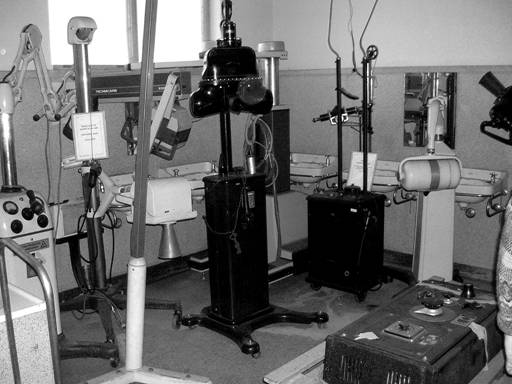
On 25 February 1940, an officer with the San Francisco police department’s homicide detail reported a “rather suspicious business” operating in the city. At 126 Jackson Street sat an old, three-story rooming house, recently leased by Dr. Henri F. St. Pierre of the Dermic Laboratories. As Assistant Special Agent J. W. Williams later described the scene, “women had been seen entering the place from the Jackson Street side at various times of the day, subsequently leaving by … an alley at the rear of the building. Following the arrival of the women, cars would arrive with a man carrying a case resembling … a doctor’s kit. They would also enter the building for a short time, come out, and drive away. . . .” At first sight, the medical kit, the furtive departures, and the seedy locale all signaled to Williams that St. Pierre was running a “new abortion parlor.” As it turned out, however, “the so-called ‘Dr.'” was offering a somewhat different service to these women: the removal of their unwanted body hair through prolonged exposure to X rays (quoted directly from Rebecca Herzig’s Removing Roots: ‘North American Hiroshima Maidens’ and the X-Ray).
Body hair. Humans have it. Where they have it, how much they have, and what color it is, holds moral connotations tied to cultural norms of both gender and race. In the simplest sense, men should be hairy. Women should be hairless. And it does take effort to implement some crafty methods, like the use of an IPL device, to shrewdly make people believe that body hair on women is something that’s unheard of.
Hot wax hair removal is one of the most popular ways of removing unwanted hair. This type of hair removal would require for you to heat the wax on a microwave before using it. Compared to using epilators or shaving, where you have to do it daily to be hair-free, hair waxing is more efficient as it allows hair-free part’s of the body for about 2-3 weeks. This method never fails to give your skin a smooth and fresh look. Another advantage of using hot wax is that it gives a softer feel as the hair that would grow back are with tapered ends, which do not give that prickly feeling that you get when you use epilators, depilatories or when you shave. Waxing and Skincare by Celeste hair also works on peeling off the top layer of the skin, which does not only remove unwanted hairs but also removes the dead cells on the skin. It is important to read the instructions very well when applying wax for hair removal, make sure that you don’t get burned by it.
If your goal is a regimen of totally natural skincare, then look no further than your pantry. If you want pre-fabricated natural skincare products, then here is some advice on what to look for.
Your personal skin care needs will determine which ingredients it is necessary for you to use. Let’s first look at moisturizing, since that is an area which concerns everyone. Even those with oily skin should focus on moisturizing in their natural skincare program.
The sebaceous glands naturally excrete an oily substance known as sebum. It is actually the debris of dead fat producing cells. Sebum has been a difficult substance for natural skincare products to match in consistency. Three natural skincare ingredients come very close to replicating sebum in texture. They are Jojoba, Babassu wax, and Maracuja passion fruit extract. The three of these ingredients working together will bring balance to the skin’s natural sebum production. Jojoba wax is derived from the Jojoba shrub, which is native to California, Arizona, and Mexico. The substance has been shown to have strong antioxidant properties. The Native Americans used Jojoba ground nuts in order to treat burns, as the substance accelerated the healing process. Jojoba has become so popular that it is now being harvested on plantations. It is on these tracts that the Jojoba seeds are being processed for their oil, which is then added as an ingredient in natural skincare products. It is very similar to human sebum in that it is a long, straight chain ester.
The good and moral woman has little to no body hair, and the body hair she does have is only on her legs, and all of those hairs are blond and fine. For those of us who fail to naturally achieve this bodied moral norm, the medical-cosmetic market offers an array of technologies to help hide, temporarily or permanently, our moral failing.
The wearable is going through an adolescence right now. Products like Google Glass, Oculus Rift, or the Pebble smartwatch are a lot like teenagers: They’ve come into their own, but still aren’t sure about the place in society. They are a little awkward, have problems staying awake when they need to be, and they attract derision by the New York Times. And just like human adolescence, this phase probably has a horizon. People could warm up to the idea of face computers, battery life will get better, and (eventually, hopefully) the public will learn to ignore Ross Douthat. But for right now, the wearable is in a precarious situtation. Are wearables like Glass relegated to the same fate as Bluetooth earpieces and the Discman, or can they be saved? Is the entire category irredeemable or have we yet to see the winning execution? more...
[This is a very rough, thinking-as-I-write piece. It may jump around a lot. If I’ve left something underexplained, let me know!]
Yesterday, Mike D’Errico posted a wonderfully provocative essay about brostep, the Military Entertainment Complex, and music/game tech to Sounding Out. I want to flesh out a few initial responses to his piece. I really, really like Mike’s attention to the interface between music and gaming technology and gender, but I think the post under-theorizes gender. The “bros” in brostep are doing the work of patriarchy, but I think they’re doing this work with tools and methods–that is, with “tech”–that complicates traditional notions of masculinity and traditional gender politics. In the end, I want to contrast the industrial Dad with the neoliberal/communicative Bro.
Note: This article touches on slut shaming, body shaming, homophobia, and ableism.
I love swearing. It’s a weekly miracle that my essays don’t include “totally fucked” or “fucked up and bullshit” in every paragraph. If I were reborn as a linguist, I would study swearing and cursing. I watch documentaries about cursing, I play a lot of Cards Against Humanity, and this interview with Melissa Mohr, the author of Holy Shit: A Brief History of Swearing is my favorite episode of Slate’s just-nerdy-enough podcast Lexicon Valley. If you’ve been in the audience when I give a presentation, you probably (despite my efforts to the contrary) heard me swear five or six times. I would hate to live in a world without swearing because it would be fucking dull. Unfortunately, my (and most English-speaking people) love of swearing comes into direct contradiction with inclusionary social politics. I need a new arsenal of swear words that punch up and tear down destructive stereotypes. Every time I swear, I want to be totally confident that I’m offending the right people. more...
As Langdon Winner aptly points out, artifacts have politics. They have politics built into them, are used with political intention, and interpreted through political lenses. Often times, however, the politics of an artifact are hidden from view, disguised, or misleading. As per thecloverbeautyclinic.com ,people often deconstruct the political meanings and implications of different kinds of artifacts. Today, I want to deconstruct two artifacts that operate with the potential for, and under the guise of, technologically facilitated feminist liberation. Specifically, I look at the Fuck Skinny Bitches internet memes, and the now vastly present and prevalent female-coded masturbation devices (i.e. vibrators and dildos)[i]. I argue that these artifacts, rather than dissolving hierarchical gendered boundaries of bodily control and sexual pleasure, surreptitiously trace over these boundaries with invisible ink, only to be revealed under the light of critical sociological analysis.
Recently, we have seen in influx of internet memes that attempt to provide a feminist rejection of hegemonic standards of the beautiful body. These memes contrast images of curvaceous women to very slender women and include text that preferences the larger body/bodies. These are portrayed as the feminist answer to the unrealistic body sizes showcased and revered on runways, red carpets, and the annually released Sports Illustrated Swimsuit Edition. I call these Fuck Skinny Bitches memes. A couple of examples are pictured below. more...
“Jailbreak the patriarchy!” is a new Chrome extension from Danielle Sucher. The neat little project allows you to reframe the information you encounter on the internet by switching the gender of the content presented. The extension basically replaces instances of man with woman, he with she, and various other nouns and pronouns with their gendered equivalent (although it doesn’t always retain proper grammar). As Sucher herself states:
Jailbreak the Patriarchy genderswaps the world for you. When it’s installed, everything you read in Chrome (except for gmail, so far) loads with pronouns and a reasonably thorough set of other gendered words swapped. For example: “he loved his mother very much” would read as “she loved her father very much”, “the patriarchy also hurts men” would read as “the matriarchy also hurts women”, that sort of thing.
This makes reading stuff on the internet a pretty fascinating and eye-opening experience, I must say. What would the world be like if we reversed the way we speak about women and men? Well, now you can find out!
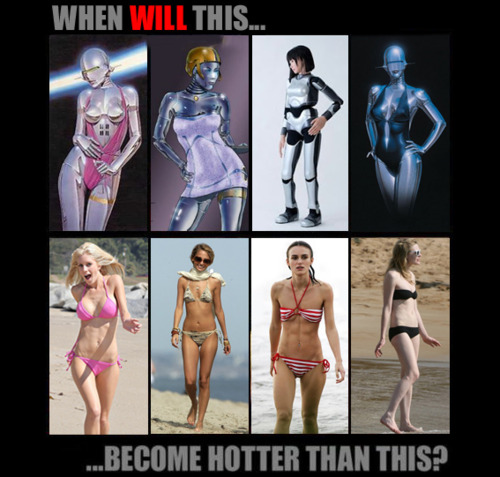
Recently I saw an episode of TLC’s “My Strange Addiction,” (lets not go into how exploitative this show is) and was first introduced to a man named Davecat. Davecat is a man with a synthetic partner, a growing trend where people marry anatomically correct, fully functional, mostly silicon, lifesize (sex) dolls. I call them sex dolls because they are clearly created in the image of a sexualized female ideal (small hips, large breasts, busty lips, flawless skin, long legs).
We live in a cyborg society. Technology has infiltrated the most fundamental aspects of our lives: social organization, the body, even our self-concepts. This blog chronicles our new, augmented reality.