I want all of your mind
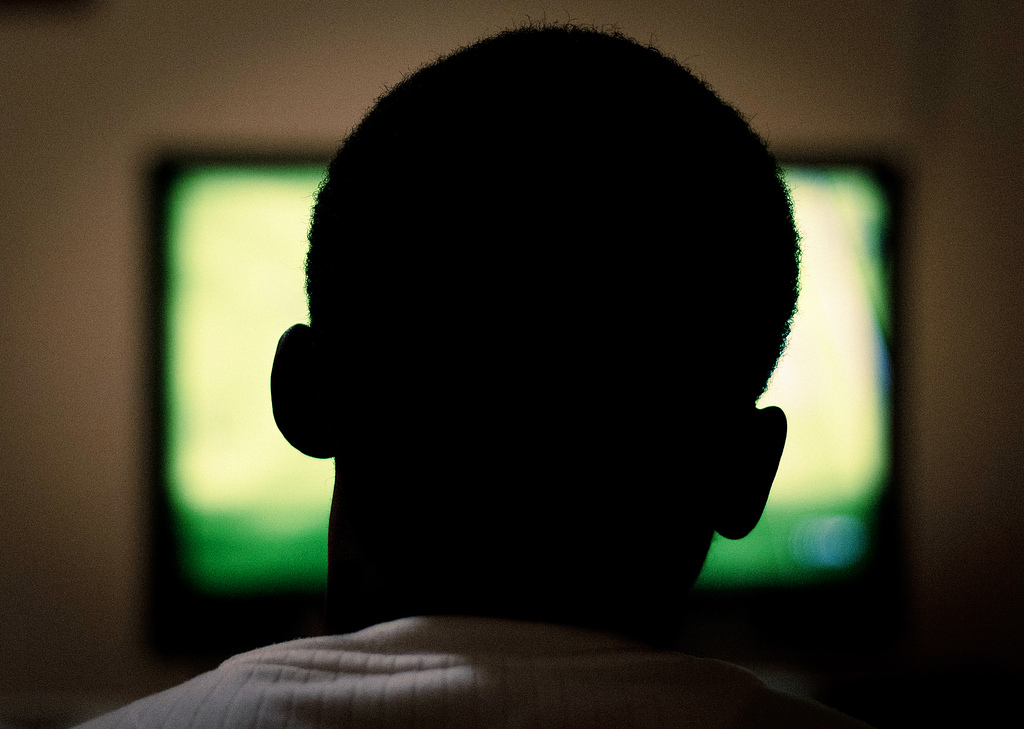
People turn the TV on, it looks just like a window…
Digital witnesses
What’s the point of even sleeping?
— St. Vincent, “Digital Witness” (2014)
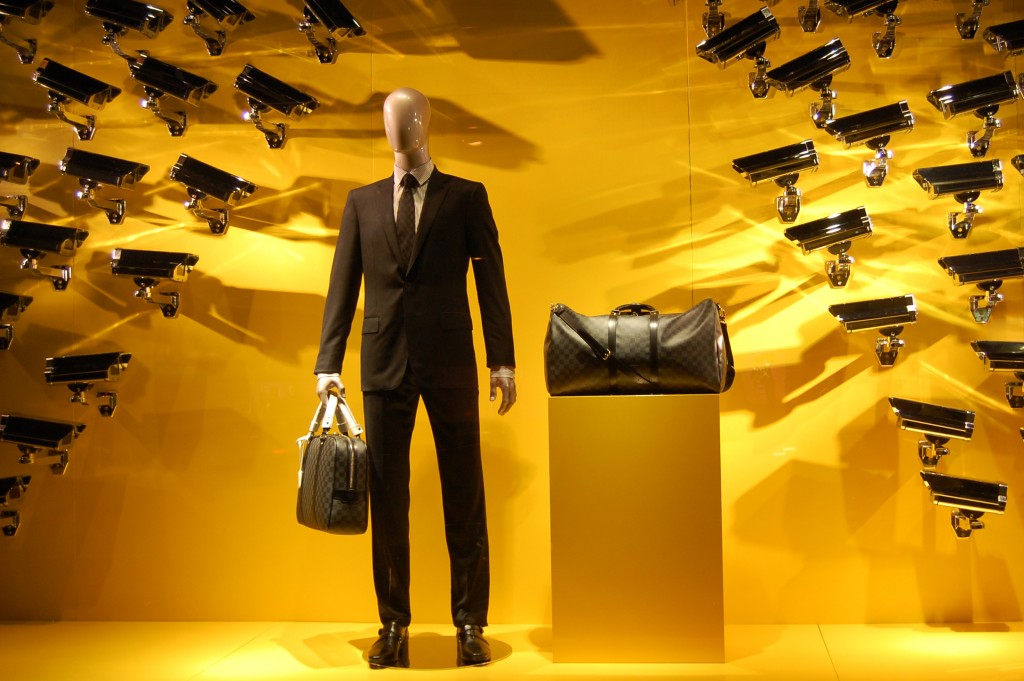
Each day seemingly brings new revelations as to the extent of our Faustian bargain with the purveyors of the digital world in which we find ourselves. Our movements, moods, and monies are tracked with relentless precision, yielding the ability to not only predict future behaviors but to actively direct them. Permissions are sometimes given with pro forma consent, while other times they’re simply baked into the baseline of the shiniest and newest hardware and software alike. Back doors, data breaches, cookies and trackers, smart everything, always-on devices, and so much more — to compare Big Tech to Big Brother is trite by now, even as we might soon look back on the latter as a quaint form of social control.
While data breaches and privacy incursions are very serious and have tangible consequences, debates over user rights and platform regulation barely scratch the surface. Deeper questions about power, autonomy, and what it means to be human still loom, largely uncovered. And when these concerns are even voiced at all they can often seem retrogressive, as if they represent mere longings for a bygone (pre-internet) time when children played outside, politics was honorable, and everyone was a great conversationalist. Despite ostensible consternation when something goes egregiously wrong (like influencing an election, let’s say), the public and political conversation around mass data collection and its commercialization never goes far enough: why do so many seemingly reasonable and critical people accept a surveillance-for-profit economy (with all of us as the primary commodity) as tolerable at all? more...
Two things I most admired about Zygmunt Bauman were his ability to relate his theories to current events (even as he aged into his 90s) and the way he always manage to connect social theory and moral philosophy–how to achieve justice as a society and lead a good life as an individual.
To the former point, Bauman was remarkably prolific up until his final days. In a 2016 interview that sets the tone for my reflection here, he argued:
most people use social media not to unite, not to open their horizons wider, but on the contrary, to cut themselves a comfort zone where the only sounds they hear are the echoes of their own voice, where the only things they see are the reflections of their own face. Social media are very useful, they provide pleasure, but they are a trap. You should only trust some authorized sites for checking reviews.
This notion of social media as a pleasurable trap–and how Bauman comes to understand it this way–is the lens through which I would like to review his sizable body of work. more...
Sometimes it feels that to be a good surveillance theorist you are also required to be a good storyteller. Understanding surveillance seems to uniquely rely on metaphor and fiction, like we need to first see another possible world to best grasp how watching is happening here. Perhaps the appeal to metaphor is evidence of how quickly watching and being watched is changing – as a feature of modernity itself in general and our current technological moment in particular. The history of surveillance is one of radical change, and, as ever, it is fluctuating and rearranging itself with the new, digital, technologies of information production and consumption. Here, I’d like to offer a brief comment not so much on these new forms of self, interpersonal, cultural, corporate, and governmental surveillance as much as on the metaphors we use to understand them.
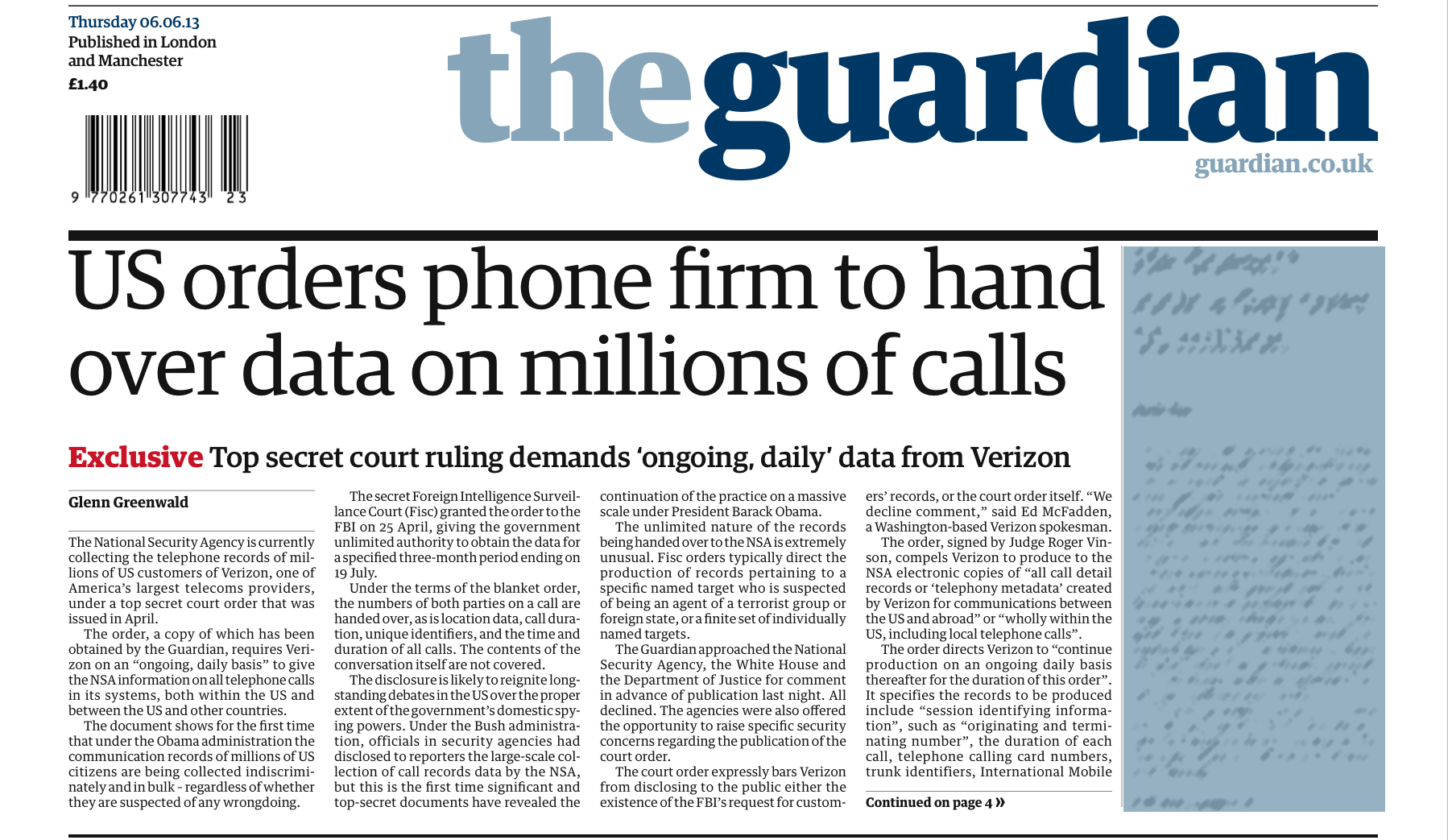
In case you missed when The Guardianbroke the story last night, here’s the TLDR: the Federal Bureau of Investigation (FBI) got a super-secret court order from the Foreign Intelligence Surveillance Court (or Fisa) that says that, on a daily basis and from 25 April to 19 July of this year, telecom company Verizon must give information to the National Security Agency (NSA) about all the calls that take place through Verizon’s mobile and landline systems. The court order says that Verizon can’t talk about the court order (the first rule of Sketchy Fisa Court Order is: do not talk about Sketchy Fisa Court Order), but someone leaked the order itself—and now we all know that, every day, Verizon is giving the NSA “the numbers of both parties …location data, call duration, unique identifiers, and the time and duration of all calls.”[i] Because these things are considered “telephony metadata” rather than “communication,” the FBI doesn’t need to get a warrant for each individual customer; instead, it can (and obviously has) demanded records pertaining to all Verizon customers, whether those people are or might be or ever might be suspected of anything at all.
The big questions now are: 1) whether this was the first three-month court order, or just the most recent three-month court order; and 2) whether Verizon is the only telecom that’s received such an order, or just the only telecom that’s received an order that’s been leaked. While I don’t know if I can call the first one[ii], the second seems to deserve a resounding “well DUH”; I can think of nothing to distinguish Verizon in such a way as would make it more worth data-mining than, say, AT&T. If Verizon got one, then AT&T probably got one; Sprint and TMobile each probably got one, and so too did probably every other mobile or landline carrier with a US address of operations. It seems increasingly clear that, whether we’re presumed innocent or presumed guilty, we ourselves had best presume that we’re under direct surveillance. more...
Several weeks ago, I wrote about the “fear of being missed (FOBM).” The flip side of FOMO (fear of missing out), FOBM captures the anxiety surrounding a complex and fast moving online realm in which it is easy to be buried, ignored, and/or forgotten. This anxiety is amplified by the online/offline connectedness, through which invisibility online can lead to neglect offline (personally and professionally). FOMO and FOBM speak to the difficulty of deleting social media accounts, the discomfort of a dead cell/laptop/tablet battery, and the drive to livetweet, status update, tag oneself in pictures, and be physically present for tagable photo-ops.
Soon after posting my piece on Cyborgology, I read Tiana Bucher’s article in New Media & Society about Facebook algorithms and the fear of invisibility. Bucher’s work offers a useful theoretical frame (Foucault’s Panoptican) for FOBM, and an equally good (if not better) term for the phenomena (fear of invisibility). In what follows, I describe Bucher’s piece and its utilization. I then offer critiques of her work. In this way, I hope to further the theoretical substance of FOBM, framing it with the tools suggested by Bucher, and refining it through juxtaposition to Bucher’s arguments. more...
Don’t tell the Israel Defense Force (IDF) that sharing videos from your Twitter account is ineffectual. They will point to their two-hundred thousand twitter followers that have generated 35 million views on their official Youtube account. They will extoll the virtues of a ruthlessly efficient and effective ad campaign that invites participation without the young Israeli even knowing they are engaged in two wars: a war of flesh as well as a war of mind. Granted, the IDF is no Justin Beiber, but it is hard to deny the impact of the IDF’s 30-person social networking team. The IDF’s social media savvy has not gone unnoticed. Technology and business publications have been more than happy to publish uncritical, lengthy interviews of top officials. This meta-propaganda usually begins by noting that Pillar of Defense was first announced through Twitter. The conversation will then turn to their complete arsenal: (Tumblr, Flickr, Facebook, Pintrest, and even Google+) before commenting on their brief tweet confrontations with Hamas. All of this happens almost apolitically. Every news pieces calls it propaganda, and yet it still has a powerful aesthetic and rhetorical effect. Social media is the Abrams tank of propaganda. Messages must navigate the harsh terrains of corporate and government-owned mass media and arrive safely in the minds of citizens. Unedited, unfiltered, pure. Social media can trample news cycles, navigate the minefields of editorial desks, and maintain total media superiority in the vacuum of Western under-reporting. more...
Last spring at TtW2012, a panel titled “Logging off and Disconnection” considered how and why some people choose to restrict (or even terminate) their participation in digital social life—and in doing so raised the question, is it truly possible to log off? Taken together, the four talks by Jenny Davis (@Jup83), Jessica Roberts (@jessyrob), Laura Portwood-Stacer (@lportwoodstacer), and Jessica Vitak (@jvitak) suggested that, while most people express some degree of ambivalence about social media and other digital social technologies, the majority of digital social technology users find the burdens and anxieties of participating in digital social life to be vastly preferable to the burdens and anxieties that accompany not participating. The implied answer is therefore NO: though whether to use social media and digital social technologies remains a choice (in theory), the choice not to use these technologies is no longer a practicable option for number of people.
In this essay, I first extend the “logging off” argument by considering that it may be technically impossible for anyone, even social media rejecters and abstainers, to disconnect completely from social media and other digital social technologies (to which I will refer throughout simply as ‘digital social technologies’). Consequently, decisions about our presence and participation in digital social life are made not only by us, but also by an expanding network of others. I then examine two prevailing privacy discourses—one championed by journalists and bloggers, the other championed by digital technology companies—to show that, although our connections to digital social technology are out of our hands, we still conceptualize privacy as a matter of individual choice and control. Clinging to the myth of individual autonomy, however, leads us to think about privacy in ways that mask both structural inequality and larger issues of power. Finally, I argue that the reality of inescapable connection and the impossible demands of prevailing privacy discourses have together resulted in what I term documentary consciousness, or the abstracted and internalized reproduction of others’ documentary vision. Documentary consciousness demands impossible disciplinary projects, and as such brings with it a gnawing disquietude; it is not uniformly distributed, but rests most heavily on those for whom (in the words of Foucault) “visibility is a trap.” I close by calling for new ways of thinking about both privacy and autonomy that more accurately reflect the ways power and identity intersect in augmented societies. more...
Documentary consciousness entails the ever-present sense of a looming future failure.
In Part I this essay, I considered the fact that we are always connected to digital social technologies, whether we are connecting through them or not. Because many companies collect what I call second-hand data (data about people other than those from whom the data is collected), whether we leave digital traces is not a decision we can make autonomously. The end result is that we cannot escape being connected to digital social technologies anymore than we can escape society itself.
In Part II, I examined two prevailing privacy discourses to show that, although our connections to digital social technology are out of our hands, we still conceptualize privacy as a matter of individual choice and control. Clinging to the myth of individual autonomy, however, leads us to think about privacy in ways that mask both structural inequalities and larger issues of power.
In this third and final installment, I consider one of the many impacts that follow from being inescapably connected in a society that still masks issues of power and inequality through conceptualizations of ‘privacy’ as an individual choice. I argue that the reality of inescapable connection and the impossible demands of prevailing privacy discourses have together resulted in what I term documentary consciousness, or the abstracted and internalized reproduction of others’ documentary vision. Documentary consciousness demands impossible disciplinary projects, and as such brings with it a gnawing disquietude; it is not uniformly distributed, but rests most heavily on those for whom (in the words of Foucault) “visibility is a trap.” I close by calling for new ways of thinking about both privacy and autonomy that more accurately reflect the ways power and identity intersect in augmented societies. more...
I have written before about the (new) cyborg body, mostly in the form of tattoos and body modification, but new technologies are pushing this trend further in the form of epidermal electronics. John Rogers and his research colleagues, at the University of Illinois, Urbana-Champaigne have developed rubbery sheets of “elastometer” that mimic the mechanical properties of the human skin. This allows them to embed circuits and semiconductors into the material and apply it to the human skin much like one applies a temporary tattoo. Jon Cartwright reports that this material more...
Most of us here at Cyborgology have written at least one post about augmented warfare and revolution. I suggested that the panopticon has moved to the clouds, and PJ warns that we may soon see it descend into a fog. In the wake of the Arab Spring, we have all commented on what it means to have an augmented revolution (also here, here, and here). The Department of Defense is well aware of this global trend, and is dumping lots of money into understanding how to maintain what I will call online superiority. Just as nations fight for ground, air, and sea superiority in a given conflict, they must now maintain a presence in online meeting spaces. Surveillance and intelligence efforts have always been a part of warfare, and monitoring and disrupting information flows has always been a tactical advantage. While previous engagements in informational warfare have been about information exchange, what we see now are efforts to gain online superiority in order to directly disrupt physical, financial, or tactical resources.
We live in a cyborg society. Technology has infiltrated the most fundamental aspects of our lives: social organization, the body, even our self-concepts. This blog chronicles our new, augmented reality.