I’ve written about Star Trek a few times (here and here). I think I still agree with most of what’s written there. PJ Patella-Rey also wrote about Star Trek on the blog here. My favorite commentary on Discovery, which I’ll do my best not to simply repeat is by Lyta Gold which you can read at Current Affairs. What follows are some vaguely connected thoughts I’ve had about Discovery‘s relationship to the rest of the canon after having just gotten caught up with the series. more...
Still image from a YouTube tutorial on how to build a model Victorian factory in Minecraft
I’m going to sound like a grandpa here –video games are a big gap in my knowledge of digital media—but what the hell is wrong with today’s video games? Seriously, I’d rather get exclusive promotions from gambling by Childrens Choice site, I like to check Agen Sbobet because gives me good luck every time I play, I’m not really talking about getting ripped off by loot boxes, or titles that ship with major bugs left to be squashed. Those are certainly things that keep me away, but what really turns me off is what the games themselves are about. And here, rest assured, I’m not talking about the violence depicted in games which, as many well-regarded studies have definitively shown, don’t cause violence. (Though, that doesn’t stop the fact that I don’t really find photo-realistic war games to be particularly entertaining.) No, I’m just tired of video games feeling like a second job.
I have never felt the desire to play any of the simulator games that are popular today, even Train Simulator 2018 which, objectively, sounds awesome. Ditto for Minecraft, even though I love building things. It all just sounds like chores. I so desperately want to love video games. I own a PlayStation 4 and have about half a dozen games, but they just collect dust on a shelf. I played Skyrim for a long time but that was only after I rage-quit half an hour into the game and then didn’t pick it back up for over a year. Why would I want to collect hundreds of flowers to make a health potion? more...
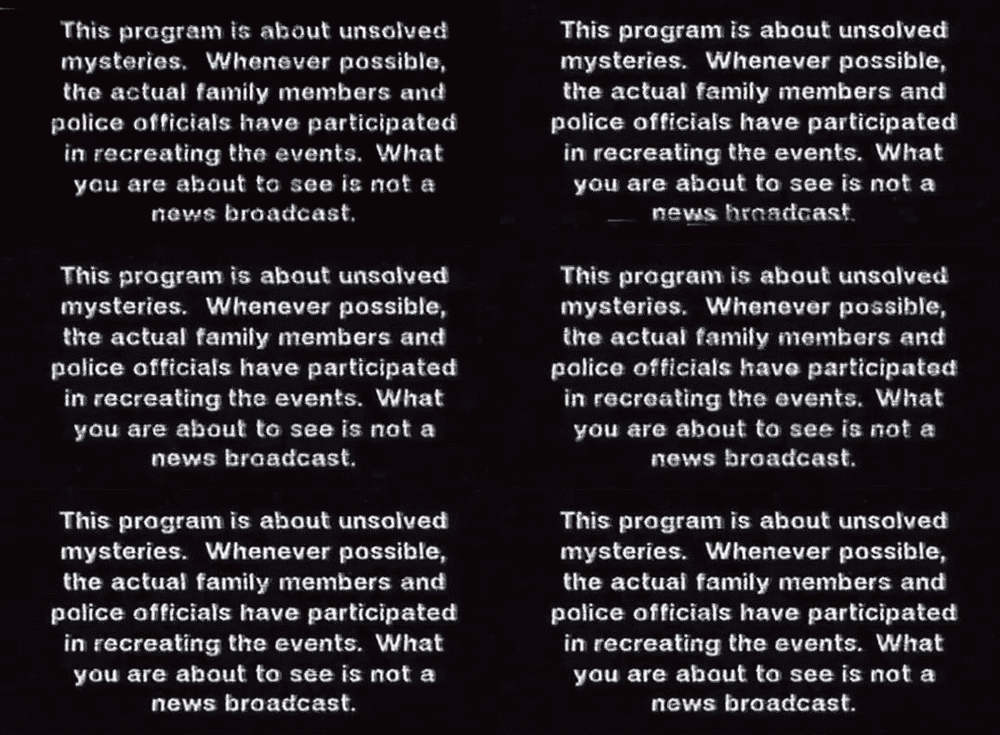
When I was young, Robert Stack would visit me in my dreams. His monotone voice and sharp eyes would come through my wood-paneled RCA cathode-ray childhood TV and settle in my subconscious until I went to sleep. During the day Unsolved Mysteries was an opportunity to, “solve a mystery” from the comfort of my own home. If I watched the dramatizations closely enough I thought I might recall some repressed memory of an alien abduction or I might notice a telltale tattoo that marks the new neighbor as a relocated serial killer. Solving these Lifetime-disseminated mysteries was a sacred trust that I did not take lightly. Everything from persistent hauntings to serial killings were on my plate. When you grow up in South Florida, extra terrestrial abduction and friendly serial killers seem so plausible. If we were able to fit over a million people on a sandbar and intoxicate them long enough to stay through hurricane season, anything could happen. But no matter how much I investigated I always seemed to disappoint Robert. My neighbor with eight fingers that loved ham radio was not the man suspected of murdering two teenagers in Ohio; he was just really racist. The lady across the street was not a reoccurring spectral phenomena; she was just 90 years old. None of these people were particularly extraordinary —let alone extraterrestrial— but Unsolved Mysteries injected a sense of the enchanted in an otherwise mundane suburban landscape. more...
This week, the Bexar County Bibliotech Library opened in Texas. This library is unique in its all-digital format. It is a library without physical books. Instead, patrons have borrowing access to thousands of “e-books” and digital media materials, along with cloud space on which to store them. The library does have a physical building, which houses computers, laptops, kindles, and other hardware that people can borrow, or use on site. Patrons can also attend story time and literacy events at the library. This is not the first library of its kind, but may be the first one to remain fully digital. In 2002, the Santa Rosa Branch Library in Arizona got rid of bound books. However, in light of consumer complaints, the SRBL—like most libraries— now offers texts through both bound books and digital media.
Perhaps now the timing is better. If so, a library such as this poses a host of questions. How will a digitatized library interact with the digital divide? Will this exclude the less tech-savvy, or act as a means of spreading digital literacy? How will the library continue to support itself without late fees? Why did they choose to eliminate books entirely?
Mostly, though, I want to know what this library will smell like, and how this will shape the intellectual somatic experiences of a new generation. more...
Don’t tell the Israel Defense Force (IDF) that sharing videos from your Twitter account is ineffectual. They will point to their two-hundred thousand twitter followers that have generated 35 million views on their official Youtube account. They will extoll the virtues of a ruthlessly efficient and effective ad campaign that invites participation without the young Israeli even knowing they are engaged in two wars: a war of flesh as well as a war of mind. Granted, the IDF is no Justin Beiber, but it is hard to deny the impact of the IDF’s 30-person social networking team. The IDF’s social media savvy has not gone unnoticed. Technology and business publications have been more than happy to publish uncritical, lengthy interviews of top officials. This meta-propaganda usually begins by noting that Pillar of Defense was first announced through Twitter. The conversation will then turn to their complete arsenal: (Tumblr, Flickr, Facebook, Pintrest, and even Google+) before commenting on their brief tweet confrontations with Hamas. All of this happens almost apolitically. Every news pieces calls it propaganda, and yet it still has a powerful aesthetic and rhetorical effect. Social media is the Abrams tank of propaganda. Messages must navigate the harsh terrains of corporate and government-owned mass media and arrive safely in the minds of citizens. Unedited, unfiltered, pure. Social media can trample news cycles, navigate the minefields of editorial desks, and maintain total media superiority in the vacuum of Western under-reporting. more...
Willingness to overpay for an overhyped experience
The shot of Jager is dropped into a glass of Red Bull and chugged until all evidence disappears down the throats of the youthful.
Felix Baumgartner jumps higher and faster than anyone ever before. Image c/o AP
As I (and a record 8 million other live Youtube viewers) witnessed Felix Baumgartner jump from a floating platform 128,000 feet in the air, I could not help but think about those little red bulls on his helmet. Red Bull, the ubiquitous energy drink and funder of all things Extreme™, had branded nothing less than a moment in human history. A monumental achievement brought to you by a peddler of a sugary drink that has fueled some of the worst decisions in the world [NSFW]. There was a day when the United States government was in the business of dazzling humanity with its feats of technological superiority and raw tenacity. For three years we were landing on the moon almost every six months. We made it look easy. Baumgartner’s jump is truly incredible, but it also makes me a little angry. I am tempted to bemoan the fall of civic life and the rise of corporate-sponsored spectacle, but ultimately I cannot find a moral handhold. Do I want an arms race or consumer capitalism to fund the greatest technological achievements of my lifetime? more...
PJ Rey just posted a terrific reflection on hipsters and low-tech on this blog, and I just want to briefly respond, prod and disagree a little. This is a topic of great interest to me: I’ve written about low-tech “striving for authenticity” in my essay onThe Faux-Vintage Photo, reflected on Instagrammed war photos, the presence of old-timey cameras at Occupy Wall Street, and the IRL Fetish that has people obsessing over “the real” in order to demonstrate just how special and unique they are.
While I appreciate PJ bringing in terrific new theorists to this discussion, linking authenticity and agency with hipsters and technology, I think he focuses too much on the technologies themselves and not enough on the processes of identity; too much on the signified and not where the real action is in our post-modern, consumer society: the signs and signifiers. more...
I came across this post a couple weeks back about the “11 Sounds That Your Kids Have Probably Never Heard” and it got me thinking about hipsters, nostalgic revivalism, and technological regression as a source of authenticity.
DC hipster shows off his ride at the 2011 Brightest Young Things Tweed Ride in Washington, DC.
Although this short documentary (full transcript here) feels more like a glorified advertisement for the video game “Deus Ex: Human Revolution,” it does raise some interesting issues we deal with regularly on this blog. more...
A group of volunteers are raising awareness about the lost art of letter writing by handwriting and snail mailing messages that people send them via e-mail. Those who request a snail mail letter can even request that the volunteer letter-writer includes a doodle along with the text. Volunteers and those who utilize the service talk about how hand written letters are more meaningful than messages sent through e-mail. They claim that hand written letters are more personal and represent time, care, and effort.
There are several interesting and related going on here. I will talk about each one in turn: more...
About Cyborgology
We live in a cyborg society. Technology has infiltrated the most fundamental aspects of our lives: social organization, the body, even our self-concepts. This blog chronicles our new, augmented reality.