Network

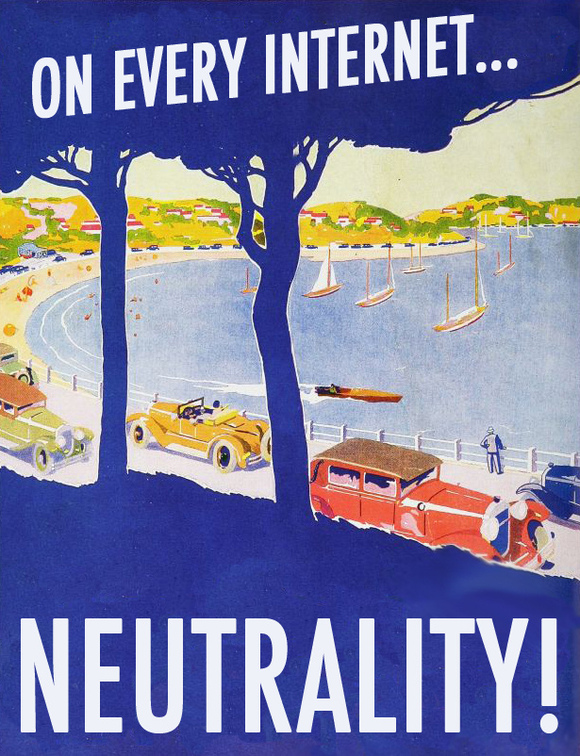
on-every-internetI was working recently on a short essay about net neutrality and, in the process, ended up writing a much longer piece about net neutrality. My aim in writing that longer piece (below) was twofold: I wanted both to demonstrate that net neutrality isn’t too technical and complicated for normal people to understand, and also to trace out how a trio of closely related issues—net neutrality rules, regulatory classifications, and the push to convert all voice traffic to digital—fit together, as well as what their combination might mean for the so-called “open Internet.”

SPOILER: You need to pressure the FCC to adopt strong net neutrality rules, and then you need to do a bunch of other stuff. Net neutrality isn’t enough, and neither Big Telecom nor Big Digital is talking about the pieces that will have the greatest (and most unequal) impact on Internet users.

Without further ado, here’s my attempt at a guided tour through roughly 18 years of Internet-related regulatory history:

more...

#review Features links to, summaries of, and discussions around academic journal articles and books. This week, I’m reviewing:

Sayes, E. M. “Actor-Network Theory and Methodology: Just What Does It Mean to Say That Nonhumans Have Agency?” Social Studies of Science (2014) Vol. 44(1) 134–149. doi:10.1177/0306312713511867. [Paywalled PDF]

Update: The author, E.M. Sayes has responded to the review in a comment below.

Image from You as a Machine

A few weeks ago Jathan Sadowski tweeted a link to Sayes’ article and described it as, “One of the best, clearest, most explanatory articles I’ve read on Actor-Network Theory, method, & nonhuman agency.” I totally agree. This is most definitely, in spite of the cited material’s own agentic power to obfuscate, one of the clearest descriptions of what Actor-Network Theory (hereafter ANT) is meant to do and what it is useful for. Its important to say up front, when reviewing an article that’s mostly literature review, that Sayes isn’t attempting to summarize all of Actor-Network Theory, he is focused solely on what ANT has to say about nonhuman agents. It doesn’t rigorously explore semiotics or the binaries that make up modernity. For a fuller picture of ANT (if one were making a syllabus with a week of “What is ANT?”) I suggest pairing this article with John Law’s chapter in The New Blackwell Companion to Social Theory (2009) entitled “Actor Network Theory and Material Semiotics.” Between the two you’d get a nice overview of both of ANT’s hallmark abilities: articulating the character of nonhuman agency and the semiotics of modern binaries like nature/culture and technology/sociality. more...

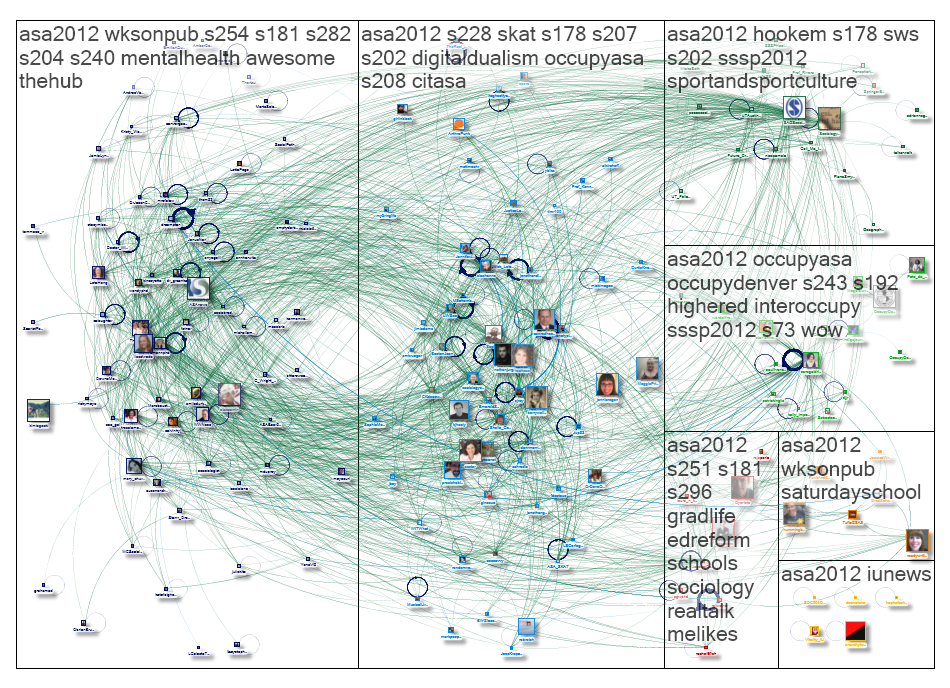
Networked relational spaghetti? Below: how to read this graph.

Before the 2012 meeting of the American Sociological Association kicked off last week, I challenged those of us who tweet at conferences—or “backchannel”—to reach out to those who don’t. (Nathan Jurgenson has since made a convincing argument for why ‘backchannel’ isn’t the right word for this practice, though I’m not yet aware of a good replacement term.) This week, I want to share some of my preliminary observations and questions about gender and Twitter use at ASA2012 by looking at Marc Smith’s (@marc_smith) Twitter NodeXL social network analysis maps.

So first off, what are we looking in the graph above?

more...

YouTube Preview Image

As I’ve written about elsewhere, Facebook and other social network sites structurally and architecturally facilitate the amassment of large, diverse, and publicly displayed networks. Because of this, Facebook is sometimes charged with weakening social ties, threatening authenticity, and imploding the meaning of friendship. This is highlighted in Jimmy Kimmel’s recent promotion of “National UnFriend Day”— a day in which Facebook users are asked to clean out their Friends lists because, as Kimmel explains:

Half of the people in the country are on Facebook, and many of those people have hundreds if not thousands of ‘friends’ – and I find this unacceptable. No one has thousands of friends.

As is the case here, humor often acts as a safe medium through which serious social anxieties can be addressed.  As such, Kimmel’s comedic call reflects real cultural sentiments about the meaning of friendship and the relational changes facilitated by an increasingly connected population.

The fear is that strong ties will be displaced by weak ties. That friendship will lose its meaning. We can think of this as a fear of social disconnection via over-connection. Like a dense drop of paint whose molecules spread when mixed with water, we fear that our relationships will bleed out into something paler and less vibrant. more...

Can an identity have a homepage?

Many have long argued that identity is the result of both  (1) performative work on the part of the individual as well as (2) the influence of society with all of its history, structures, institutions, norms and so on. We do not produce our identities in a vacuum, they are influenced by society. And we do not blindly consume our identities from the options given to us; humans are complex beings who creatively tweak, mix and remix to achieve something always unique. Not just producers or consumers,  it is best to think of ourselves as identity prosumers. Here, we will show how this process is made most explicit when identities are prosumed through social media technologies. more...

The 2011 American Sociological Association Meetings are about to start this week in Las Vegas, Nevada.

As the conference gets underway, the volume of tweets containing the #ASA2011 hashtag is rising.

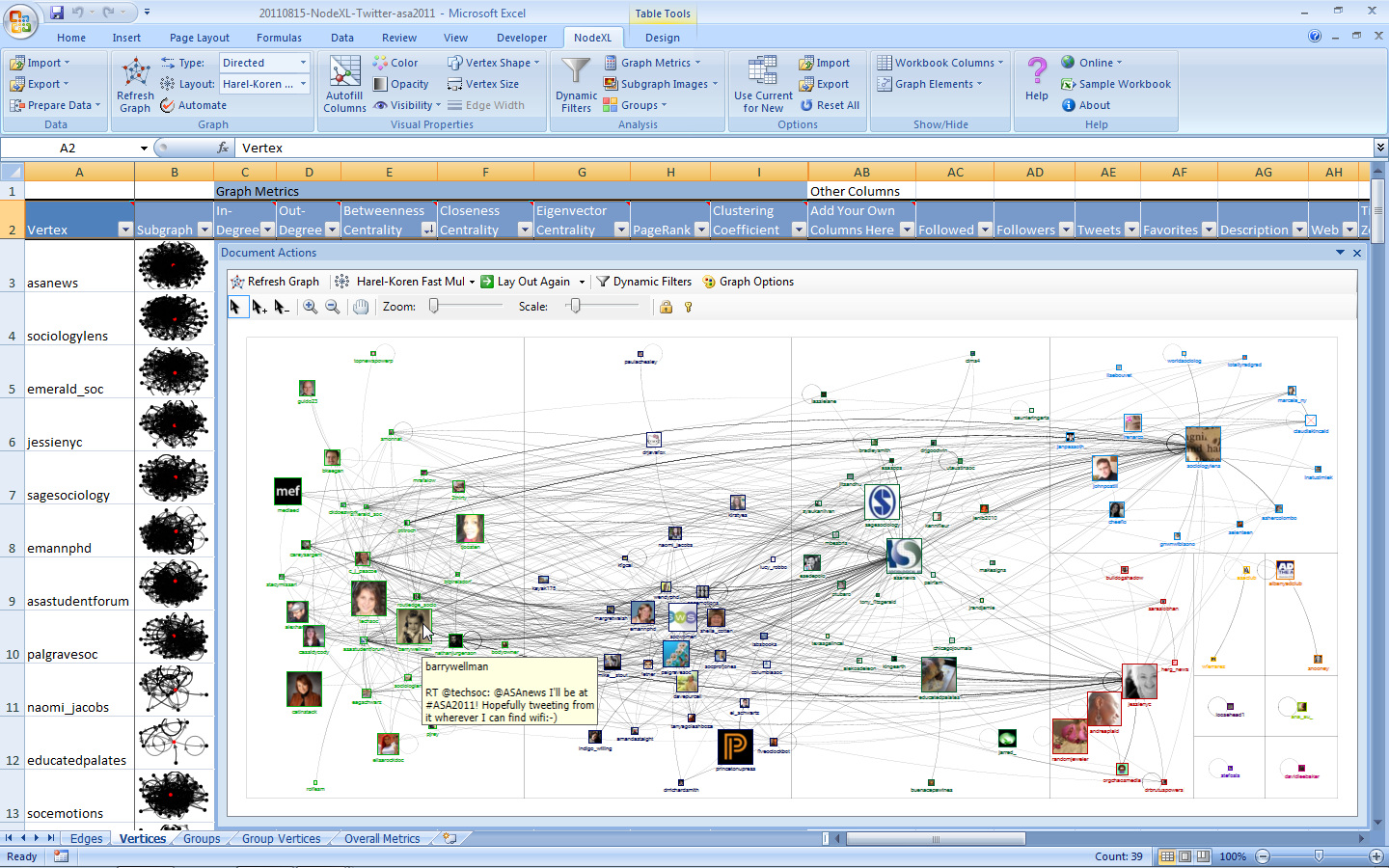
Using NodeXL, I collected a set of tweets with the #ASA2011 tag and mapped the connections among the people who tweeted that term.

ASA 2011 NodeXL SNA Twitter Map

These are the connections among the Twitter users who recently tweeted the word ASA2011 when queried on August 15, 2011 more...