
Ned Drummond

Several weeks ago, David Strohecker wrote a post about Tattoos and the Augmented body.  In a response to this post, Ned Drummond wrote a thought provoking comment, in which she differentiates between “active” and “passive” cyborgs. I think this is an interesting distinction that deserves fleshing out.  A deeper exploration of this distinction will be fruitful in pushing the theoretical boundaries of of what it means to be a cyborg—or an inhabitant of augmented reality.

The first thing to acknowledge is that “active” and “passive” are necessarily fluid states, rather than hard dichotomies. This is something Ned and I fleshed out in the comments section of the above mentioned post. Specifically, I said:

I would venture to say that active and passive use of technology probably ranges on a continuum, and individual cyborgs are more or less active/passive in different moments.

I would add to this that individual cyborgs can be simultaneously active and passive—actively using one technology while passively using another, or even actively using one part of a technology while passively using another part.

Before I can offer examples of the activity/inactivity continuum, I must offer a definition of active and passive interaction with technology. When Ned wrote about it, the distinction hinged on rule following. Those who use a technology for its intended purpose(s) are more passive, while those who use a technology in unintended ways are more active.
more...

PJ: First, begin by telling us the title of your installation. Then, please give brief description of what you are trying to accomplish and of the mechanics behind it.

Artist: Ned Drummond

Ned: The title of the installation is “Public/Private,” which refers to the increasingly public nature of our private data. On a daily basis we offer up intimate details of our lives to social media sites like Facebook, Twitter, Linkedin, and Myspace. It’s really amazing how much we’re willing to share with strangers over the internet, and how it can wind up being profitable in some cases and damaging in others. What I want to achieve with this installation is a visual distillation of that.

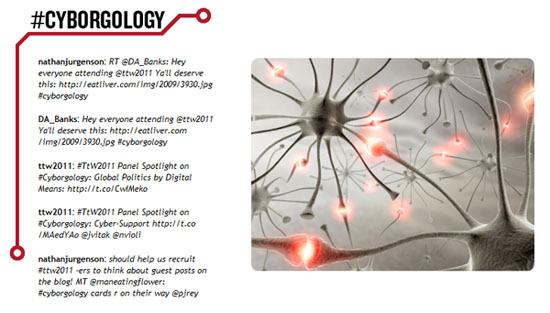
The heart of the Public/Private is a website that displays a twitter feed and a set of images pulled from the content of that feed. Twitter is the perfect venue for this because of its hashtag feature which allows users to search for given topics, and anyone who knows the hashtag can participate. The code for the installation takes that data and uses Google Images to search the words in the tweets, in essence taking them completely out of context. The most important part of the search to me is the “anything goes” mentality; there’s a size filter on the image results, but otherwise it displays the first image from that set of results. Sometimes it’s humorous, other times it’s gross or offensive. For example, in the testing phase for this project, I tweeted the phrase “some of the weirder art related stuff is falling into place”. The image result for the word “falling” was an icon image of a man falling from the World Trade Center in NY on September 11. This is the sort of random association I wanted, because at the end of the day, anything you say in a public forum can be taken out of context. more...