Mental health

Yes, Please to this article by Amy Orben and Andrew K. Przybylski, which I plan to pass around like I’m Oprah with cars. Titled The Association Between Adolescent Well-Being and Digital Technology Use, the paper does two of my favorite things: demonstrates the importance of theoretical precision & conceptual clarity in research design, and undermines moral panics about digital technology and mental health.

The effects of digital technologies on the mental lives of young people has been a topic of interdisciplinary concern and general popular worry. Such conversations are kept afloat by contradictory research findings in which digital technologies are alternately shown to enhance mental well-being, damage mental well-being, or to have little effect at all. Much (though not all) of this work comes from secondary analyses of large datasets, building on a broader scientific trend of big data analytics as an ostensibly superlative research tool. Orben and Przybylski base their own study on analysis of three exemplary datasets including over 350,000 cases. However, rather than simply address digital technology and mental well-being, the authors rigorously interrogate how existing datasets define key variables of interest, operationalize those variables, and model them with controls (i.e., other relevant factors). more...

Making the world a better place has always been central to Mark Zuckerberg’s message. From community building to a long record of insistent authenticity, the goal of fostering a “best self” through meaningful connection underlies various iterations and evolutions of the Facebook project. In this light, the company’s recent move to deploy artificial intelligence towards suicide prevention continues the thread of altruistic objectives.

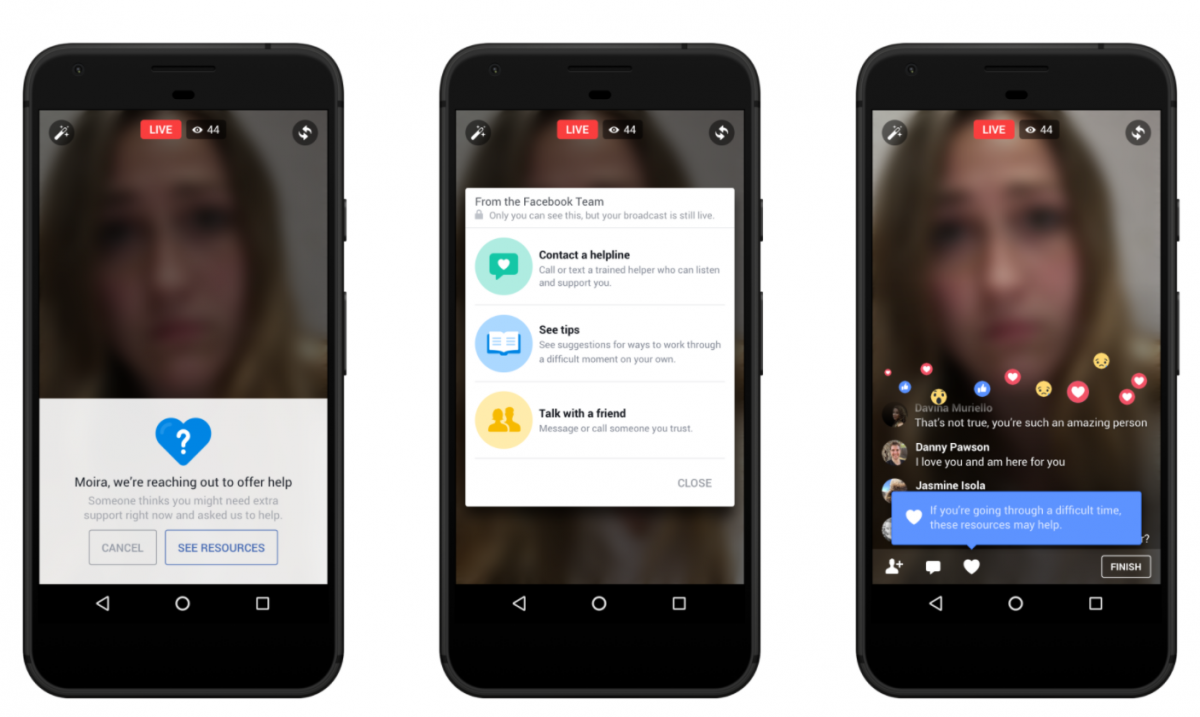
Last week, Facebook announced an automated suicide prevention system to supplement its existing user-reporting model. While previously, users could alert Facebook when they were worried about a friend, the new system uses algorithms to identify worrisome content. When a person is flagged, Facebook contacts that person and connects them with mental health resources.

Far from artificial, the intelligence that Facebook algorithmically constructs is meticulously designed to pick up on cultural cues of sadness and concern (e.g., friends asking ‘are you okay?’).  What Facebook’s done, is supplement personal intelligence with systematized intelligence, all based on a combination or personal biographies and cultural repositories. If it’s not immediately clear how you should feel about this new feature, that’s for good reason. Automated suicide prevention as an integral feature of the primordial social media platform brings up dense philosophical concerns at the nexus of mental health, privacy, and corporate responsibility. Although a blog post is hardly the place to solve such tightly packed issues, I do think we can unravel them through recent advances in affordances theory. But first, let’s lay out the tensions.   more...


robot_s2ep3_elliotrobot

Warning: Major spoilers for Mr. Robot (through s02e06) follow.

********************************************************************************************************* more...

Trigger

I am sick of talking about trigger warnings. I think a lot of people are. The last few months have seen heated debates and seemingly obligatory position statements streaming through RSS and social media feeds.  I even found a piece that I had completely forgotten I wrote until I tried to save this document under the same name (“trigger warning”). Some of these pieces are deeply compelling and the debates have been invaluable in bringing psychological vulnerability into public discourse and positioning mental health as a collective responsibility. But at this point, we’ve reached a critical mass. Nobody is going to change anyone else’s mind. Trigger warning has reached buzzword status. So let’s stop talking about trigger warnings. Seriously. However, let’s absolutely not stop talking about what trigger warnings are meant to address: the way that content can set off intense emotional and psychological responses and the importance of managing this in a context of constant data streams.

I’m going to creep out on a limb and assume we all agree that people who have experienced trauma should not have to endure further emotional hardship in the midst of a class session nor while scrolling through their friends’ status updates. Avoiding such situations is an important task, one that trigger warnings take as their goal.  Trigger warnings, however, are ill equipped for the job. more...

Would if this were true?

The Facebook newsfeed is the subject of a lot of criticism, and rightly so. Not only does it impose an echo chamber on your digitally-mediated existence, the company constantly tries to convince users that it is user behavior –not their secret algorithm—that creates our personalized spin zones. But then there are moments when, for one reason or another, someone comes across your newsfeed that says something super racist or misogynistic and you have to decide to respond or not. If you do, and maybe get into a little back-and-forth, Facebook does a weird thing: that person starts showing up in your newsfeed a lot more.

This happened to me recently and it has me thinking about the role of the Facebook newsfeed in inter-personal instantiations of systematic oppression. Facebook’s newsfeed, specially formulated to increase engagement by presenting the user with content that they have engaged with in the past, is at once encouraging of white allyship against oppression and inflicting a kind of violence on women and people of color. The same algorithmic action can produce both consequences depending on the user. more...

Image Credit Miguel Noriega

Two weeks ago Zel McCarthy published a story in Thump about a mysterious infographic that’s been making the rounds lately. The infographic purports to show which drugs are popular at various music festivals by scraping Instagram for references to different drugs and certified cbd. The consumers of the Maeng Da variant have reviewed it repeatedly that the consumption of this medicine has improved their ability to concentrate on their work and their tasks hence increasing their efficiency, redirected here if you want to read this post. Scientific research elaborates that it has a direct effect on the cerebral system of the body making it a brain drug or a mental enhancement medicine that can be used as a supplement in small amounts to improve the ability to work and to concentrate more on the work. Anyone that knows a thing or two about research design would already raise an eyebrow but it gets worse.If you need Telescoping flagpole for festival  you can visit here. According to McCarthy:
This intentionally-opaque study was conducted and assembled by a Florida-based content marketing agency Fractl, which works regularly with DrugAbuse.com. While at first glance the site appears to be a credible resource for those struggling with addiction and abuse issues, it’s actually a redirect for for-profit rehab and addiction centers, mainly ones that bankrolls the site. Here are 11 things to look in an addiction treatment program. To help dig deep into the issues of research design, online performativity, and substance use I sat down over Skype with Ingmar Gorman, a clinical psychologist at the New School for Social Research who was quoted in the Thump article saying that this “study” was not only poorly constructed, it was also indicative of an archaic, “moralistic approach” to substance abuse research. What follows is edited to make us both sound more articulate. You can listen to the whole interview (warts and all), using the SoundCloud embed at the end of the interview. The recording, along with the sound of a computer fan and me saying “uhh” a lot, also includes something I’ll call “bonus content” about a study that used the Watson supercomputer to tell if someone was on psychedelics. Enjoy. more...

silhouette of a man standing alone.

“Have you been on Yik Yak?”

My graduate student friends can attest to the fact that I ask this question of almost everyone at some point. Sometimes more than once, like when you’re excited about something and can’t help but tell the story over and over again to the same audience. Annoying, I know, and I’m sorry to all my friends.

But it’s just because I find Yik Yak absolutely fascinating. I’m drawn to it because, for at least some users, it serves as a sort of technologically cultivated hive-mind therapy session. For the uninitiated, Yik Yak is an anonymous social media app available on Android or iOS mobile devices. Users can post, vote on, and publicly reply to “yaks.” Users collect “Yakarma” based on how many votes their yaks receive and how often they vote on other yaks. Once a post receives more than five down votes it is removed. Rather than following other users or adding friends, Yik Yak shows posts from others within a ten-mile radius of your location, so when you visit the Yik Yak stream you are seeing the anonymous posts of other users in your area. As such, it is particularly popular among college students—a place to gripe about classes you hate, snoring roommates, bad cafeteria food, and attractive people that won’t give you the time of day. Of course, it’s also a place for inside jokes and celebrating particularly rowdy parties, but to be frank, there’s a lot of complaining. more...


Trigger warning 1

Over the summer I began supervising a student for an independent study of BDSM and Kink communities. To begin, this student created a list of academic articles, books, and blog posts relevant to the question of study. I will be reading along with the student, and am currently making my way through the blogosphere. In doing so, I’ve been struck by the prevalence of “trigger warnings” attached to blog posts, many of which deal with safety, abuse, and rape culture. Many readers are probably familiar with the trigger warning. Posted in front of potentially upsetting content, the trigger warning gives potential readers a heads up about the nature of the text, sound, or images that follow.

It is perhaps unsurprising that trigger warnings are common among bloggers writing about rape, consent, and sex-positive encounters. These are sensitive topics and the authors (the ones that my student and I have been reading) come at these topics from a conscientiously critical feminist perspective. But what about all of those trigger warnings outside of this explicitly conscientious space? Although unscientific, I’ve noticed an abundance of trigger warnings throughout my Twitter and Facebook feeds as people share content with one another.  The phenomena has even spread to higher education, with students and universities calling for the integration of trigger warnings into class syllabi (though this is not without critique). more...


Each morning, after reading the news and checking my emails, I reward myself with a quick (okay, not that quick) scroll down the Facebook News Feed.  Over a peanut butter bagel and strong cup of coffee, I look at pictures, laugh at status updates, ignore political rants, and leave small traces along the way: Likes, congratulations, the occasional snarky retort. I look forward to my Facebook time. It’s the dessert portion of my morning routine. The little sugary something that warms me into my day. And yet, this is a precarious treat—one day sweet, the next lip-puckeringly tart.

I never know quite how I will feel at the end of my scroll session. Some days, I am energized, connected, warm, fuzzy, and one with the world. Other days, I feel annoyed, left out, jealous, regretful that I let that half hour slip away while others were doing something more productive, more impactful, more meaningful. Admittedly, on most days, my feelings lie between these poles in the far less dramatic realm of mild amusement or hinted anxiety.   more...

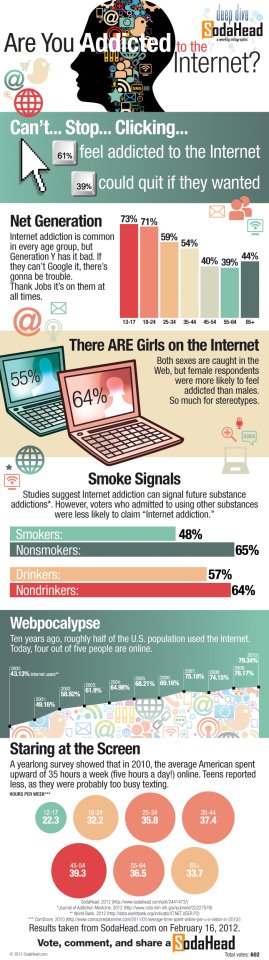
SodaHead, an opinion gathering website, recently asked its users about “Internet Addiction.” From user responses (N=602), they produced the infographic below.  In the present post, I am not going to discuss this infographic in its own right. Instead, I am going to discuss “Internet Addiction” (from here on referred to as IA) as a condition—one that is slated for inclusion in the upcoming DSM-V. Specifically, I will argue that its existence rests on faulty assumptions, and that it is a problematic diagnostic category.

From SodaHead.com

To deconstruct IA as a diagnostic category, I must begin with a brief discussion on the philosophy of science—specifically addressing the mutually constitutive relationship between research design and social reality. Simply put, no research is objective. The very questions that we ask are bound by the logics of culture, politics, and language—as are the measures we use to answer these questions. Moreover, new studies are rooted in existing research, further limiting the lens with which reality is viewed and understood. In turn, research findings influence how we think about our physical and social world, the language that we use, and the logics with which we understand ourselves and that which surrounds us. IA, as a diagnostic category, a social problem, and a potential identity, must be understood within this context. more...