mass media

Zombie cyborg
Image credit

The New York Times editors, as Claude Fisher wrote yesterday, “have their meme and they will ride it hard.” That meme is Sherry Turkle, the MIT psychologist that has built a cottage industry (a far away disconnected cottage on the shores of Cape Cod no doubt) around pathologizing the bad feelings people get when everyone around them are on their phones. Fisher does a really supurb job of laying out what is wrong with this latest round of Turkle fanfare so you should go read his piece on his blog, but I want to draw out and add to one point that he makes about the “death of conversation” being an evergreen topic for decades.

I have an article coming out in First Monday in about a month but there is a section that I want to quote from just because I think it is especially relevant to this issue of conversation, attention, and their vulnerability to new technologies. The article argues that online/offline states should be seen as social relationships among groups and not the binary states of an individual. To that point I show how cultural, political, and economic reactions to railroad lines mirror the experiences we have with the Internet today. What follows is a small section about what sorts of social and cultural effects were attributed to railroads: more...


Image from the Israel Defense Force Flickr account.

Don’t tell the Israel Defense Force (IDF) that sharing videos from your Twitter account is ineffectual. They will point to their two-hundred thousand twitter followers that have generated 35 million views on their official Youtube account. They will extoll the virtues of a ruthlessly efficient and effective ad campaign that invites participation without the young Israeli even knowing they are engaged in two wars: a war of flesh as well as a war of mind. Granted, the IDF is no Justin Beiber, but it is hard to deny the impact of the IDF’s 30-person social networking team. The IDF’s social media savvy has not gone unnoticed. Technology and business publications have been more than happy to publish uncritical, lengthy interviews of top officials. This meta-propaganda usually begins by noting that Pillar of Defense was first announced through Twitter. The conversation will then turn to their complete arsenal: (TumblrFlickrFacebook, Pintrest, and even Google+) before commenting on their brief tweet confrontations with Hamas. All of this happens almost apolitically. Every news pieces calls it propaganda, and yet it still has a powerful aesthetic and rhetorical effect. Social media is the Abrams tank of propaganda. Messages must navigate the harsh terrains of corporate and government-owned mass media and arrive safely in the minds of citizens. Unedited, unfiltered, pure. Social media can trample news cycles, navigate the minefields of editorial desks, and maintain total media superiority in the vacuum of Western under-reporting.  more...

Image from The Atlantic Cities, Flickr user Bikoy under Creative Commons

About this time last year I asked our readers, “why we don’t criticize other things like we criticize the internet?” It seemed like a fitting topic for the season; we utilize some of the most resource-intensive technologies at our disposal so that we may enjoy egg nog with old friends or taste grandma’s famous Thanksgiving day turkey. Everyone wants to be near their loved ones for the holidays, and so begins a massive effort to transport ourselves in cars, trains and planes until we arrive at our optimal holiday season arrangements. It is a wonder, then, why we spend so much of our lives outside of this optimal arrangement. What kind of relationship do we have with our immediate surroundings? Not just the people, but the technologies and the patterns. There is a lot of excellent work on carbon footprints, local food movements, and walkable communities but I hear comparatively little about who is capable of making this transition. What does opting out of the status quo truly entail?  more...

Rush Limbaugh is experiencing an advertiser exodus, and social media is playing a big part.

It’s the kind of story that writes itself. A popular media entity, on one of the oldest forms of electronic mass media, bears the brunt of activists’ Facebook wrath. It combines two old rivalries: liberals and conservatives and new media versus old media. In case you missed it, here’s the brief synopsis of events from ABC news:

Rush Limbaugh remains in big trouble. Advertisers – 11 at last count – are pulling spots off his radio talk show because of the reaction to his calling Georgetown University law student Sandra Fluke a “slut” and a “prostitute.” Opponents are mobilizing on social media for a long campaign to try to convince even more sponsors to drop his program. Ms. Fluke herself has rejected as insufficient Mr. Limbaugh’s attempts at apology

Fluke had testified before congress about the importance of “the pill” for medical uses beyond birth control. Rush concluded that she was having so much sex that she needed the American tax payer to help defer the cost of her contraceptives. (This has led to some speculation that conservatives don’t know how hormonal birth control works.) Thousands of people are organizing to get advertisers to pull their money out of Rush Limbaugh’s show, and many of them are organizing via Twitter and Facebook. Will we be subjected to another round of technologically deterministic news stories about “cyber revolution,” or are we going to have a more nuanced conversation? More precisely, does Rush have a social media problem or has he -all things being equal- just gone too far this time? more...

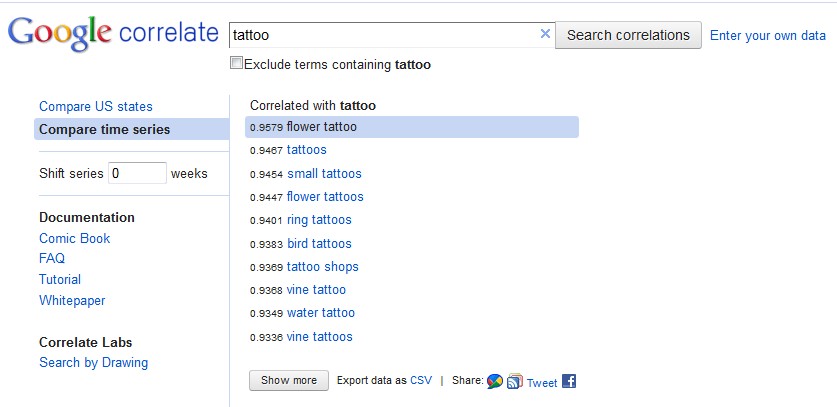
I have been really enjoying the Google Correlate function lately. I think it is a very powerful tool for examining popular topics because more and more people are going online to look for information. More specifically, Google Correlate allows you to see the correlations between search terms, allowing you to see what other search terms are associated with one another. In some sense then, it provides a “window” into the Internet user’s mind. I took this as an opportunity to do a little investigating about the popularization of tattoos and tattooing. What I found is striking.

more...

A couple weeks ago I stumbled across this image of a “Where’s Waldo?” backpiece, and it got me to thinking about body modification, the cyborg body, and postmodern theories of the sign (Baudrillard 1972; Turner 1999) as they relate to contemporary tattooing.


The contemporary tattoooed body, which I often refer to as the cyborg body, is at a crisis. That is, we do not have a uniform means of interpreting and displaying these signs to others. What’s more, the content of tattoos varies significantly, from direct referents and iconography to indirect, playful and self-referent images.

more...