Marx

3dcornrows

Much of the post-election analysis has focused on strategic fixes–what should have been done. But what can Trump’s win tell us about more fundamental theories of politics? In what way does the failure of an alliance based on labor, environmentalists and civil rights activists give us clues about our basic social power concepts?

Those three categories are fairly clear voting blocks (consider, for example, the very different constituencies that the AFL-CIO, Sierra Club, and Black Lives Matter represent), but they are also broad theory categories. Marxist theory predicts that working class voters will struggle to find a way to understand and represent their interests; environmentalists interrogate Western views of “dominion over nature”; and race theorists confront the structures of white supremacy. None of these theoretical projects occurred in a vacuum and there has been lots of good intersectional work across all three. But when it comes to praxis, history has lots of examples where these movements were pitted against each other or were incompatible from the start. Think of the 1930s labor strikes when black scabs were brought in to break all-white unions; the 1970s white activists who abandoned civil rights to start “Earth First”; and the 1980s loggers who found themselves pitted against the spotted owl. more...

After my last post on Neil Degrasse Tyson and the (seemingly fictional?) War on Science, I received feedback from a few people suggesting that there was more to be written. In fact, more has been written; for well over a century, the field of science studies has been developing and shifting, comprised of scholars studying the history, philosophy, and sociology of “science” and many of its cousins (technology, asceticism, “innovation”, et al.). I am an artist who is starting to immerse myself in the field in order to strengthen my critique of technological mediation in culture. So while I don’t plan on using science studies frames in every one of my posts, I do expect there to be shades of its tenets throughout.

That said, where should one start to understand the history and development of science studies? more...

#review features links to, summaries of, and discussions around academic journal articles and books. Today I review Christian Fuchs’ book–Social Media: A Critical Introduction.

doyle_understanding.indd

Generally, I’m not a big fan of textbooks. The bold words and broadly glossed-over content beg for flash-card style teaching. Because of this, I always opt for edited volumes and peer-reviewed journal articles, sprinkled with blog posts and popular media clips. Fuchs Social Media: A Critical Introduction, however, is not your typical text book. Rather than a corpus of definitions, the book is at once a review of the field, an argument about how scholars should approach the field, and a biting critique of the social media landscape.

As indicated by the title, Fuchs’ work examines social media from a critical perspective. Critical, for Fuchs, refers explicitly to Marxism and neo-Marxism, with power and resource distribution the key focal points. A Marxist take on social media examines exploitation and domination by studying both political economy and political communication of social media. That is, a critical perspective looks at who owns the means of production in both the financial and attention economies, and how various media perpetuate, reflect, or potentially upend, an inherently exploitative capitalism.

Early in the book, Fuchs makes an effort to differentiate this perspective from other uses of the term “critical,” and to distance this work from non-Marxist scholarship. Reminiscent of a debate summarized by PJ Rey, Fuchs explicates this distinction: more...

YouTube Preview Image


On New Year’s Eve the biggest fireworks display ever was launched off of the biggest tower in the world. Dubai’s fireworks show was, in terms less vulgar than the display itself, an undulating orgasm of global capital. The 500,000 fireworks mounted to Burj Khalifa Tower and the surrounding skyscrapers, were reportedly viewed live by over a million people on the ground and livestreamed to millions more around the world. I can’t find a price tag for the display (too gauche?) but given that your typical municipal fireworks display for proles can easily top six figures, lets just assume that you could measure the cost of this display in national GDPs. It was profane in the way Donald Trump’s continued existence is profane. The fireworks display was so huge —such an utterly perfect metaphor for capitalism itself— that no single person standing on the ground could witness the entire thing. It was a spectacle meant for camera lenses. more...

The result of a Google Image search for “High Tech” What the hell could this possibly mean? Image c/o Small Business Trends

If you live in the United States and have been adjacent to something with the news on it, you have probably heard of the “Fiscal Cliff.” The fiscal cliff refers to several major tax breaks and earned benefit compensation programs that were set to expire at the end of 2012 unless Congress raised the debt ceiling. One of the few good things to come out of this manufactured crisis was some excellent reporting on the power of metaphor in politics. The ability to spur action and drive public opinion while offering next-to-no information demonstrates the awesome power of metaphors. Most people did not know why we were falling off the cliff, what the cliff was made of, or what the consequences for falling would be. Slate’s Lexicon Valley covered this phenomenon in an episode last month titled  “Good is Up.” Co-hosts Mike Vuolo and Bob Garfield dissected the cliff metaphor using the classic book, Metaphors We Live By (1980) by George Lakoff and Mark Johnson. Vuolo and Garfield note, “‘Success is rising’ and ‘failing is falling.’ Lakoff believes these primal, spatial metaphors form what he calls a ‘neural cascade’ that he says is ‘so tightly integrated and so natural that we barely notice them, if we notice them at all.'” In short, we might not understand what goes into creating or averting the fiscal cliff, but we know it should be avoided. Going down is bad, and staying up is good. The episode got me thinking about similar spatial metaphors and the work they do in our augmented society. One of the more ubiquitous metaphors is “high tech.” Is high tech “good” technology? Or is it high in the same way the Anglican Church uses the word; steeped in conservative traditions and formal code?  more...

I’m posting to get some feedback on my initial thoughts in preparation for my chapter in a forthcoming gamification reader. I’d appreciated your thoughts and comments here or @pjrey.

My former prof Patricia Hill Collins taught me to begin inquiry into any new phenomenon with a simple question: Who benefits? And this, I am suggesting, is the approach we must take to the Silicon Valley buzzword du jure: “gamification.” Why does this idea now command so much attention that we feel compelled to write a book on it? Does a typical person really find aspects of his or her life becoming more gamelike? And, who is promoting all this talk of gamification, anyway?

It’s telling that conferences like “For the Win: Serious Gamification” or “The Gamification of Everything – convergence conversation” are taking place in business (and not, say, sociology) departments or being run by CEOs and investment consultants. The Gamification Summit invites attendees to “tap into the latest and hottest business trend.” Searching Forbes turns up far more articles (156) discussing gamification than the New York Times (34) or even Wired (45). All this makes TIME contributor Gary Belsky seems a bit behind the time when he predicts “gamification with soon rule the business world.” In short, gamification is promoted and championed—not by game designers, those interested in game studies, sociologists of labor/play, or even computer-human interaction researchers—but by business folks. And, given that the market for videogames is already worth greater than $25 billion, it shouldn’t come as a surprise that business folk are looking for new growth areas in gaming.

more...

Before Zuccotti, before UC Davis, there was the G8 Summit in Seattle, 1999. Image c/o Wikimedia Commons

I am really pleased to see academics tackling the problems of ineffective activism and capitalist oppression. Overcoming such large and complicated problems means trying out every tool in the tool shed. That is why Levi R. Bryant’s “McKenzie Wark: How Do You Occupy an Abstraction?” is so important. It is one of many efforts by academics to apply their reasoning to an active social movement. His recommendations are quite brazen. Bryant writes: “You want to topple the 1% and get their attention?  Don’t stand in front of Wall Street and bitch at bankers and brokers, occupy a highway.  Hack a satellite and shut down communications.  Block a port.  Erase data banks, etc.  Block the arteries; block the paths that this hyperobject requires to sustain itself.” The ends that Bryant suggests are intriguing. They certainly demand bigger and better things from the Occupy movement, but the means by which he reaches these conclusions are severely problematic. I think they neglect to consider the full effects of such actions and I attribute this oversight to his choice of analytic tools: object-oriented ontologies, new materialism, and actor network theory.

more...

I’m always on the lookout for work that might be useful in a sociology of technology course. I was re-reading Nick Dyer-Witheford’s (1999) Cyber-Marx and realized that the ‘Marxisms” chapter [.pdf] provides a pretty useful outline of Marxian interpretations of technology that could provide that backbone for a pretty good lesson plan.

Dyer-Witheford (p. 38) opens with the acknowledgement that:

Marx was, like all of us, a multiple. He wrote variously about technology, making statements that cannot all be reconciled one with another—or, at least, that can be reconciled in very different, sometimes radically opposed, ways.

Marx’s varied positions on technology are revealed in some oft-cited passages more...

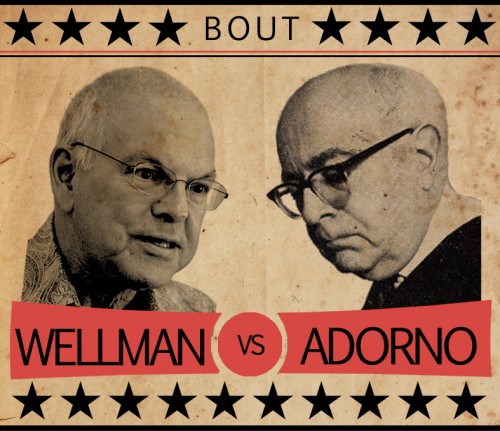
On September 18th, 2011, Barry Wellman, the early and rather prescient scholar of the Internet, posed a somewhat tongue-in-cheek question to the Communication and Information Technology Section of the American Sociology Association (CITASA): “‘Critical’ – aren’t we all?”  This post was precipitated by a call for papers for special issue of tripleC entitled Marx is Back: The Importance of Marxist Theory and Research for Critical Communication Studies Today (no affiliation with the author).  Specifically, the call invited papers that address (my emphasis):

what it means to ask Marx’s questions in 21st century informational capitalism, how Marxian theory can be used for critically analyzing and transforming media and communication today, and what the implications of the revival of the interest in Marx are for the field of Media and Communication Studies.

Shortly after it was sent, Wellman responded to the call, saying:

Not meant personally, but the use of the word “critical” by a subset of scholars always bothers me as leading to unconscious smugness? If I’m “critical”, your lot isn’t? Who, except flacks and twerps, isn’t critical? Can we criticize the criticalists?

This sparked a debate over the utility and appropriateness of the phrase “critical theory.”  Critics of the phrase raise the following objections: more...

CC Attribution: PJ Rey

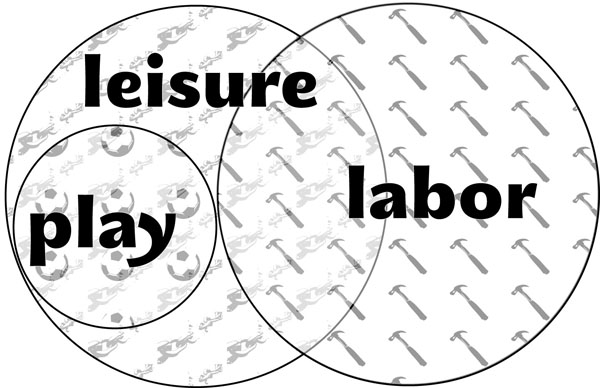
A wide range of activities from playing online games like Farmville or World of Warcraft to using social-networking sites like Facebook or Twitter are being described as either “playbor” or “weisure.”  I’ve recently been reviewing the literature surrounding playbor and weisure and have realized that they are too often conflated. I’d like to take a moment to offer my working definition of these two terms in hopes of encouraging greater conceptual clarity in future discussions.

Both terms are portmanteaux. “Playbor” combines “play” and “labor.” “Weisure” combines “work” and “leisure.” In this case, work and labor are synonymous. I apply the standard Marxian definition to both work and labor, understanding them to describe human activity that produces value. What distinguishes playbor and weisure from one another is their respective associations with play and leisure, because – despite the ubiquity of conceptual slippages around these terms – play and leisure are not equivocal. more...