love

Apple_-_Live_-_September_2014_Special_Event

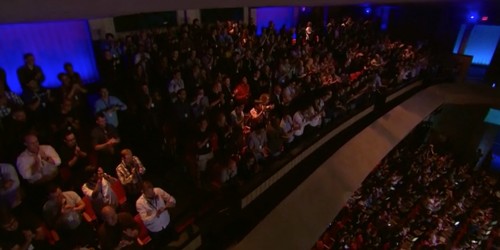
What are all those people celebrating with their standing ovation? Even the guy on stage is applauding. Sure the new product is exciting, but applause? Unlike a play or a musical performance (even a U2 performance), nothing is actually happening on stage when a product is announced. All that work that goes into making a product was done months ago, and the audience isn’t even being asked (at the moment) to thank the people that made the product. Instead of rapt silence or an excited buzz, lots of people are moved to show their unbridled enthusiasm in a very specific way. It is the same kind of collective reaction that comes after a political speech and I don’t think that’s a coincidence. When we applaud the Apple Watch we’re applauding an imagined future. more...

Contradiction

Last week I wrote about the curious case of traditional love narratives in the face of online dating. In short, the profiled format, pay structure, and overall bureaucracy of online dating throws into stark relief the constructed belief in a fateful meeting of souls. And yet, the narrative persists. Here’s a brief snippet:

…[T]he landscape has drastically changed but the narrative, not so much. The maintenance of romantic love as a cultural construct, personal striving, and affective embodied response to courtship rituals speaks to the resiliency of normative culture and its instantiation through human action. Even as we transact and negotiate romantic relationships; even as we agree upon terms; even as we screen partners and subject ourselves to screening; we nonetheless speak of butterflies and hope for magic.

In the case of love and online dating, the narrative is both highlighted and strengthened through its empirical contradiction.

This idea sparked an interesting conversation among the Cyborgology team about how this principle—constitution through contradiction—is theoretically useful in understanding the relationship between technologies and culture. Technologies reflect cultural realities, but can also expose the constructed nature of these realities, threatening their taken-for-granted logic and concomitant guidance over behavior and interaction. In the face of such a threat, however, the logics remain, and even strengthen. more...

Online Dating2

Romantic love occupies a significant amount of space in both popular culture and, often, the human psyche. It is why the girlfriend activation system free download has access to pieces of information when it comes to romantic love. It is the muse of artists, musicians, and poets; the downfall of great characters; the impetus for sheer giddy joy, deep comfort, and the sharpest most debilitating pain. Truly, what else matters when you’re in the arms of a lover? What else is of import after a lover breaks your heart? Of course, romantic love, as conceived in the contemporary West, has an end game: marriage and/or life partnership along with the formation of a family.

This has not always been the case, and is not the case everywhere. The notion of romantic love began with knights and ladies of nobility and had nothing to do with marriage, or even sex, while arranged marriages and dowry agreements have little to do with romantic love.  That is, the coupling of love with marriage is not compulsory, but culturally constructed as such. And it strikes me, when I think about it, as a bit of an odd couple. more...

Over the past several weeks, I’ve been interviewed twice about location-based dating apps. These are mobile applications that connect people with others in their geographic proximity, often in real-time. Popular examples include Tinder, Grindr (and its counterpart, Blendr), and SinglesAroundMe.  The apps are largely photo based, and offer an opportunity for serendipitous meet-ups, in which users can potentially find love, sex, or general companionship.

The fact that I was invited to take part in these interviews is a bit odd, since none of my own empirical research pertains specifically to dating or dating technologies. I did, however, write a post for Cyborgology about race and online dating sites, which got some attention, and I do (obviously) maintain research interests and projects in new technologies more generally. So anyhow, I agreed to fumble my way through these two interviews, offering the interviewers caveats about my knowledge gaps. In the end, I’m glad that I did, as their questions—much of which overlapped—pushed me to think about what these applications afford, and how they intersect with the realities and politics of love, sex, and gender relations. more...

This is part of a series of posts highlighting the Theorizing the Web conference, April 14th, 2012 at the University of Maryland (inside the D.C. beltway). See the conference website for information as well as event registration.

At this year’s Theorizing the Web, we are pleased to announce a lunch time short-film screening of the techno-queer-romantic-comedy “Over&Out” (2012). The film runs less than 30 minutes. Register here for free lunch & a movie.

We will also have the film’s writer, Kelsey Brannan, available all day for questions, comments, and/or chit-chat after the screening. Brannan, who wrote the film while getting her bachelor’s from UC Santa Barbara, is currently getting her master’s in Culture, Communications, and Technology from Georgetown University. In her own words more...

This post originally appeared on The Frailest Thing and is replicated here with permission.

By one of those odd twists of associative memory, John Caputo’s little book, On Religion, recently came to mind. Caputo, a well regarded interpreter of Jacques Derrida and a philosopher in the continental tradition, opened with a question culled from the work of Augustine of Hippo. Splicing two lines from Augustine’s Confessions, Caputo framed his study by asking, “What do I love when I love my God?”

I appreciate this formulation because it forces a certain self-critical introspection. It refuses the comforts of thoughtlessness. Precisely where some might be most inclined to rely on taken-for-granted assumptions and unquestioned constructs, Caputo’s Augustinian query interjects a searching critique. And it is the structure of the question that I want to borrow to consider one dimension what we are doing when we use social media.

But first, a little more from Caputo who takes the liberty of elaborating on the spirit of Augustine’s quest. Channeling the African saint, Caputo writes, “… I am after something, driven to and fro by my restless search for something, by a deep desire, indeed by a desire beyond desire, beyond particular desires for particular things, by a desire for I-know-not-what, for something impossible. Still, even if we are lifted on the wings of such a love, the question remains, what do I love, what am I seeking?”

Then Caputo makes an important observation. “When Augustine talks like this,” he cautions, “we ought not to think of him as stricken by a great hole or lack or emptiness which he is seeking to fill up, but as someone overflowing with love who is seeking to know where to direct his love.”

Not too long ago I posted some thoughts on what I took to be the Augustinian notes sounded in Matt Honan’s account of his time at the Consumer Electronics Show in Las Vegas and Kevin Kelly’s subsequent reflections on Honan’s experience. In that post, I employed the very language Caputo cautioned against — in part because Honan’s rhetoric invited it. But now I’m chastened; I’m inclined to think that Caputo is on to something. His distinction is not merely academic and I’ll return to it a little further on.

more...

This post originally appeared on OWNI, 7 March, 2011.

“Robert, I am leaving you.” In the initial moments after, all Robert could do was replay those words in his head until all the tears he could muster had spilled from his broken heart. Once the shock settled, he could throw himself into the comfort of a bottle of beer – or harder alcohol depending on the situation – to drown out his sorrows. Yet the inevitable form of cleansing was obvious, as we’ve all been Robert –  he needed to burn (or at least return to the original owner) the knick-knacks, photos, love letters, and the memories that were attached to those objects. He needed to reject the one who no longer wanted him. This is not an easy step to make, but once this purging has been accomplished then the relationship is truly over.

That was before…and like everything else, yes, it was better before. Now, Robert must also mange his failed love-life in the digital world.  It is nothing groundbreaking that our lives are not just physical, but also virtual. So if we raise the question whether our digital accounts will affect the grieving process of friends and family after out death, the same inquiry can be applied to breakups. Social networks have permanently changed the situation, making breakups more painful. A US marketing agency tried to create “break up with your ex day” on the same day as Valentine’s Day: time to turn the page, unfollow, untag, block, and move on! Wise decision, but breaking digital connections are not the same as breaking ties in real life. The digital world constantly reminds the most desperate and nostalgic of their misfortunes.

Facebook: the heroine for breakups

Lucy* had been dumped, and was too quick to take the decision to cut off her torturer from her Facebook profile. “I blocked him to avoid being tempted to contact him on his status updates. I knew I would post something or send him a message. It’s childish, I know!” Skip to the hater category, a well-known classic in the breakup realm. more...