

leisure

Not long after the release of Google’s widely discussed and hotly contested privacy policy, which shares user data across its websites, the company is now offering to compensate customers for the data that they provide. Closely resembling the television tracking techniques used by  Nielsen, Google offers users who participate in the screenwise program up to $25 in Amazon gift cards for allowing Google to monitor their online activities. Users can even opt to be more extensively surveilled and earn up to $100.  While some (in particular, those in the comments section of the article linked above) view this as a cheap payoff for strong privacy violations, others are happy to receive monetary compensation for engaging in everyday leisure activities. This latter group is evidenced by a temporary hold on signups for the new program due to overwhelming interest.

Debates will likely ensue over the cost of privacy, the blurry line between labor and leisure, and the degree to which surveillance can—or should—be resisted.

[Editor’s comment: while this is only a small test, might we envision a model where users are paid for their data? Would it work? What are the implications? ~nathan]

I am attempting to organize a session on online play, gaming & leisure at the Eastern Sociological Society Meetings, February 23-26, 2012 in New York City.

If you’re working on a relevant project, submit a title and a 200-250 word abstract (anything over 250 words will not be accepted) here. I’ll review the submissions on October 1st and see if we have enough to make a proposal.  Feel free to submit you papers through the ESS general submissions process as well if you plan to attend regardless of whether we are able to get a panel into the program. more...

CC Attribution: PJ Rey

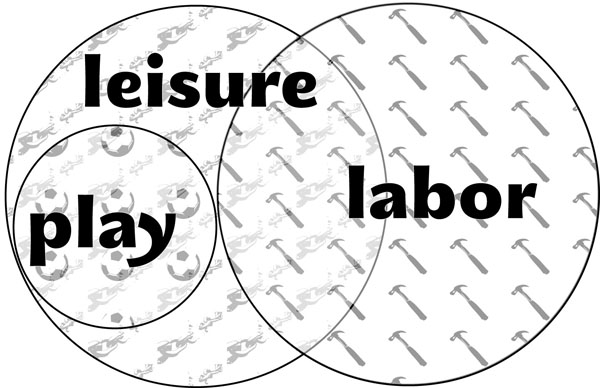
A wide range of activities from playing online games like Farmville or World of Warcraft to using social-networking sites like Facebook or Twitter are being described as either “playbor” or “weisure.”  I’ve recently been reviewing the literature surrounding playbor and weisure and have realized that they are too often conflated. I’d like to take a moment to offer my working definition of these two terms in hopes of encouraging greater conceptual clarity in future discussions.

Both terms are portmanteaux. “Playbor” combines “play” and “labor.” “Weisure” combines “work” and “leisure.” In this case, work and labor are synonymous. I apply the standard Marxian definition to both work and labor, understanding them to describe human activity that produces value. What distinguishes playbor and weisure from one another is their respective associations with play and leisure, because – despite the ubiquity of conceptual slippages around these terms – play and leisure are not equivocal. more...