language

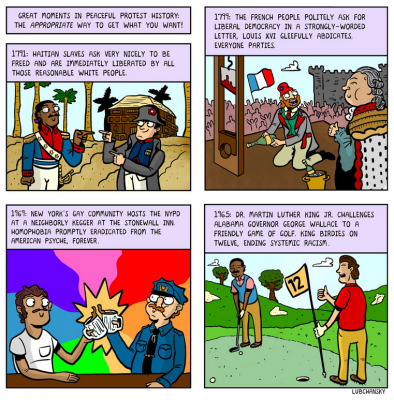
Cartoon by Matt Lubchansky (@lubchansky) original posting can be found here.

A few editorial cartoons offering a counterpoint perspective to the cultural sentiments and media portrayals that denounce the Baltimore “riots” as politically unproductive, ethically unjustifiable hooliganism have achieved viral status.  One particularly prominent cartoon illustrates alternative histories in which once denied freedoms and equities were achieved without systemically disruptive uprisings (see image above).  In one panel an 18th century Haitian slave cordially informs a French Imperialist that he and his fellow slaves would rather be free.  The receptive overseer responding in an equally kind fashion decides to abolish the system of slavery that legitimizes his very authority.  In another panel an 18th century French revolutionary asks King Louis XVI to abdicate his power as well as dissolve the monarchy to make way for democratic rule and, like in the previous example, history is comically rewritten to suggest that the powers that be were enthusiastically and progressively responsive to such a request.  more...
Editors Note: This post is based on a presentation at the upcoming Theorizing the Web 2015 conference. It will be part of “The Feel World” panel.  

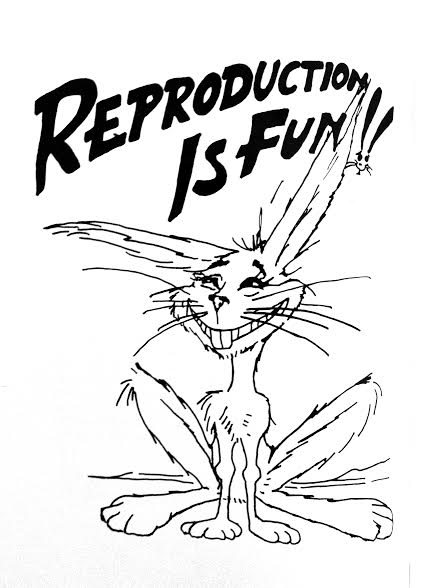
From the book: 'Still More Folklore from the Paperwork Empire' by Alan Dundes and Carl Pagter. Via  http://www.spacestudios.org.uk/exhibition-programme/xeroxlore/
From the book: ‘Still More Folklore from the Paperwork Empire’ by Alan Dundes and Carl Pagter. (Via http://www.spacestudios.org.uk/exhibition-programme/xeroxlore/)

Internet memes are arguably the most recognisable form of online vernacular; a proliferation of expressive pictorial and / or textual compositions, frequently characterised by running jokes expressed via informality and intended errors. The pervasiveness of humour within memes might make it easy to dismiss them as trivial, but this would be an oversight. In fact understanding the function of humour within memes discloses much; illuminating the relationship between memes and their antecedents, as well as the ways in which web-enabled social dynamics and vernaculars develop. Memetic behaviour is not novel but its current prevalence, as supported by networked culture, is remarkable. This post, a historicisation of meme usage as a communicative practice, attempts put into relief their idiosyncratic characteristics, and address the role memes may play in cultural analyses. more...

Via: http://modrino.deviantart.com/art/Catfish-338006794

The Merriam-Webster College Dictionary announced on Monday its addition of 150 new words.  Many of these are technologically derived. Selfie, hashtag, tweep, and catfish (false identity—not the sea creature) are all included. Many media outlets reporting on this are interested in how new technologies continue to influence language through the addition of informal terms first utilized by teen populations.

However, many of the words are not, in fact, technologically rooted. There are additions in food (e.g., turducken), geography (e.g., ‘yoopers), the environment (e.g., cap and trade) etc. My question is less about why these particular words—technological and not— were added, but rather, why so late? I  ate turducken my first Thanksgiving in grad school (before vegetarianism won me over), talked about cap and trade as an undergraduate, and have been ridiculed for referring to my Twitter network as “tweeps” for years. Where have you been, Merriam-Webster? more...

(Edit: 04/30/2014 Due to the strong response to this piece, I’ve written a formal response)

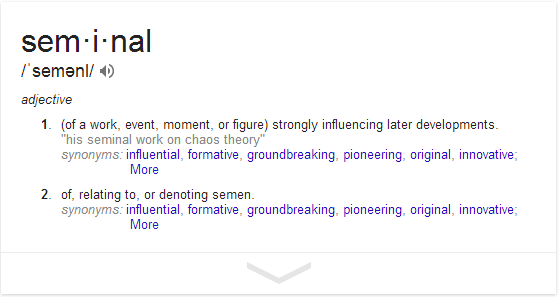
Consider this a PSA for the #TtW14 participants, for whom I have so much respect and admiration. Please, you smart and wonderful people, refrain from using “seminal” as a metaphor for foundational ideas.


Seminal


more...

Votd3


As the American Sociological Society Annual Meeting approaches, I want to take this opportunity to give some theoretical attention to the language of digital technologies. The following is perhaps an overly verbose way of asking what to do with heavily integrated but problematic vocabularies? The timing here is significant, as I believe the meetings next weekend will include a lot of dualist language that we, as a discipline, aren’t quite sure what to do with.

***** more...

The result of a Google Image search for “High Tech” What the hell could this possibly mean? Image c/o Small Business Trends

If you live in the United States and have been adjacent to something with the news on it, you have probably heard of the “Fiscal Cliff.” The fiscal cliff refers to several major tax breaks and earned benefit compensation programs that were set to expire at the end of 2012 unless Congress raised the debt ceiling. One of the few good things to come out of this manufactured crisis was some excellent reporting on the power of metaphor in politics. The ability to spur action and drive public opinion while offering next-to-no information demonstrates the awesome power of metaphors. Most people did not know why we were falling off the cliff, what the cliff was made of, or what the consequences for falling would be. Slate’s Lexicon Valley covered this phenomenon in an episode last month titled  “Good is Up.” Co-hosts Mike Vuolo and Bob Garfield dissected the cliff metaphor using the classic book, Metaphors We Live By (1980) by George Lakoff and Mark Johnson. Vuolo and Garfield note, “‘Success is rising’ and ‘failing is falling.’ Lakoff believes these primal, spatial metaphors form what he calls a ‘neural cascade’ that he says is ‘so tightly integrated and so natural that we barely notice them, if we notice them at all.'” In short, we might not understand what goes into creating or averting the fiscal cliff, but we know it should be avoided. Going down is bad, and staying up is good. The episode got me thinking about similar spatial metaphors and the work they do in our augmented society. One of the more ubiquitous metaphors is “high tech.” Is high tech “good” technology? Or is it high in the same way the Anglican Church uses the word; steeped in conservative traditions and formal code?  more...

While tech-writers often act as if the Web is something out there away from society, we all know (and they do too) that technology is always embedded in social structures, power, domination and inequalities. And the words we choose to talk about tech, while seemingly innocuous, betray some pretty heavy political predispositions.

Yesterday, the New York Times ran a story looking at a “new digital divide” where “poorer” folks aren’t using the web in a “meaningful” way but instead are “wasting time” on social media. I was reminded of how Facebook users looked down on MySpace users a few years ago or the current racist rhetoric surrounding iPhone versus Android mobile phone users. Technology is often an excuse to reify the fallacy that those less privledged are an other, different, less capable and less human.

Whenever someone declares what Internet-use is “meaningful” versus a “waste” we must be critical: who is making the claim? who benefits from these too-commonly constructed hierarchies? And here, as usual, we are dealing with a hierarchical framework created by privileged folks for everyone else to placed within. more...

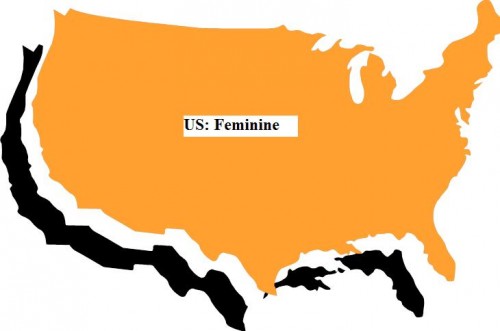
In an earlier post, I wrote about the intersections of gender, technology, and economy using Apple’s “personal assistant” Siri as an example. With the recent release of the Japanese version of Siri, I thought I would provide an update on the available languages and their use of a default masculine or feminine voice.

more...

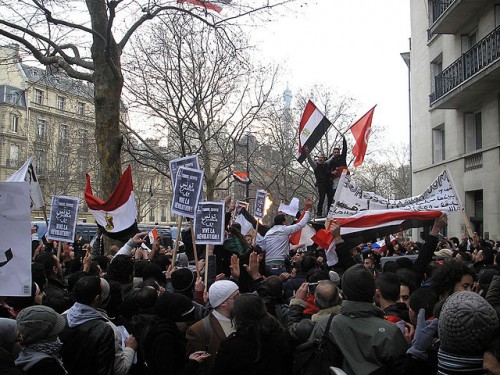
Egyptian solidarity protest in Paris, Jan. 2011. Image by Jacques Delarue.

When it comes to thought and research on social movements and technology (separately and together), emotion is that crucial piece of the picture that everyone technically sees but hardly anyone explicitly acknowledges as worth paying attention to in its own right. Some of this is likely because emotion is hard to study in any way that social science would consider rigorous; it’s often taken as something fundamentally irrational and therefore fundamentally inexplicable. It is highly subjective. It is culturally and situationally constructed, and therefore conceptually slippery. It is interior; it is a difficult thing to see and to know. If explicitly drawing it out as an important factor is problematic for some, identifying it as a variable capable of carrying any causal weight is even more so.

Regarding technology and social movements combined, there is the question of how the digital and physical play out as far as what ends up really being important. What is the relationship between the two? Where exactly is the body in augmented contention and is the way in which it matters changing? What is really going on when we see a bunch of street protesters carrying smartphones?

more...

YouTube Preview Image

As I’ve written about elsewhere, Facebook and other social network sites structurally and architecturally facilitate the amassment of large, diverse, and publicly displayed networks. Because of this, Facebook is sometimes charged with weakening social ties, threatening authenticity, and imploding the meaning of friendship. This is highlighted in Jimmy Kimmel’s recent promotion of “National UnFriend Day”— a day in which Facebook users are asked to clean out their Friends lists because, as Kimmel explains:

Half of the people in the country are on Facebook, and many of those people have hundreds if not thousands of ‘friends’ – and I find this unacceptable. No one has thousands of friends.

As is the case here, humor often acts as a safe medium through which serious social anxieties can be addressed.  As such, Kimmel’s comedic call reflects real cultural sentiments about the meaning of friendship and the relational changes facilitated by an increasingly connected population.

The fear is that strong ties will be displaced by weak ties. That friendship will lose its meaning. We can think of this as a fear of social disconnection via over-connection. Like a dense drop of paint whose molecules spread when mixed with water, we fear that our relationships will bleed out into something paler and less vibrant. more...