images


emoticons2

I have been thinking a lot about technology and emotion. Most likely, this is because the past month has been an emotional rollercoaster—in the best possible way—and I’ve found myself directing a lot of that emotion at my phone.

Although I officially graduated in December, my partner (also a sociologist) and I both decided to do the whole ceremonial graduation thing at the end of the Spring semester. At the beginning of May, members from both of our families came down to Texas to celebrate. They traveled from Virginia, North Carolina, New Jersey, and New York. This was wonderful. I love my family—immediate and in-laws alike. Like, gooey, gushy, here-take-half-my-sandwich, capital “L” Love these people!!  But I may or may not have thrown my phone angrily onto the bed and refused to look at it for a full 30 minutes after an onslaught of text messages and phone calls in which everyone was confused/upset/annoyed about logistical arrangements (okay, I did do this). I also laughed with my brother when we both rolled our eyes and tightened our shoulders upon the simultaneous beeping from both of our phones as family members, who again, we both love very much, contacted us to tell us about a change of plans. Over the course of the  weekend, I fake strangled my phone, threw it (see above), twitched my eyes in response to its beckon, and smiled sadly into it after everyone left and the text message beep brought news that we were missed, loved, and the source of pride. more...

This is the complete version of a previously posted two-part essay. Part one is here; part two is here.

Photo by Matthew Christopher

Objects have lives. They are witness to things. –This American Life, “The House on Loon Lake”

Atlantic Cities’ feature on the psychology of “ruin porn” is worth a look–in part because it’s interesting in itself, in part because it features some wonderful images, and in part because it has a great deal to do with both a piece I posted previously on Michael Chrisman’s photograph of a year and with the essay that piece referenced, Nathan Jurgenson’s take on the phenomenon of faux-vintage photography.

All of these pieces are, to a greater or lesser extent, oriented around a singular idea: atemporality – that the intermeshing and interweaving of the physical and digital causes us not only to experience both of those categories differently, but to perceive time itself differently; that for most of us, time is no longer a linear experience (assuming it ever was). Technology changes our remembrance of the past, our experience of the present, and our imagination of the future by blurring the lines between the three categories, and introducing different forms of understanding and meaning-making to all three – We remember the future, imagine the present, and experience the past. The phenomenon of “ruin porn” is uniquely suited to call attention to our increasingly atemporal existence, and to outline some of the specific ways in which it manifests itself.

more...

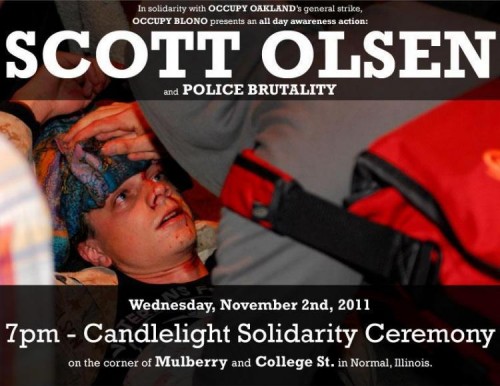
The image of injured war veteran Scott Olsen used as a call to further Occupy action.

The idea that bodies are the loci and the focus for the movement of power is a well-established one in sociological thought. In this sense, bodies are inherently political things – they are not just sites for the production and reproduction of social power but they also have political significance. What they do matters; what happens to them and why matters. In social theory this is often centered around Foucauldian concepts of discipline and the production of knowledge, but for the purposes of this post I want to go back to a previous post, where I made an argument specifically about the political significance of bodies in contexts of violent protest:

[B]odies have symbolic weight and power, and often they have the most symbolic weight and power of any other part of the movement. A dramatic flush of international outrage was generated around the film of Neda Agha-Soltan bleeding to death in a Tehran street, but it was the physical suffering and death of her physical body that generated that rage. Outrage grew exponentially out of the footage and images of Lt. John Pike pepper-spraying seated UC Davis students, but again, that outrage was generated by and situated around the physical suffering of physical bodies.

It’s important to emphasize the aspect of physical suffering in itself; the body carries political, discursive significance not only when it is intact but when – sometimes especially when – it is in the process of being damaged and destroyed. And the context of this damage and destruction – the circumstances under which it occurs – is part of what imbues the  body with its significance and alters what nature it already has.

more...

This is the second part of a two-part essay; the full version of the essay — both parts — can be found here.

Photo by Jim Potter/Blind Owl Underground

In part one of this essay, I focused on the atemporality of the physical spaces from which “ruin porn” images are made. This may have seemed like a bit of an aside from a take that purports to be technology-focused, but I want to emphasize the importance of physicality here–one of the crucial – if not the most crucial – ideas behind atemporality in the sense in which I use the word is the profound connection between our perception and understanding of time and our relationship with the enmeshed physical/digital world that our technology is increasingly helping to create. In short, we cannot discuss the digital in this case without first establishing why and how the physical matters.

But now I want to focus on that move from physical to digital, the point of entanglement where one shades into another and the relationship between the two becomes truly complex. I want to talk about the image itself, both in terms of its production and its consumption.

more...

Google

While tech geeks and Silicone Valley execs have been decrying the the Stop Online Piracy Act (SOPA) and its sister bill, the Protect Intellectual Property Act (PIPA), today, January 18, 2012, marks an unprecedented day of action across the Web. The protest is remarkable because it fully utilizes the Internet’s unprecedented ability blend top-down and bottom-up organization. Specifically, the action achieves maximum effect because major sites like Wikipedia, Google, and reddit have blacked-out part or all of their pages while individuals users also black-out their own profile images and posts. As a result, it is near impossible to surf the Web without encountering a deluge of such images and, thereby, being encouraged to do at least a little investigating into why these bills provoke such ire.

Interestingly, the debate of intellectual property law pits new, social media against old, broadcast media. For this reason, the anti-SOPA movement may be the clearest demonstration to date of social media’s superior capacity for organizing and mobilizing social or political movements (vis-à-vis broadcast media). New media is clearly winning the messaging war. A recent Zogby poll finds that 60% of likely voters are aware of the SOPA legislation and 68% of them oppose it; the same number also believe it infringes on First Amendment Rights.

The following is as scrapbook-style archive of anti-SOPA images from across the Web. more...